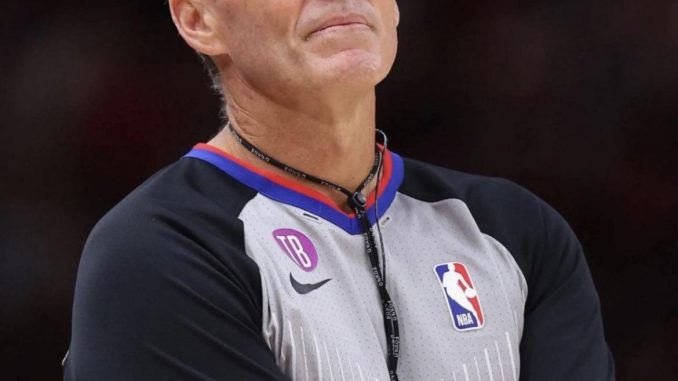
The spotlight in the Western Conference Finals has shifted from superstar shot-making and tactical adjustments to a growing controversy surrounding NBA officiating, with veteran referee Scott Foster becoming the center of one of the league’s loudest postseason debates in recent memory. As tensions continue to rise between the Oklahoma City Thunder and the San Antonio Spurs, online speculation exploded this week after widespread reports and viral social media claims suggested Foster had been quietly removed from officiating future Oklahoma City games following backlash over a series of controversial missed calls.
While the NBA has not publicly confirmed any disciplinary action or officiating reassignment involving Foster, the conversation surrounding the veteran official has become impossible to ignore. Fans, analysts, former players, and media personalities have all weighed in after multiple contentious moments throughout the series fueled accusations of inconsistent officiating, selective whistle-blowing, and excessive physicality being allowed during key stretches of play.
The controversy intensified after Game 2 of the Western Conference Finals, when Oklahoma City defeated San Antonio 122-113 to even the series at 1-1. That game quickly became less about the final score and more about how it unfolded physically. Spurs superstar Victor Wembanyama, who had dominated Game 1 with an astonishing 41-point, 24-rebound masterpiece, suddenly found himself battling through relentless contact from Thunder big man Isaiah Hartenstein and Oklahoma City’s aggressive defensive pressure.
Clips from the game spread rapidly across social media platforms. One sequence appeared to show Hartenstein pulling Spurs guard Stephon Castle by the hair without a whistle. Another showed Wembanyama being held, bumped, and redirected multiple times in the paint while officials allowed play to continue. Critics argued that the physical style crossed the line from playoff toughness into blatant missed fouls.
As frustration mounted, fans began directing their anger toward Foster, one of the league’s most recognizable and polarizing referees. Foster has long carried a controversial reputation among NBA fanbases, often becoming the target of conspiracy theories and officiating criticism during high-profile playoff series. His name resurfacing at the center of another postseason storm only amplified the reaction online.
By Thursday morning, unverified social media posts claiming Foster had apologized to Oklahoma City and would “no longer be allowed” to officiate Thunder games had already gone viral. (Instagram) Although there has been no official confirmation from the league office, the rumors gained traction because of the sheer intensity of public criticism following Game 2. Spurs fans, neutral observers, and even some national commentators openly questioned how many fouls Oklahoma City appeared to get away with during the matchup.
The uproar reflects a much larger issue facing the modern NBA. Officiating controversies have increasingly become a central storyline during the playoffs, especially in the social media era where every missed call can instantly be clipped, replayed, slowed down, and dissected millions of times within minutes. In previous decades, debates about referees largely stayed within television broadcasts and postgame press conferences. Today, one controversial whistle — or lack thereof — can dominate the sports conversation for days.
For the Thunder, the situation has created an unusual dynamic. Oklahoma City has simultaneously emerged as one of the NBA’s most exciting young dynasties while also becoming one of its most polarizing teams. The defending champions have faced growing criticism this postseason over their physical style, frequent foul-drawing, and reputation for pushing the limits defensively. (Vox)
Much of that criticism has centered around MVP superstar Shai Gilgeous-Alexander, whose elite ability to manipulate defenders and generate free throws has frustrated opposing fans throughout the playoffs. While statistical analysis does not necessarily support claims of officiating favoritism, perception has become reality for many viewers watching this Thunder run unfold. (Vox)
The Game 2 controversy only intensified that perception. Oklahoma City adjusted after being overwhelmed in the opener by Wembanyama’s size and skill, choosing to crowd him physically, deny him clean catches, and force referees to make difficult judgment calls possession after possession. The strategy worked. Wembanyama’s production dropped significantly compared to his historic Game 1 performance, and the Thunder reclaimed momentum in the series. (Reuters)
But for Spurs supporters, the issue was never about strategy alone. It was about what they believed officials permitted Oklahoma City to do without consequence. The anger became especially loud because several disputed plays occurred during critical stretches that helped swing momentum toward the Thunder.
Even neutral fans joined the debate. A highly upvoted Reddit thread titled “Disgusted Neutral Fan” accused officials of allowing Hartenstein to “hold Wemby on every possession” and claimed the referees “gave this game to the Thunder.” (Reddit) While such reactions are emotional by nature, they reflected the broader frustration spreading across basketball discourse after Game 2.
The NBA, historically, has always battled accusations and suspicions surrounding officiating during marquee playoff moments. From the infamous Sacramento Kings-Los Angeles Lakers series in 2002 to ongoing debates involving star treatment and whistle disparities, referee controversies are woven into league history. (Wikipedia) Foster himself has frequently become a lightning rod because of his longevity, visibility, and involvement in numerous high-stakes playoff games over the years.
Still, the league rarely comments publicly on officiating assignments unless discipline or policy violations are formally announced. That silence often fuels speculation even further.
What makes this current situation particularly explosive is how quickly the series itself has become emotionally charged. After San Antonio stole Game 1 behind Wembanyama’s dominance, Oklahoma City answered emphatically in Game 2 before reclaiming control of the series with a 123-108 victory in Game 3. (Houston Chronicle)
Game 3 again featured several tense moments, including technical fouls, physical confrontations, and another wave of discussions about officiating consistency. Although the Thunder ultimately won comfortably behind strong performances from Gilgeous-Alexander and their bench unit, the atmosphere surrounding the series has become increasingly hostile. (Houston Chronicle)
Players and coaches have largely avoided directly criticizing officials publicly, understanding the NBA’s strict policies regarding referee comments. League rules impose automatic fines for accusations implying bias or conspiracy involving officiating. (Wikipedia) That has forced many frustrations to be communicated indirectly through body language, postgame pauses, and carefully worded remarks instead of outright condemnation.
Yet even without direct public attacks from team personnel, the noise surrounding Foster and the officiating has continued to escalate.
Some analysts argue the backlash is simply part of playoff basketball. Physicality traditionally increases in the postseason, and elite defenses constantly search for ways to disrupt superstars legally while testing officiating boundaries. Others believe the NBA has created confusion by inconsistently defining what constitutes playoff contact versus regular-season fouls.
For San Antonio, the challenge now becomes psychological as much as tactical. The Spurs entered the series riding enormous momentum behind Wembanyama’s brilliance and the rapid emergence of one of the league’s brightest young cores. But after Oklahoma City’s response, questions about officiating have threatened to distract from the basketball itself.
Head coach Mitch Johnson has repeatedly emphasized toughness, execution, and composure while trying to keep his young team focused amid the noise surrounding the series. (San Antonio Express-News) That composure will be tested even further moving forward as every whistle — or non-whistle — becomes magnified under the national microscope.
Meanwhile, Thunder supporters argue that the criticism toward Oklahoma City is unfair and dismissive of their legitimate defensive excellence. From their perspective, the Thunder are simply playing harder, smarter, and more aggressively than opponents prepared to match their physicality. They point to Oklahoma City’s defensive versatility, relentless ball pressure, and championship pedigree as the real reasons behind the team’s success.
That divide has turned this Western Conference Finals into something larger than a basketball series. It has become a referendum on modern NBA officiating, playoff physicality, and the league’s ongoing struggle to maintain trust among increasingly skeptical fanbases.
Foster’s involvement, whether officially addressed by the league or not, only adds another layer to that tension.
The veteran referee has officiated thousands of NBA games and countless playoff matchups during a long career that has seen him both respected internally within league circles and heavily scrutinized publicly by fans. His name has become almost synonymous with playoff controversy, fairly or unfairly, because of how often he appears in nationally televised postseason games.
The NBA historically defends its officials aggressively, emphasizing the difficulty and speed of the modern game while pointing to evaluation systems, replay reviews, and referee grading processes that occur behind the scenes. But transparency remains a major criticism from fans who feel the league rarely explains controversial decisions in enough detail.
In an era where every angle is instantly available online, the league faces increasing pressure to modernize how it communicates officiating accountability. Last Two Minute Reports were introduced partly to improve transparency, yet they often inflame frustration further by publicly acknowledging missed calls after games are already decided.
The Thunder-Spurs series now sits directly at the center of that larger conversation.
As Game 4 approaches, all eyes will once again be on the officiating crew almost as much as the players themselves. Every interaction involving Wembanyama, Hartenstein, Holmgren, or Gilgeous-Alexander will likely trigger immediate online reactions. Any controversial whistle could dominate headlines within seconds.
That reality places enormous pressure not only on officials but on the NBA as a whole.
For the league, the ideal outcome is simple: let the basketball reclaim center stage. The Western Conference Finals should be remembered for Wembanyama’s rise into superstardom, Oklahoma City’s championship resilience, and the emergence of a potential rivalry that could define the next decade of NBA basketball. Instead, discussions about referees threaten to overshadow the brilliance unfolding on the court.
Still, controversy has always followed the NBA postseason. From the Jordan era to today’s social media-fueled landscape, officiating debates remain inseparable from playoff basketball. The stakes are too high, the emotions too intense, and the margins too thin for controversy to disappear completely.
Whether the rumors involving Foster prove true or not, the reaction itself reveals just how fragile public trust in officiating has become. Fans no longer merely disagree with calls — they dissect them frame by frame, create viral narratives around them, and sometimes build entire conspiracy theories from them.
For now, the only certainty is that the Thunder-Spurs series has become must-watch television for reasons extending far beyond the scoreboard. Oklahoma City may currently hold the upper hand in the series, but the scrutiny surrounding officiating is unlikely to fade anytime soon.
And as the postseason drama deepens, the NBA finds itself once again confronting an old reality in a new era: when fans stop talking about the basketball and start talking about the referees, the league has a problem it cannot afford to ignore.
Be the first to comment