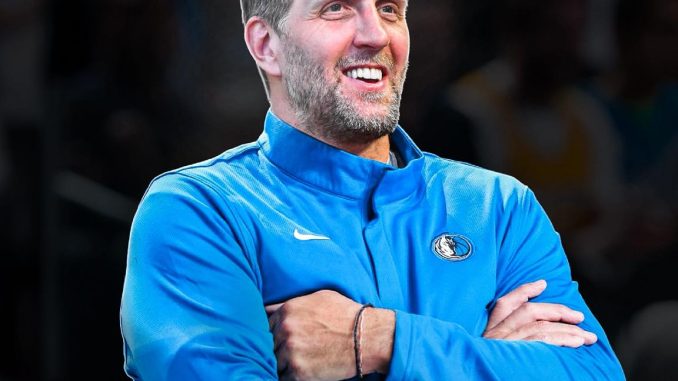
The basketball world stood still when the Dallas Mavericks unveiled one of the most emotional and unexpected franchise decisions in recent NBA history, officially naming Dirk Nowitzki as the new head coach of the Dallas Mavericks. For a franchise deeply connected to its greatest icon, the announcement felt less like a routine coaching hire and more like the closing of a historic circle that began more than two decades ago when a skinny teenager from Germany first arrived in Texas and changed basketball forever.
Fans packed outside the American Airlines Center within minutes of the announcement, many wearing vintage No. 41 jerseys and waving signs that read “Welcome Home Coach Dirk” and “MFFL Forever.” Social media exploded across the NBA landscape as former teammates, players, executives, and fans reacted to the stunning development. Few expected Nowitzki to enter coaching, especially at this level, but the Mavericks made it clear that this was not a ceremonial move built on nostalgia alone. According to team executives, the organization believes the Hall of Famer’s leadership, championship pedigree, basketball IQ, and connection with modern players make him uniquely qualified to guide Dallas into its next era.
The move comes at a critical point for the Mavericks organization. After seasons filled with high expectations, roster reshuffling, playoff disappointments, and mounting pressure surrounding the franchise’s long-term direction, ownership decided the team needed a cultural reset rooted in identity, accountability, and stability. Rather than searching for another established coaching name from outside the organization, Dallas turned inward and handed the keys to the man who defined the franchise for 21 unforgettable seasons.
Nowitzki’s relationship with Dallas transcends basketball. Drafted in 1998 and initially viewed as a risky international prospect, he evolved into one of the greatest power forwards in NBA history and became synonymous with loyalty in an era increasingly dominated by player movement and superteam construction. He led the Mavericks to 15 All-Star appearances, an NBA MVP award in 2007, and most memorably, the 2011 NBA championship, where Dallas defeated LeBron James, Dwyane Wade, Chris Bosh, and the heavily favored Miami Heat in one of the greatest Finals runs ever witnessed.
For many Mavericks fans, that championship remains the proudest moment in franchise history. Nowitzki battled through injuries, exhaustion, and enormous pressure during that postseason, delivering legendary performances against the Lakers, Thunder, and Heat while cementing his place among basketball immortality. More importantly, he represented professionalism, humility, and loyalty throughout his entire career, becoming not only the greatest player in franchise history but also one of the most respected figures the league has ever seen.
Those qualities are central to why Dallas ownership believes he can succeed as head coach.
At his introductory press conference, Nowitzki appeared emotional as he stepped behind the podium wearing a dark blue suit and a Mavericks lapel pin. Standing in front of reporters and cameras, he paused briefly while looking around the room before smiling.
“This city gave me everything,” Nowitzki said. “It gave me a home, a family, friendships, and memories I’ll cherish forever. I never imagined I’d be standing here as head coach of the Dallas Mavericks, but I’m honored, I’m excited, and I’m ready for this challenge.”
The crowd inside the media room erupted into applause.
Nowitzki admitted that he initially resisted coaching opportunities after retirement because he wanted to spend more time with his family and step away from the daily grind of NBA life. Since retiring in 2019, he has largely remained out of the spotlight, appearing occasionally at Mavericks games, charity events, and basketball celebrations while serving as an informal advisor within the organization. However, according to sources close to the franchise, conversations about a larger role began quietly over the past year.
Team governor Mark Cuban reportedly played a major role in convincing Nowitzki to embrace the opportunity. Cuban and Nowitzki built one of the closest owner-player relationships in sports history during their two decades together in Dallas, and their mutual trust helped make the shocking move possible.
“This isn’t about headlines or selling tickets,” Cuban told reporters after the announcement. “Dirk understands winning. He understands sacrifice. He understands leadership. Nobody represents the Dallas Mavericks better than Dirk Nowitzki, and we believe he can inspire this team in a way very few people can.”
Around the NBA, reactions ranged from surprise to genuine excitement. Former teammates praised the hire, while current players openly expressed curiosity about what a Nowitzki-led team might look like. Many pointed to his calm demeanor, elite basketball intelligence, and ability to relate to players as major strengths.
Several NBA veterans also noted that modern players often respond strongly to coaches who have experienced the pressures of stardom firsthand. Nowitzki not only experienced those pressures but overcame criticism, playoff heartbreak, and championship expectations throughout his career. That credibility matters in today’s NBA locker rooms.
The biggest question now becomes how Nowitzki’s coaching philosophy will translate onto the court.
During his playing days, he was known for meticulous preparation, unselfishness, and adaptability. He revolutionized the power forward position with his outside shooting, footwork, and offensive versatility, helping pave the way for the modern spacing era that dominates basketball today. Many league insiders expect his Mavericks teams to emphasize ball movement, floor spacing, disciplined offensive execution, and intelligent shot creation.
Sources inside the organization suggest Nowitzki also plans to prioritize defensive accountability and conditioning, two areas Dallas struggled with during stretches of recent seasons. While he was never viewed as an emotional screamer during his playing career, teammates consistently described him as fiercely competitive behind closed doors.
Former Mavericks players often recalled how Nowitzki set the standard through preparation rather than speeches. He routinely arrived early, practiced relentlessly, and played through pain without complaint. That example-driven leadership style could become a defining characteristic of his coaching tenure.
Of course, the transition from legendary player to successful head coach is never guaranteed.
NBA history is filled with iconic players who struggled when making the leap to coaching. Greatness on the court does not automatically translate to success on the sidelines. Coaching demands different communication skills, strategic adjustments, staff management, media responsibilities, and emotional balance over an 82-game season.
Still, there are reasons to believe Nowitzki may be uniquely positioned to thrive.
Unlike some former superstars who relied primarily on overwhelming athletic dominance, Nowitzki built his career through skill, discipline, timing, and constant evolution. He understood how to adapt as he aged, developed counters for defensive schemes, and learned how to maximize teammates around him. Those qualities often translate well into teaching and player development.
Additionally, his personality could become a major asset in navigating today’s player-driven NBA culture. Widely respected across generations, Nowitzki maintains relationships with current stars, international players, executives, and former teammates throughout the league. His authenticity and humility have always resonated with players, and many around the NBA believe athletes will immediately buy into his message.
For Dallas, the hire also carries enormous symbolic importance.
The Mavericks have spent years searching for continuity and identity in the post-Nowitzki era. Even with talented rosters and playoff appearances, the franchise often appeared to be chasing the emotional connection and stability that existed during the No. 41 era. Bringing Nowitzki back into a central leadership role instantly reconnects the organization to its most beloved chapter.
Fans see him not merely as a former player but as the embodiment of Mavericks basketball itself.
The pressure surrounding the move, however, will be immense.
Anything involving Nowitzki in Dallas automatically carries emotional weight and sky-high expectations. Every win will be celebrated passionately, and every loss will be dissected intensely. If the team struggles early, critics will inevitably question whether the franchise allowed sentimentality to influence basketball decisions.
Nowitzki addressed those concerns directly during his press conference.
“I understand the expectations,” he said. “I know people love this franchise and love what we built together over the years. But I’m not here because of nostalgia. I’m here because I believe I can help this team compete, grow, and win.”
That competitive focus reportedly impressed Mavericks executives throughout the interview process. Sources say Nowitzki approached meetings with detailed plans regarding offensive structure, player communication, sports science integration, and staff construction. He also emphasized the importance of creating a culture where players embrace responsibility while enjoying the game.
One of the most fascinating aspects of this new era will be watching how younger Mavericks players respond to learning from one of basketball’s all-time greats on a daily basis. Few coaches can walk into a room with a championship résumé and level of respect comparable to Nowitzki’s.
His presence alone changes the atmosphere surrounding the franchise.
Practices are expected to draw increased national attention, and television ratings for Mavericks games could surge as fans across the world tune in to witness the NBA legend’s coaching debut. International interest will likely skyrocket as well, especially in Germany and across Europe, where Nowitzki remains one of the most influential figures in basketball history.
For international players throughout the NBA, Nowitzki’s rise to head coach also carries broader significance.
Long before global superstars became common in the league, he helped shatter stereotypes about European players. He faced criticism early in his career from analysts who doubted whether international stars could lead teams to championships. Over time, he changed those perceptions permanently through brilliance, toughness, and sustained excellence.
Now, his appointment as head coach represents another milestone for international basketball influence in the NBA.
The Mavericks organization hopes that influence extends into player development and future roster building. Dallas has long been considered an attractive destination for international talent, thanks largely to Nowitzki’s legacy. His presence as head coach could further strengthen those relationships and enhance the franchise’s global appeal.
Current and former NBA stars quickly reacted online after the announcement. Messages poured in congratulating Nowitzki and praising the Mavericks for making such a bold decision. Some players jokingly wondered whether they would now have to guard the one-legged fadeaway in practice sessions.
Others simply celebrated seeing one of basketball’s most universally admired personalities return to the spotlight.
Throughout his career, Nowitzki rarely sought attention or controversy. He became famous for letting his game speak for itself while maintaining a grounded personality that resonated with fans around the world. That authenticity made him beloved not only in Dallas but throughout the basketball community.
Now, he steps into perhaps the most challenging role of his basketball life.
Coaching requires navigating egos, injuries, losing streaks, lineup controversies, media scrutiny, and the exhausting emotional demands of an NBA season. It requires difficult decisions that may strain relationships and moments where patience is tested under relentless pressure.
Yet those close to Nowitzki believe he understands exactly what he is walking into.
They say he spent months studying modern NBA schemes, consulting experienced coaches, and analyzing trends around the league before accepting the position. Rather than treating the opportunity casually, he reportedly approached it with the same meticulous preparation that defined his playing career.
If that dedication translates successfully, Dallas may have found more than just an inspirational figurehead.
They may have found the leader capable of restoring championship aspirations.
For Mavericks fans, the emotional impact of seeing Nowitzki return to center stage is impossible to overstate. His statue already stands proudly outside the arena, immortalized with the phrase “Loyalty Never Fades Away.” Now, the man behind that legacy will once again walk the sidelines representing the franchise he helped transform into a global brand.
The NBA thrives on storylines, and few stories compare to the return of a franchise icon attempting to guide his team from the bench after conquering the league as its greatest player. Whether this bold gamble ultimately leads to championships or painful growing pains, it instantly becomes one of the most compelling narratives in modern basketball.
As reporters exited the arena following the announcement, hundreds of fans still lingered outside, chanting Nowitzki’s name while celebrating the beginning of a new era in Dallas. Many had tears in their eyes. Others simply smiled in disbelief.
For a city that never stopped embracing its greatest sports hero, the feeling was unmistakable.
Dirk Nowitzki is home again.
Be the first to comment