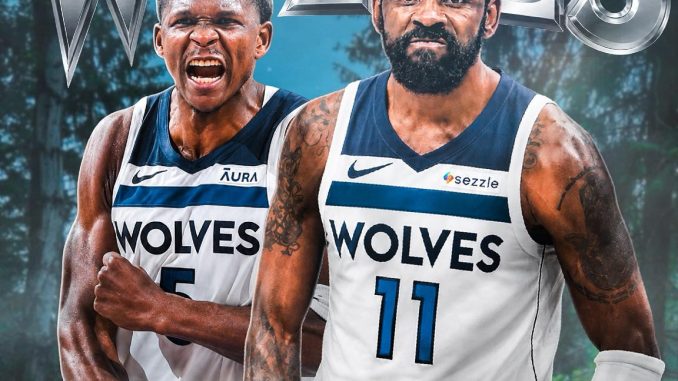
In one of the most seismic transactions of the modern NBA era, the Minnesota Timberwolves have reportedly completed a blockbuster deal to acquire star guard Kyrie Irving from the Dallas Mavericks, sending forward Julius Randle, guard Bones Hyland, and multiple first-round draft picks to Dallas in a stunning franchise-altering swap that instantly reshapes the balance of power in the Western Conference.
League sources describe the move as a “win-now earthquake” for Minnesota, a calculated gamble that signals an all-in commitment to championship contention around Anthony Edwards and a rapidly accelerating roster core. For Dallas, the deal represents a dramatic pivot—one that converts a volatile star-driven roster into a deeper, more flexible future asset base while maintaining competitive relevance.
The shockwaves hit the NBA landscape within minutes of the initial report, with front offices across the league scrambling to reassess their positioning. Anytime a player of Kyrie Irving’s caliber is moved, it reverberates beyond the two franchises involved, but this deal carries additional weight due to the timing, the playoff stakes, and the sheer magnitude of assets exchanged.
For Minnesota, this is not a subtle adjustment. It is a full declaration.
Pairing Irving with Anthony Edwards instantly creates one of the most explosive backcourts in the league. Edwards, already ascending into superstardom with his power, athleticism, and two-way dominance, now gains one of the most skilled offensive creators the game has ever seen. Irving’s ball-handling, shot creation, and late-game composure address a long-standing Minnesota need: a reliable, elite-level closer who can generate offense against set defenses when possessions grind in the postseason.
The Timberwolves have spent recent seasons building a defensive identity anchored by size, length, and physicality. But their playoff exits have repeatedly exposed a recurring issue—half-court offensive stagnation in critical moments. Irving’s arrival directly targets that weakness. He provides a dynamic counterbalance to Edwards’ downhill pressure, offering a different tempo, different angles of attack, and a proven ability to break defensive schemes in isolation.
Within league circles, the immediate question is not whether the fit is talented—it unquestionably is—but whether it is structurally sustainable. Irving’s usage demands are high, and Minnesota’s system has historically leaned toward disciplined spacing and defensive accountability. Integrating a free-flowing offensive artist into that structure will require careful calibration from the coaching staff, particularly in late-game execution scenarios.
Still, there is optimism that the pairing could unlock a level of offensive versatility Minnesota has never previously possessed.
For Dallas, the decision to move Irving marks the end of a high-risk, high-reward era that ultimately failed to fully stabilize into consistent contention. While Irving delivered flashes of brilliance alongside the Mavericks’ core, the volatility inherent in the roster construction made long-term cohesion difficult. By pivoting now, Dallas reclaims control over its future timeline while acquiring assets that provide both flexibility and optionality.
The centerpiece returning to Dallas, Julius Randle, brings a fundamentally different profile. A powerful forward with scoring versatility, rebounding strength, and playmaking ability from the frontcourt, Randle gives Dallas a more grounded offensive hub who can operate through contact and sustain production over long stretches. While not a direct replacement for Irving’s perimeter wizardry, he represents stability—something the Mavericks have often lacked during high-pressure stretches.
Bones Hyland adds another layer of backcourt depth, offering scoring burst, pace variation, and developmental upside. For a Mavericks team recalibrating its identity, Hyland becomes a low-cost, high-upside swing who can either grow into a rotation staple or serve as a valuable trade asset in future roster maneuvers.
But the true prize for Dallas lies in the multiple first-round picks included in the deal. In a league where draft capital has become the currency of roster construction, those selections represent the ability to reshape the franchise over multiple cycles. Whether used to draft young talent or to pursue another star via trade, those picks give Dallas something it had been gradually sacrificing in pursuit of immediate contention: control over its own trajectory.
Around the league, executives are already dissecting the implications. Minnesota’s move is being viewed as one of the boldest gambles in recent franchise history. The Western Conference is already stacked with elite guard play and versatile wing talent, and the addition of Irving pushes Minnesota directly into the highest tier of offensive firepower.
The pressure, however, will be immediate. Minnesota’s front office has effectively tied its championship window to the next two-to-three seasons. Anything short of a deep playoff run will intensify scrutiny on both the fit and the cost of the acquisition. First-round picks in today’s NBA are not just future assets—they are lifelines for sustaining long-term competitiveness. By moving multiple selections, the Timberwolves have significantly narrowed their margin for error.
Still, there is a belief internally that the current roster structure is strong enough to justify the risk. The combination of Edwards’ athletic dominance, Irving’s shot-making brilliance, and Minnesota’s defensive infrastructure could, in theory, produce a team capable of matching any offensive powerhouse in a seven-game series.
Coaches and analysts will immediately focus on how the backcourt responsibilities are distributed. Edwards has grown into a primary initiator, particularly in transition and high-paced sets, while Irving traditionally thrives with controlled tempo and isolation spacing. The challenge will be balancing those two identities without diminishing either player’s strengths.
Defensively, Minnesota will also need to adjust. Irving, while experienced and savvy, is not known as a high-impact defensive stopper. That responsibility will fall heavily on Minnesota’s wings and bigs, who will need to compensate for perimeter mismatches in postseason scenarios. The Timberwolves’ ability to maintain their defensive identity while upgrading offensively will likely determine the success or failure of this deal.
For Dallas, meanwhile, the post-trade outlook centers on recalibration rather than immediate contention overhaul. The Mavericks are not tearing everything down, but they are clearly transitioning toward a more flexible and sustainable roster construction model. Randle’s presence allows them to remain competitive in the short term while exploring additional moves around the edges of the roster.
There is also strategic intrigue in how Dallas utilizes its newly acquired draft capital. With the Western Conference in constant flux, the ability to package picks for another star—or to reload through the draft during a downturn cycle—gives the Mavericks a reset button they previously did not possess.
Fan reaction across both markets has been immediate and intense. In Minnesota, excitement is tempered with anxiety over the cost, but the overwhelming sentiment is anticipation. For a franchise that has long searched for a legitimate championship-caliber offensive engine to pair with its defensive identity, Irving represents the most significant acquisition in years.
In Dallas, emotions are more divided. Irving’s talent was never in question, but his tenure was marked by inconsistency, both in availability and team rhythm. For some fans, the move signals overdue pragmatism. For others, it is the end of a vision that never fully materialized.
Across the NBA, rival teams are now adjusting their own expectations. The Timberwolves are no longer just a rising team with upside—they are now a fully loaded contender with elite offensive shot creation and one of the most dangerous late-game duos in the league. Any playoff series involving Minnesota immediately becomes more complex for opposing coaching staffs.
As the league digests the magnitude of the trade, one reality is clear: this is not a marginal adjustment or a rotational tweak. It is a franchise-defining gamble on both sides. Minnesota has chosen urgency over patience, star power over asset preservation, and immediate contention over long-term flexibility. Dallas, in turn, has chosen recalibration, depth, and future control over continued volatility.
Whether the move ultimately crowns a new Western Conference powerhouse or becomes a cautionary tale about overextension will depend on execution, chemistry, and timing. But in the moment, with the ink still drying and the league still reacting, one truth stands out above all else: the NBA landscape has shifted, and it now runs directly through Minneapolis and Dallas in ways few could have predicted just days ago.
Be the first to comment