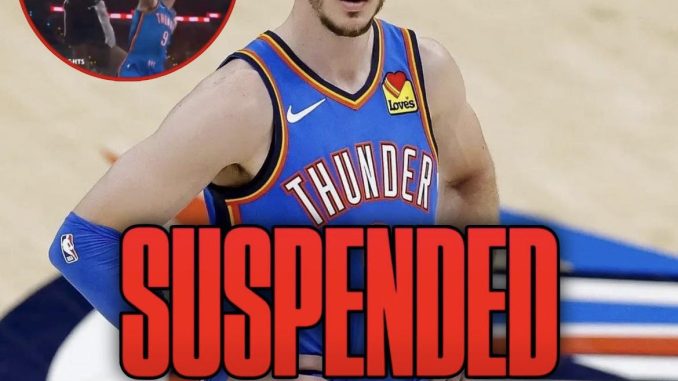
The NBA playoffs took another dramatic turn on Friday afternoon when the league announced that Alex Caruso has been suspended for Game 4 following his hard foul on Stephon Castle during a heated postseason battle that had already been teetering on the edge of physical chaos. In addition to the suspension, the league office also handed Caruso a $10,000 fine, citing what it described as “dangerous and unnecessary contact” during the incident that sparked outrage across social media, ignited debates on sports television, and intensified an already emotional playoff rivalry.
The announcement immediately sent shockwaves through the basketball world because of Caruso’s importance to Oklahoma City’s defensive identity and because of the growing tension surrounding the series itself. What had started as a high-level chess match between two of the Western Conference’s youngest and most explosive teams has quickly transformed into a bruising emotional war filled with hard fouls, constant jawing, technical fouls, and escalating physicality. The league’s decision now places an even brighter spotlight on player safety while simultaneously shifting the competitive balance heading into a pivotal Game 4.
The controversial play occurred late in the second half when Castle attacked the rim in transition after forcing a turnover near midcourt. As the rookie guard elevated toward the basket, Caruso rotated from the weak side and delivered a hard collision that sent Castle crashing violently to the hardwood. The contact immediately stunned the arena. Players from both benches rushed toward the scene as officials blew the whistle and attempted to separate several heated confrontations near the baseline.
Castle remained on the floor for several moments while medical personnel checked on him, creating an eerie silence inside the building before boos rained down from the crowd once replay angles appeared on the jumbotron. The replay quickly fueled the controversy because many believed Caruso made little attempt to play the basketball and instead targeted Castle’s body while he was airborne — the exact type of dangerous situation the NBA has tried to eliminate over the past decade.
Officials reviewed the play for several minutes before ultimately assessing Caruso with a Flagrant 2 foul, triggering an automatic ejection. As Caruso walked toward the locker room, fans showered him with boos while players on both teams continued exchanging words near the scorer’s table. Castle eventually got to his feet under his own power and walked slowly to the bench, though he appeared visibly shaken after the collision.
The league office later released a statement explaining the punishment, emphasizing that the suspension was based not only on the severity of the contact but also on the heightened risk associated with airborne players. NBA executives have repeatedly stressed over recent years that protecting players in vulnerable positions remains one of the league’s biggest priorities, especially during the intensity of playoff basketball where emotions and desperation often override caution.
For Oklahoma City, losing Caruso for Game 4 represents a potentially devastating blow. While he may not be the team’s leading scorer or biggest superstar, his value has consistently extended far beyond the box score. Throughout the postseason, Caruso has served as the Thunder’s emotional tone-setter, defensive quarterback, and veteran stabilizer for one of the league’s youngest contenders. His relentless perimeter defense, hustle plays, communication, and ability to disrupt opposing guards have made him one of the most trusted players in crunch-time situations.
Head coach Mark Daigneault now faces one of the toughest adjustments of the postseason. Caruso’s absence creates a major defensive gap against a San Antonio backcourt that has been playing with increasing confidence throughout the series. Castle, in particular, has emerged as one of the breakout stars of the playoffs, showcasing poise and fearlessness well beyond his years. The rookie has repeatedly attacked Oklahoma City’s defense with aggressive downhill drives, transition pressure, and timely perimeter shooting, making him a major factor in San Antonio’s offensive rhythm.
That growing confidence likely played a role in the intensity surrounding the foul itself. Castle’s emergence has altered the dynamics of the series, and Oklahoma City’s defenders have increasingly attempted to challenge him physically at every opportunity. While playoff basketball has always featured a higher level of contact and aggression, many around the league felt Caruso crossed the line with the force and timing of the hit.
Former players and analysts quickly weighed in after the suspension became official. Some defended the league’s decision as necessary in an era where player safety must remain paramount. Others argued that playoff basketball has always involved hard fouls and emotional moments, insisting that suspending a key rotation player could unfairly influence the outcome of a tightly contested series.
Several former defenders pointed out that Caruso has long built a reputation as one of the league’s toughest and most competitive perimeter stoppers but not necessarily as a dirty player. That distinction became central to the debate. Supporters argued the play was reckless rather than malicious, saying Caruso was simply attempting to prevent an easy basket during a critical playoff moment. Critics, however, countered that intent becomes secondary when the result places another player at significant risk of injury.
The NBA ultimately sided with the latter interpretation.
The decision also underscores how aggressively the league has worked to discourage dangerous midair contact. Since several high-profile injuries over the years involving undercutting and airborne collisions, the NBA has consistently issued harsher penalties for plays deemed capable of causing serious harm. In today’s league, even respected defenders can face severe punishment if officials believe they endangered an opponent.
For San Antonio, the ruling felt like validation after players and coaches openly voiced frustration following the game. Members of the Spurs reportedly believed the foul warranted immediate league review and expressed concern about the physical escalation taking place throughout the series. Several San Antonio players appeared visibly upset after the incident, particularly because Castle has become such an important part of the team’s playoff push.
Castle’s growth during the postseason has been one of the biggest stories in basketball. The rookie entered the playoffs viewed primarily as a promising defensive guard with developing offensive tools, but his performances under pressure have rapidly elevated his national profile. He has consistently attacked elite defenders without hesitation while embracing difficult defensive assignments on the other end. His confidence has energized the Spurs and added another dangerous weapon alongside the franchise’s young core.
That confidence was evident again before the collision. Castle had been playing aggressively, repeatedly getting downhill against Oklahoma City’s defense and forcing rotations that opened opportunities for teammates. His willingness to attack the paint appeared to frustrate Thunder defenders throughout the night, contributing to the increasingly physical tone of the matchup.
After the game, Castle briefly addressed reporters and said he was feeling okay physically, though he admitted the fall was dangerous. The rookie avoided escalating the controversy publicly, choosing instead to focus on his recovery and preparation for Game 4. His composure only further impressed teammates and coaches who have repeatedly praised his maturity throughout the season.
Meanwhile, Oklahoma City now faces difficult questions regarding discipline and composure moving forward. The Thunder have built their identity around relentless defense, toughness, and emotional energy, but the Caruso suspension serves as a reminder of how thin the line can be between physical basketball and recklessness. In the postseason, where every possession carries enormous weight, maintaining emotional control becomes just as important as tactical execution.
The absence of Caruso will likely place additional pressure on Shai Gilgeous-Alexander and the rest of Oklahoma City’s core to respond with discipline rather than frustration. Gilgeous-Alexander has carried a massive offensive workload throughout the playoffs, and losing one of the team’s best defenders only increases the burden on both ends of the floor. Oklahoma City will now need younger players to step into expanded defensive roles against a Spurs team that suddenly carries significant momentum.
For San Antonio, the suspension could provide a massive opportunity to seize control of the series. The Spurs have gradually grown more comfortable with the intensity of playoff basketball, and their confidence appears to rise with every game. Castle’s emergence, combined with the dominant interior presence of Victor Wembanyama, has transformed San Antonio into one of the most dangerous young teams remaining in the postseason.
Wembanyama’s influence in particular looms large heading into Game 4. With Caruso unavailable to help disrupt perimeter actions and rotations, San Antonio may find it easier to create clean entry angles and drive-and-kick opportunities that place Oklahoma City’s defense under enormous strain. The Spurs have increasingly used Castle as a secondary initiator alongside Wembanyama, creating a dynamic combination of length, athleticism, and playmaking that has tested the Thunder throughout the series.
At the same time, the suspension also adds emotional fuel to Oklahoma City’s locker room. Teams often rally around adversity during the playoffs, and the Thunder will likely enter Game 4 feeling both challenged and motivated after losing one of their emotional leaders. Caruso’s teammates publicly defended him after the incident, insisting he was not attempting to injure Castle and emphasizing his reputation as a fierce competitor who plays every possession at full speed.
Still, the broader conversation surrounding the play reflects the changing nature of modern basketball. The NBA’s increased emphasis on speed, spacing, and player protection has altered expectations regarding physicality. Plays that might once have been viewed as “hard playoff fouls” are now evaluated through a different lens because of the league’s responsibility to minimize preventable injuries.
That evolution continues to generate debate among fans and former players, particularly during the postseason when physical intensity naturally rises. Some believe the modern NBA has become too restrictive regarding contact, arguing that playoff basketball should allow greater physical freedom. Others believe the league is simply adapting responsibly to protect athletes from unnecessary danger.
Caruso’s suspension now becomes another major chapter in that ongoing debate.
What cannot be disputed, however, is the magnitude of the moment for both franchises. Game 4 suddenly carries even greater significance after the league’s ruling. Oklahoma City must prove it can maintain its defensive edge and emotional composure without one of its toughest veterans. San Antonio, meanwhile, has an opportunity to capitalize on the absence and push the series further in its favor.
All eyes will now shift toward how both teams respond emotionally. Playoff rivalries are often defined not only by talent but by resilience, composure, and the ability to handle pressure under the brightest lights. The Caruso suspension has intensified every storyline surrounding this matchup, ensuring Game 4 will be played under enormous scrutiny from fans, analysts, and league officials alike.
And while the debate over the foul itself may continue for days, the NBA’s message was unmistakably clear: even in the chaos and intensity of playoff basketball, dangerous plays that threaten player safety will not be tolerated.
Be the first to comment