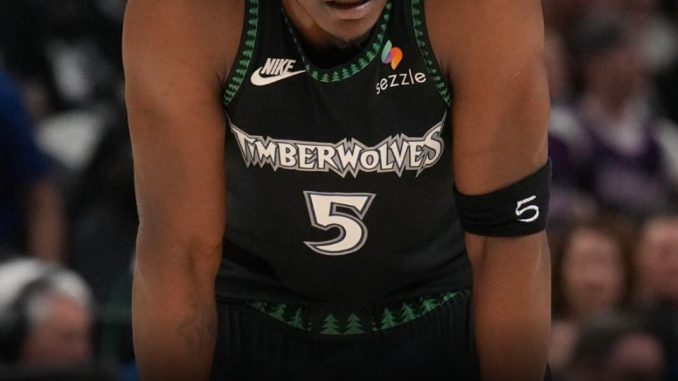
Anthony Edwards isn’t new to the spotlight, but the Minnesota Timberwolves star once again found himself at the center of basketball’s cultural conversation after Nike’s recent viral campaign appeared to take a playful jab at San Antonio Spurs phenom Victor Wembanyama. The ad, which leaned into Wembanyama’s widely used “alien” nickname, sparked immediate buzz across social media, with fans dissecting its meaning, intent, and whether it subtly elevated the rookie sensation above the rest of the league’s young stars.
But while the internet debated Nike’s marketing message, Edwards responded in typical fashion—calm, confident, and completely unfazed.
For Edwards, the moment wasn’t about being overshadowed or drawn into a manufactured rivalry. Instead, it was another example of how his name continues to circulate in the league’s most high-profile conversations. The Timberwolves guard, who has rapidly transformed from rising prospect to certified franchise cornerstone, dismissed the noise and reframed the narrative in a way that only he can: attention like this is proof of arrival, not a distraction from it.
Around the league, Edwards has become one of the NBA’s most recognizable personalities. His explosive scoring ability, fearlessness in big moments, and unfiltered charisma have made him a marketing dream and a fan favorite. So when Nike’s campaign leaned into the hype surrounding Wembanyama—casting him in an almost extraterrestrial light—it naturally triggered discussion about where Edwards fits in the league’s evolving hierarchy of young stars.
Rather than react defensively, Edwards leaned into perspective. Those close to him describe his mindset as increasingly grounded, built on performance rather than perception. He has seen enough basketball cycles to understand how narratives shift overnight, especially in an era driven by social media amplification and brand storytelling.
The “alien” branding surrounding Wembanyama is not new. Since his arrival in the NBA, the Spurs rookie has been framed as a once-in-a-generation talent, a 7-foot-4 anomaly with guard-like skills and defensive instincts that seem to defy conventional basketball logic. Nike’s campaign simply took that existing narrative and magnified it for global audiences.
But in doing so, it also inadvertently placed Edwards in the orbit of that conversation—not as a supporting character, but as one of the league’s counterpoints. If Wembanyama represents the future of positional uniqueness, Edwards represents the raw, explosive human force that still defines the modern NBA. The collision of those narratives is what makes the league’s current era so compelling.
Edwards has never been shy about his belief in his own ability. That confidence has carried him through playoff battles, clutch scoring stretches, and increasingly high expectations in Minnesota. The Timberwolves’ rise in the Western Conference over the past seasons has mirrored his development, as he has evolved from a high-flying scorer into a more complete offensive engine capable of controlling tempo, reading defenses, and carrying late-game responsibilities.
What makes his reaction to the Nike moment notable is not just what he said—or didn’t say—but how it fits into his broader trajectory. Players at Edwards’ level often reach a point where external narratives begin to either define them or distract them. Edwards appears to be doing neither. Instead, he is actively shaping his own lane, where recognition from brands, media cycles, and opponents is secondary to what happens on the court.
Around league circles, there is a growing understanding that Edwards is becoming one of the NBA’s most bankable stars. His playoff performances have already elevated his reputation beyond regular-season production, and his ability to deliver in high-pressure environments has drawn comparisons to some of the league’s most fearless competitors. While he is still refining consistency at the highest level, his ceiling as a face-of-the-league candidate is no longer theoretical—it is being actively tested every night.
The Nike campaign involving Wembanyama only intensified the spotlight on that conversation. Marketing campaigns in the NBA have long played a role in shaping perception. From the “Air Jordan” era to the modern superteam storytelling age, brands have consistently helped define the league’s icons. In this case, Wembanyama’s “alien” identity has been carefully constructed to emphasize his uniqueness, his physical advantages, and the sense that basketball has never seen anything quite like him.
Edwards, however, exists in a different narrative space. He is not framed as otherworldly or scientifically unusual. Instead, his appeal lies in something more familiar but equally powerful: dominance through athleticism, competitive fire, and emotional intensity. He plays with a style that feels grounded in instinct rather than abstraction, which makes him relatable even as he produces highlight-reel moments that go viral across the league.
The juxtaposition of the two stars—Wembanyama and Edwards—has become one of the NBA’s most intriguing undercurrents. One represents the boundary-pushing evolution of the game’s physical possibilities. The other represents the continuation of its most electrifying traditions. Both are young, both are already franchise pillars, and both are shaping how the next decade of basketball will be discussed.
Edwards’ refusal to engage in the marketing narrative is consistent with how he has handled external attention throughout his career. Even as endorsements, media features, and highlight compilations continue to increase his visibility, he has maintained a focus on team success and internal growth. The Timberwolves organization has leaned into that mentality, building around his skill set and leadership style as they attempt to establish themselves as perennial contenders in a loaded Western Conference.
Inside Minnesota’s locker room, Edwards is viewed as the emotional engine of the team. His energy is often contagious, his confidence sets the tone, and his willingness to embrace tough matchups has helped define the team’s identity on both ends of the floor. Coaches have frequently pointed to his competitive maturity, noting that while his game still carries the flair of a young star, his approach has steadily matured with experience.
That maturation is part of why his reaction to the Nike-Wembanyama moment resonated more broadly. It wasn’t a denial of the spotlight, but an understanding of it. In today’s NBA, attention is unavoidable. The difference between fleeting relevance and sustained stardom is often how players manage that attention when it arrives in unexpected forms.
For Edwards, the message was simple: if people are talking, it means you’re in the conversation that matters.
Around the league, young stars are increasingly being shaped not just by their on-court development, but by how they are positioned in cultural narratives. Social media, branding campaigns, and player-driven content ecosystems have blurred the lines between performance and perception. Edwards is one of the few players who seems equally comfortable navigating both.
He has embraced his role as an entertainer without letting it dilute his competitive edge. Whether it’s a thunderous dunk, a clutch three-pointer, or a postgame quote that travels faster than the game itself, Edwards has become one of the league’s most consistent sources of basketball moments that transcend box scores.
Meanwhile, Wembanyama’s ascent continues to redefine expectations for what a young star can look like. His presence alone alters defensive schemes, and his skill set challenges traditional basketball logic. Nike’s campaign simply reflects what the league and its fans are already experiencing in real time: a player whose uniqueness is so pronounced that even marketing language struggles to contain it.
Yet Edwards’ emergence in the same conversation is a reminder that the NBA’s future is not singular. It is layered, competitive, and constantly evolving. There is no one path to superstardom, and there is no single archetype that defines greatness in this era.
As the Timberwolves continue their push in the Western Conference, Edwards remains locked in on the only metric he consistently emphasizes: winning. Individual narratives, marketing campaigns, and viral debates may come and go, but playoff success and championship contention are what ultimately shape legacy.
Still, moments like the Nike campaign ensure that Edwards’ name remains firmly embedded in the league’s cultural fabric. Even when he chooses not to engage directly, his presence is felt in the conversation. That, in itself, is part of what defines modern stardom.
In the end, his response—measured, confident, and unbothered—was perhaps the most telling sign of all. Anthony Edwards is no longer reacting to the league’s storylines. He is part of writing them.
Be the first to comment