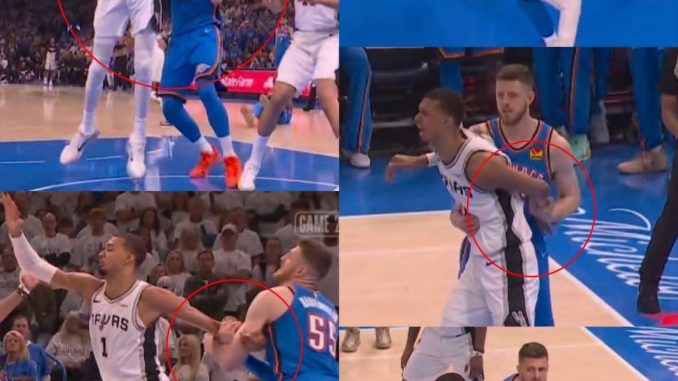
What began as a routine battle in the paint has quickly evolved into one of the NBA’s most talked-about physical matchups, as veteran big man Isaiah Hartenstein has drawn attention for his unusually persistent, hands-on defensive approach against generational phenom Victor Wembanyama.
Across multiple possessions and stretches of game action, Hartenstein’s strategy has appeared to go beyond conventional box-out positioning or standard post defense. Instead, it has been defined by constant physical contact—particularly repeated instances where he is seen grabbing, holding, and subtly tugging at Wembanyama’s arms and upper body as the Spurs’ towering star attempts to establish position in the paint or spin into space.
The tactic, while not entirely foreign in the physical language of NBA interior defense, has sparked debate among analysts and fans alike because of its consistency and specificity. Against most big men, such contact is often brief and situational. Against Wembanyama, however, it has been noticeably frequent, almost rhythmic in nature—occurring on box-outs, post-entry passes, off-ball movement, and even during transition runs where the Spurs attempt to unlock his rim-running ability.
For defenders tasked with slowing down Wembanyama, the challenge is obvious: he is unlike anything the league has seen before. Standing at a towering height with extraordinary wingspan, mobility, and shot-making touch, Wembanyama stretches traditional defensive schemes to their limits. As a result, opponents have experimented with a variety of approaches—fronting the post, sending early doubles, switching smaller defenders to deny entry passes, and in some cases, relying on physical disruption to break his rhythm before he can fully engage.
Hartenstein’s approach appears to fall into the latter category.
Rather than allowing Wembanyama to freely seal his defender or comfortably receive the ball at his preferred spots, Hartenstein has consistently attempted to “feel” him early—establishing contact before the catch and maintaining it through the initial movement. On several possessions, this has involved a visible hand on the arm or torso as Wembanyama tries to turn, roll, or rise into scoring position.
At times, the contact has been subtle enough to fall within the gray area of NBA officiating—those moments where referees often choose to “let them play,” especially in high-intensity matchups. At other times, it has been more overt, drawing visible reactions from Wembanyama as he looks toward officials or resets his footing to absorb the physical resistance.
The underlying logic from a defensive standpoint is clear: disrupt timing, reduce comfort, and force the offensive player to expend extra energy simply to receive the ball or complete a movement. Against most players, this kind of sustained contact can gradually wear down efficiency over the course of a game. Against Wembanyama, the goal is even more specific—slow down the chain reaction that begins with his catch and ends with his release at the rim or from midrange.
Still, the execution of such a plan against a player of Wembanyama’s unique frame is easier said than done. His reach alone allows him to secure passes in tight windows, and his ability to elevate over contact often neutralizes defenders who rely too heavily on physical disruption rather than vertical contesting. Even when defenders succeed in making him uncomfortable, Wembanyama has shown an unusual ability to adjust mid-play, extending over arms, absorbing bumps, and still finding clean angles toward the basket.
That is what makes the Hartenstein approach so intriguing: it is not necessarily designed to stop Wembanyama outright, but rather to prevent him from ever finding a sustained rhythm.
In modern NBA defensive philosophy, this kind of strategy sits in a long tradition of trying to “take a superstar out of his spots.” From bruising center matchups in earlier eras to contemporary switching schemes that prioritize switching length and physicality, the goal is often not domination, but disruption. Coaches frequently emphasize making elite scorers “work early” in possessions, forcing them to feel contact before they can dictate terms.
In that sense, Hartenstein’s physical engagement fits within a broader defensive identity that values effort, positioning, and controlled aggression. But against Wembanyama, the stakes of that approach are amplified. Every slight delay in receiving the ball can alter the geometry of the Spurs’ offense. Every moment of off-balance footing can affect the timing of a pick-and-roll dive or a post turnaround. And every extra ounce of resistance can influence whether Wembanyama rises into a clean shot or is forced into an awkward release.
Yet there is also a risk inherent in this strategy. Players of Wembanyama’s stature are often most dangerous when they are physically challenged early and respond by escalating their own assertiveness. When a defender becomes overly reliant on grabbing or holding, it can lead to foul trouble, especially against officials who are quick to clamp down on repeated off-ball infractions.
Moreover, Wembanyama’s composure has been one of his most striking attributes since entering the league. Rather than reacting emotionally to physical defense, he has shown a tendency to recalibrate—slowing his movement, adjusting his angles, and finding alternative ways to impact the game when direct scoring opportunities are denied.
That adaptability makes him particularly difficult to scheme against over a full game, let alone a series of matchups. Even when defenders succeed in making catches uncomfortable, Wembanyama’s ability to influence the game defensively—blocking shots, altering attempts, and controlling the paint—means he remains impactful even when his offensive rhythm is disrupted.
Still, there is no denying that the Hartenstein approach has added a new layer to the matchup dynamic. Each time the two big men collide in the paint, there is a visible contest of leverage and intent. Hartenstein, known for his toughness, rebounding instincts, and willingness to absorb contact, is attempting to establish himself as the more physically imposing presence in those micro-battles. Wembanyama, meanwhile, is forced to operate through contact that few players in the league ever experience at his size.
The psychological element cannot be ignored either. Constant contact can serve as a message—an attempt to communicate that nothing will come easy in the paint. For younger stars in particular, early career experiences against physical defenders often shape how they respond to adversity later in games and seasons. But Wembanyama is not a typical young star. His composure, combined with his unique physical tools, places him in a category where traditional intimidation tactics may have limited long-term effect.
From a coaching perspective, these matchups are often studied frame by frame. Teams look closely at how referees are calling contact, how often offensive fouls are being enforced, and whether physical strategies are producing measurable fatigue or simply increasing foul counts. If Hartenstein’s approach is seen as effective in limiting clean touches, it may encourage similar defensive looks from other teams facing the Spurs. If not, adjustments will inevitably follow.
What is already clear, however, is that Wembanyama has become a focal point for opposing defensive creativity. Every matchup seems to bring a different solution—or attempted solution—to the problem he presents. Some teams try speed. Others try switching. Some rely on doubling before he even catches the ball. And now, in this particular matchup, sustained physical contact has emerged as a notable theme.
As the league continues to adjust to Wembanyama’s presence, these tactical experiments are likely to become more pronounced. Defensive schemes will evolve not just from game to game, but possession to possession. Coaches will test boundaries, referees will recalibrate enforcement, and players like Hartenstein will continue to operate at the edge of what is permissible in the effort to gain an advantage.
For Wembanyama, each of these encounters serves as another chapter in his rapid education as an NBA superstar. Every form of resistance he faces contributes to the refinement of his game, forcing him to find new solutions, new angles, and new ways to impose his will despite increasing attention.
For Hartenstein, the assignment is more immediate and practical: make the paint uncomfortable, make touches difficult, and make every possession feel like a physical negotiation rather than a clean scoring opportunity.
In a league defined by margins, that kind of interior warfare can often decide games—not through highlight plays or dramatic sequences, but through the accumulation of small disruptions that tilt efficiency over time.
Whether this approach ultimately proves sustainable or merely a short-term tactical wrinkle remains to be seen. What is certain, however, is that the matchup between Isaiah Hartenstein and Victor Wembanyama has added yet another fascinating dimension to the evolving story of how the NBA attempts to contain one of the most unique talents the sport has ever seen.
And as long as Wembanyama continues to rise in prominence, defenders across the league will continue searching for answers—some conventional, some creative, and some as physically persistent as the one currently on display.
Be the first to comment