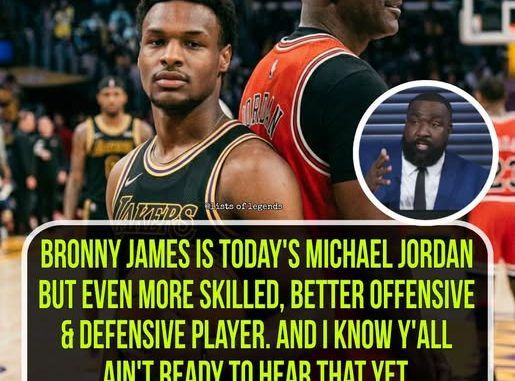
The debate surrounding basketball greatness has always thrived on impossible comparisons, but few statements in recent memory have ignited the NBA world quite like the latest hot take from Kendrick Perkins. During a fiery television discussion that quickly exploded across social media, Perkins delivered a jaw-dropping declaration that left fans stunned, analysts divided, and basketball purists scrambling for context. In a moment that instantly became viral material, the former NBA champion boldly suggested that Bronny James possesses more basketball skill than Michael Jordan ever did at the same stage of development, triggering one of the loudest reactions the basketball community has seen all year.
The comment arrived during a broader conversation about Bronny’s rapid development, his adjustment to the professional game, and the enormous expectations tied to carrying the James surname. While many expected Perkins to praise Bronny’s basketball IQ, defensive instincts, or polished perimeter game, few could have predicted the former center escalating the conversation into territory normally reserved for the greatest legends in NBA history. Yet that is exactly what happened, and within minutes clips of the statement flooded social media platforms, sports talk shows, podcasts, and online forums.
For years, Bronny James has existed under one of the brightest spotlights in modern sports. As the son of LeBron James, every dribble, every workout clip, every high school performance, and every professional appearance has been dissected in microscopic detail. The pressure has been relentless from the moment he first stepped onto a national stage as a teenager. Critics questioned whether his opportunities were earned or inherited. Supporters argued that his composure and steady improvement deserved genuine respect. Through it all, Bronny has attempted to forge his own identity while carrying the weight of perhaps the most famous basketball surname on the planet.
Perkins’ remarks poured gasoline on an already intense discussion surrounding the younger James. According to Perkins, modern basketball training, skill development, spacing concepts, and player versatility have fundamentally changed the sport. He argued that Bronny’s polished perimeter mechanics, court vision, defensive awareness, and comfort operating in multiple offensive roles make him “more skilled” than Jordan was during the early years of his own basketball journey. While Perkins never directly diminished Jordan’s greatness, his wording sent shockwaves because of the sacred status Jordan holds among basketball fans across generations.
The backlash was immediate. Longtime Jordan supporters viewed the statement as basketball blasphemy. To many fans, Jordan remains untouchable in conversations involving greatness, competitiveness, scoring dominance, and championship excellence. The six-time NBA champion’s résumé with the Chicago Bulls has become basketball mythology: six titles, six Finals MVPs, five league MVP awards, ten scoring crowns, and countless iconic moments that transformed the NBA into a global phenomenon during the 1990s. Comparing a rookie still trying to establish himself to a figure of Jordan’s stature was always going to provoke outrage.
Social media reactions ranged from disbelief to outright mockery. Some fans accused Perkins of chasing attention with outrageous takes, a criticism frequently directed at modern television analysts competing for viral relevance. Others defended Perkins by arguing that “skill” and “greatness” are not identical concepts. They pointed out that basketball evolution has dramatically expanded the technical abilities expected from younger players today. Modern guards and wings are trained from childhood to handle the ball, shoot from long range, switch defensively, and operate within complex offensive systems. In that sense, supporters argued, Perkins may have been referring strictly to technical refinement rather than overall basketball legacy.
Even that nuance, however, did little to quiet the storm.
The timing of the debate is particularly fascinating because Bronny’s development has quietly begun earning genuine respect within league circles. While his path to the NBA carried unprecedented attention, coaches and scouts have consistently praised his discipline, defensive intensity, and willingness to embrace a team-oriented role. Unlike many young prospects raised in celebrity environments, Bronny has largely avoided controversy and maintained a reputation as a grounded competitor eager to improve.
Those qualities have drawn admiration from veterans around the league. Several former players have publicly noted Bronny’s composure under pressure, especially considering the impossible expectations surrounding him. Every game he plays attracts cameras. Every performance generates headlines. Every mistake becomes national conversation material. Few young athletes in modern American sports have entered professional competition under a brighter microscope.
That context partially explains why Perkins may have leaned so aggressively into defending Bronny’s potential. Over recent years, Perkins has repeatedly advocated for younger players receiving patience rather than immediate condemnation. He has often criticized what he believes is an unfair tendency to compare prospects to all-time legends before their careers truly begin. Ironically, though, his latest remarks intensified that exact dynamic by placing Bronny in direct comparison with perhaps the most revered player basketball has ever seen.
Jordan’s supporters were especially vocal because of the immense historical context surrounding his rise. Before becoming the face of the NBA, Jordan dominated college basketball at University of North Carolina, hit one of the most iconic shots in NCAA championship history, and rapidly evolved into a professional phenomenon. By the mid-1980s, his athleticism, footwork, scoring creativity, and competitive fire had already separated him from virtually everyone in the league. Many older fans argue that younger generations cannot fully appreciate the terror Jordan instilled in opponents during his prime years.
Former players also joined the discussion. Some dismissed Perkins’ statement as absurd, insisting that Jordan’s footwork alone remains unmatched even decades later. Others acknowledged that modern players are indeed trained differently from earlier generations, leading to broader technical versatility at younger ages. The debate ultimately evolved into a larger philosophical question that basketball has wrestled with for years: does being “more skilled” necessarily mean being a better player?
In today’s NBA, skill development begins earlier than ever before. Young athletes work with personal trainers before reaching high school. They study advanced analytics, shooting mechanics, nutrition science, and positionless basketball concepts. Guards routinely practice step-back threes from distances that once would have gotten players benched. Big men now handle the ball like perimeter creators. Defensive schemes are more complex. Pace and spacing demand adaptability. By comparison, earlier eras emphasized physical toughness, mid-range scoring, and more rigid positional structures.
That evolution creates endless tension when comparing generations. Supporters of modern basketball believe today’s athletes are technically superior because of improved training methods and strategic sophistication. Traditionalists counter that older legends faced far more physical defenses, harsher officiating, and less spacing, forcing them to survive under brutal conditions modern players rarely encounter. Jordan’s era, in particular, is often remembered for punishing physicality and defensive intensity that would likely trigger countless flagrant fouls today.
Perkins’ comments unintentionally reopened all those old wounds.
Meanwhile, Bronny himself has remained largely silent amid the controversy, a decision many observers believe reflects maturity beyond his years. Throughout his basketball journey, he has consistently avoided fueling media storms or responding emotionally to criticism. That calm demeanor mirrors the approach his father has often encouraged publicly. LeBron has repeatedly emphasized that Bronny’s career should unfold naturally without unrealistic pressure tied to legacy comparisons.
Still, avoiding those comparisons has become virtually impossible. From the moment Bronny entered the national spotlight, basketball fans have debated whether he could someday approach the greatness of his father. Perkins’ latest comments expanded that conversation even further by invoking Jordan, the player many still consider the gold standard of basketball excellence.
For LeBron supporters, the controversy carried another layer. The Jordan-versus-LeBron debate remains perhaps the most emotionally charged discussion in sports culture. Fans from both sides fiercely defend their preferred icon with near-religious passion. Because Bronny is LeBron’s son, any comparison involving Jordan automatically becomes magnified. Some interpreted Perkins’ comments as another indirect attempt to elevate the James basketball legacy over Jordan’s historical standing.
That interpretation only intensified online warfare between fanbases.
Television analysts spent the next 24 hours dissecting Perkins’ wording. Some argued he should have clarified the distinction between “raw skill set” and “career greatness.” Others believed the statement was irresponsible regardless of context because it unfairly places impossible expectations on Bronny before his NBA career has truly begun. Young athletes have historically struggled when burdened with unrealistic comparisons, and critics worry that sensational debates only increase unnecessary scrutiny.
Yet despite the backlash, the controversy revealed something important about Bronny’s growing place within the basketball conversation. Love him or criticize him, the young guard is no longer viewed solely as LeBron’s son. He is becoming a legitimate NBA storyline in his own right. Analysts are now debating his potential, projecting his development, and examining his game with serious attention. That transition represents a significant milestone for a player who has spent years battling accusations of benefiting solely from family connections.
The modern sports media landscape also played a major role in amplifying the moment. In previous decades, controversial comments might have remained confined to a television segment. Today, however, a single quote can circle the globe within minutes. Short clips spread across social platforms instantly, often stripped of broader context. Debates intensify before full conversations are even viewed. In that environment, bold statements become currency.
Perkins understands that reality better than most. Since transitioning from player to analyst, he has built a reputation for passionate commentary and fearless opinions. Some viewers appreciate his willingness to speak bluntly. Others believe he occasionally crosses the line into theatrics designed for attention. Regardless of perspective, his remarks consistently generate conversation, and this latest explosion proved no different.
What makes the debate especially compelling is that it touches on basketball’s constant evolution. Comparing players across eras has always been deeply subjective. Rules change. Strategies evolve. Athletic training improves. Cultural pressures shift. Jordan never grew up in the social media age. Bronny has never known anything else. Jordan developed in an era without modern analytics or positionless basketball philosophies. Bronny has been immersed in those systems since childhood.
Even so, the emotional attachment fans have to Jordan’s legacy ensures that any comparison involving him will always provoke powerful reactions. To millions, Jordan represents more than statistics or championships. He symbolizes basketball perfection, competitive obsession, and global cultural impact. Challenging that mythology—even indirectly—is guaranteed to spark outrage.
As the debate continues, Bronny’s actual development as a player risks becoming secondary to the noise surrounding him. Lost within the arguments is the reality that he remains a young athlete still learning the professional game. Growth in the NBA rarely happens overnight. Even superstars required time to adjust. Expectations tied to family legacy can distort normal developmental timelines, making every performance feel disproportionately significant.
For now, Bronny appears focused on continuing that process quietly while the basketball world argues around him. Coaches reportedly remain impressed by his work ethic and willingness to embrace coaching. Teammates have praised his professionalism. Those qualities may ultimately matter far more than any television debate.
As for Perkins, his comments have already secured a place among the year’s most controversial basketball takes. Whether viewed as thoughtful commentary about generational skill evolution or simply outrageous television theater, the statement accomplished one undeniable goal: it captured the full attention of the sports world.
And perhaps that is what makes modern basketball discourse so fascinating. The game is no longer just about wins and losses. It is about legacy, identity, evolution, media narratives, and endless comparison. One bold opinion can dominate headlines, ignite fan wars, and reshape public conversations overnight.
In the center of the storm stands Bronny James, still writing the opening chapters of his own story while carrying the impossible weight of basketball history on his shoulders. And somewhere within the chaos of hot takes, viral clips, and GOAT debates lies the truth that only time can reveal: whether Bronny James will ultimately become merely a solid NBA player, a future star, or something far greater than anyone currently imagines.
Be the first to comment