One year ago, the NBA witnessed a statistical performance so clean, so controlled, and so rare that it didn’t just enter the record books—it forced people around the league to question whether the record books themselves needed updating.
On this day, Indiana Pacers star Tyrese Haliburton authored a playoff masterpiece that had never been seen before in league history: 30 points, 15 assists, and 10 rebounds with zero turnovers. A triple-double without a single mistake in ball security during the highest-pressure stage of basketball is already absurd on its own. Doing it in the postseason, against elite defensive schemes designed specifically to force errors, elevated it into something closer to myth than basketball box score.
It wasn’t just the uniqueness of the stat line that stood out. It was the control. Haliburton dictated tempo from the opening tip, bending the game to his pace, reading rotations before they fully developed, and delivering passes with surgical precision. Every possession seemed intentional, every decision calculated. He didn’t just avoid turnovers—he eliminated the very conditions that typically produce them.
That performance also marked his 11th career game with at least 15 assists and zero turnovers, a staggering benchmark that already places him in historically elite company. For context, two of the greatest floor generals the league has ever seen—John Stockton and Chris Paul—sit at the top of that category with 14 and 13 such games respectively. Haliburton, still in the early stages of his prime, is already pressing into territory once thought almost unreachable even for Hall of Fame-level decision-makers.
The implications of that kind of efficiency go beyond aesthetics. Zero-turnover games with high assist totals represent the purest form of offensive orchestration: creation without waste. In playoff basketball, where possessions are magnified and defensive pressure is relentless, even elite guards typically see their turnover numbers rise. For Haliburton to produce that level of volume passing without a single miscue speaks to an uncommon blend of anticipation, composure, and spatial awareness.
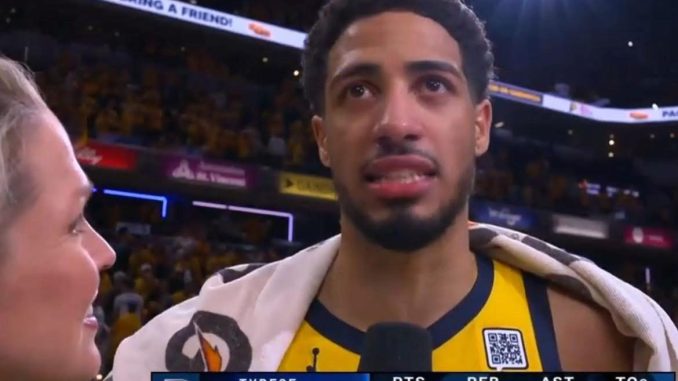
After the game, Haliburton responded to the growing fascination with his statistical profile with characteristic humility and humor.
“I feel like we making up stats at some point to make me look better,” he said, smiling at the attention surrounding his historic line.
But there was nothing fabricated about it. The numbers were real, and they reflected a player whose decision-making has become one of the most reliable assets in the league. Rather than forcing plays or overdribbling into congestion, Haliburton consistently chooses the earliest and cleanest option available. That discipline has become a defining trait of his game.
Indiana head coach Rick Carlisle didn’t hesitate to acknowledge how unusual Haliburton’s control has become, even by NBA standards.
“There will be a new statistical category, perhaps named after him somewhere down the line,” Carlisle said, half-joking but fully aware of the historical weight of what he was witnessing.
Carlisle’s comment speaks to a broader reality within the Pacers’ system: Haliburton is not just running the offense—he is redefining its efficiency ceiling. The Pacers’ half-court execution and transition flow are built around his ability to accelerate or slow the game without sacrificing possession security. That balance is what makes his stat line so extraordinary. High-volume playmaking typically comes with risk. Haliburton is removing that tradeoff almost entirely.
What makes the achievement even more striking is how it contrasts with the modern pace-and-space era. Today’s NBA encourages speed, improvisation, and constant ball movement, but those same principles often lead to increased turnover rates. Defensive schemes are more aggressive than ever, with traps, switches, and pre-rotations designed specifically to disrupt elite ball-handlers. In that environment, a 30/15/10 playoff line without a single turnover is not just rare—it borders on mathematically improbable.
Yet Haliburton continues to produce these kinds of outlier performances with growing frequency. His ability to process defensive coverages in real time allows him to stay ahead of the chaos that typically ensnares even the best guards. He doesn’t wait for pressure to arrive—he neutralizes it before it forms.
That is why comparisons to some of the greatest passers in NBA history have started to emerge more frequently. While Stockton’s precision and Chris Paul’s control remain the gold standard for error-free orchestration, Haliburton’s trajectory suggests a modern evolution of that archetype—one that combines traditional point guard discipline with today’s expanded offensive spacing and pace.
And yet, despite the historical framing, Haliburton continues to treat these milestones as side effects rather than objectives. His focus remains on winning possessions, not accumulating statistical accolades. That mentality may be the most important part of all. Because while numbers can define a moment, it is consistency in the playoffs that ultimately defines legacies.
One year later, that game still stands as a statistical anomaly that feels almost untouched by time. In an era defined by offensive explosiveness and defensive complexity, Tyrese Haliburton delivered something even more rare than scoring brilliance: flawless control under playoff pressure.
And as the league continues to evolve, performances like that raise a question no defense seems close to answering—how do you force mistakes from a player who so rarely makes them in the first place?
Be the first to comment