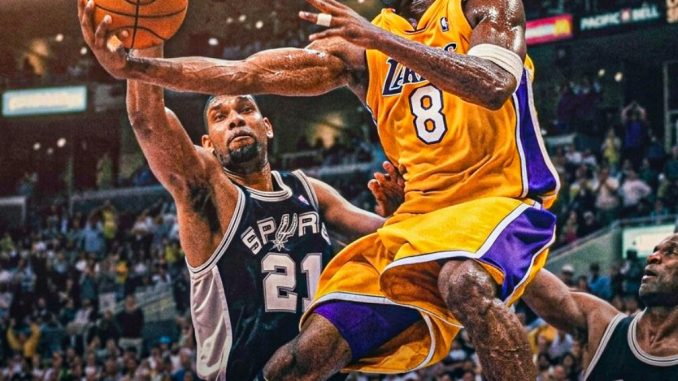
Before he became a global icon and before the championships stacked into a legacy that would define an era, there was a version of Kobe Bryant that struck fear into defenses with something far more unsettling than experience—pure, unfiltered inevitability. At just 22 years old, in the heart of the 2001 Western Conference Finals, Kobe didn’t just arrive on the stage. He seized it, bent it to his will, and left the San Antonio Spurs searching for answers that never came.
What unfolded over four games was more than a sweep. It was a declaration. The defending champions, the San Antonio Spurs, built around Tim Duncan and David Robinson, entered the series with discipline, defensive structure, and championship pedigree. They left it dismantled by a player still technically growing into his prime, yet already operating like a force beyond tactical containment.
The Los Angeles Lakers didn’t just win. They overwhelmed, outpaced, and outclassed a Spurs team that had no antidote for the explosiveness of Kobe Bryant when he decided the game would be played on his terms.
From the opening tip of Game 1, it was clear the series would not follow conventional script. San Antonio tried to start physical, leaning on their frontcourt defense and attempting to slow the tempo into a half-court grind. But Kobe refused the invitation. He attacked early, often, and without hesitation. Whether it was curling off screens into midrange pull-ups or slicing baseline from impossible angles, Bryant dictated rhythm like a veteran conductor.
Even alongside Shaquille O’Neal, the Lakers’ gravitational force in the paint, Kobe’s aggression stood out. Shaq would dominate the interior as expected, but it was Kobe who stretched San Antonio’s defensive identity beyond its limits. The Spurs couldn’t double both. And when they shifted attention toward Shaq, Bryant punished them with surgical precision.
By the end of Game 1, the message was already delivered: this wasn’t just a co-star riding shotgun. This was a co-star taking control of stretches that broke games open entirely.
Game 2 intensified the narrative. Gregg Popovich’s Spurs made adjustments, tightening perimeter rotations and attempting to force Bryant into contested jumpers early in the shot clock. For a brief stretch in the first quarter, it worked. Kobe missed a few rhythm shots, and San Antonio briefly stabilized the pace.
But elite players don’t just respond—they escalate.
Bryant began attacking from deeper positions, initiating contact rather than reacting to it. He hunted mismatches relentlessly, pulling bigs into space and exposing footwork gaps that simply couldn’t be corrected mid-series. Every time the Spurs appeared to regain structure, Kobe delivered a counterpunch—whether a spinning baseline finish or a step-back jumper that seemed to defy defensive positioning.
By halftime, the Spurs’ defensive scheme had shifted from containment to survival.
It was in Game 3, however, that the series tilted irreversibly. Back in San Antonio, in front of a home crowd expecting a response, the Spurs instead witnessed one of the most complete performances of Kobe Bryant’s early career.
He opened the game with an immediate assault: transition finishes, pull-up threes in rhythm, and a mid-post game that felt unnaturally advanced for a player his age. What made it more dangerous was not just the scoring—it was the timing. Every Spurs mini-run was met with an immediate answer. Momentum, in the traditional sense, didn’t exist for San Antonio.
Tim Duncan battled valiantly, anchoring the Spurs on both ends, but even his consistency couldn’t offset the avalanche coming from the perimeter. David Robinson provided veteran resistance, yet found himself stretched thin in coverage as Kobe exploited spacing gaps repeatedly.
By the third quarter, Spurs fans began to sense what was unfolding was not simply a difficult matchup—it was a mismatch in developmental timing. San Antonio was a disciplined, championship-caliber unit. But Kobe was operating at a level of instinct that ignored structure entirely.
He wasn’t reading the defense. He was pre-empting it.
Game 3 ended with the Lakers firmly in control of the series, and the tone of inevitability had fully taken hold. The Spurs weren’t just trailing—they were reacting late to everything.
Game 4 became a formality in the narrative, though the competition itself remained fiercely contested. San Antonio attempted one final strategic shift, emphasizing early double teams and physical perimeter pressure. For a moment, it created disruption. Kobe’s first few touches were contested, and turnovers briefly gave the Spurs life.
But greatness in its early form is often most dangerous when challenged.
Bryant adjusted instantly. Instead of forcing isolation scoring, he began manipulating defensive rotations with patience, drawing help defenders into uncomfortable positions before collapsing the defense with decisive cuts and passes. It was a reminder that even at 22, his game was already multidimensional.
When the Spurs closed off driving lanes, he punished them from midrange. When they overcommitted, he found Shaq. When they stayed home, he attacked anyway.
There was no winning equation.
As the fourth quarter unfolded, the Lakers’ lead expanded beyond reach, not through one singular explosion, but through sustained pressure that never allowed San Antonio to settle. Kobe’s presence on the floor alone compressed defensive spacing, forcing the Spurs into constant recalibration.
And that was the true essence of the series.
Not just scoring. Not just highlight moments. But control.
The Lakers completed the sweep, advancing out of the Western Conference Finals with authority. The Spurs, a team built on execution and defensive discipline, had been undone by a player who turned structure into suggestion.
In the aftermath, the conversation naturally gravitated toward Shaquille O’Neal’s dominance, as it often did during that Lakers era. Shaq’s interior destruction was undeniable, and his Finals MVP credentials would eventually reflect that reality. But within league circles, coaches and players alike understood something deeper had just occurred.
Kobe Bryant had shifted from “young star” to “series-defining force.”
What made it more alarming for the rest of the NBA was not just what he did—but how early he did it. At 22, most players are still learning how to survive playoff pressure. Bryant was already determining how series were won.
The Spurs, for their part, would regroup and continue building toward future championship success, refining their system into one of the most dominant dynasties the league would ever see. But this particular chapter belonged entirely to Los Angeles—and more specifically, to a young guard who played like the outcome had already been written in advance.
Phil Jackson, observing from the sideline with his trademark calm, later encapsulated the essence of what had just transpired without exaggeration or flourish. The Lakers had not simply advanced. They had witnessed a player stepping into his own gravity.
For Kobe Bryant, the sweep was not a peak. It was a threshold.
A moment where potential stopped being theoretical and became undeniable.
And for the rest of the NBA, it was a warning that would echo long after the series ended: the era of waiting for Kobe to grow up was over. He had already arrived.
Be the first to comment