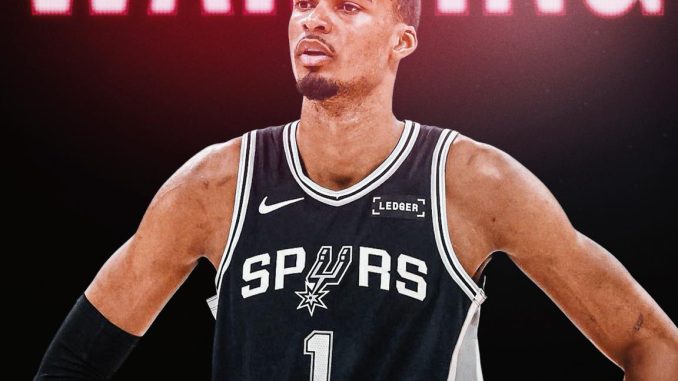
The league office has reportedly issued a formal media-relations warning to Victor Wembanyama following his decision to bypass mandatory postgame media availability after Game 5 of the Western Conference Finals, a 127–114 loss to the Oklahoma City Thunder that pushed San Antonio Spurs to the brink of elimination. According to league and team sources familiar with the situation, the NBA emphasized its expectation that all players—especially marquee stars—fulfill postgame media obligations regardless of emotional context, series pressure, or individual performance frustration.
The incident unfolded late Tuesday night in Oklahoma City after the Oklahoma City Thunder secured a commanding 3–2 series lead in a physically demanding and emotionally charged contest. Wembanyama, who had just endured one of the most scrutinized postseason outings of his young career, reportedly exited the locker room area without speaking to assembled reporters, a move that triggered immediate attention from both team officials and the league’s communications department. While postgame silence is not unprecedented in high-stakes playoff defeats, the NBA’s rapid response underscored how closely it is monitoring its emerging global face of the league.
Game 5 itself carried the weight of a defining moment in the series. Oklahoma City’s pace, defensive pressure, and late-game shot creation overwhelmed San Antonio in stretches, particularly in the second half when the Thunder created separation behind efficient scoring runs and transition execution. The Spurs, who had battled to even the series in Game 4, struggled to replicate that defensive discipline on the road, allowing Oklahoma City to dictate tempo and physicality. By the final buzzer, the Thunder had reasserted control of the matchup, moving within one win of a return to the NBA Finals conversation while the Spurs were left searching for answers and composure.
In that context, Wembanyama’s decision to avoid the media podium became a flashpoint not just for league protocol but for the broader conversation about leadership under pressure. League rules require players selected for postgame availability to speak with media representatives, a responsibility designed to maintain transparency, accountability, and engagement with fans and broadcast partners. While enforcement is typically flexible and fines are rare for first-time or emotionally driven absences, the NBA has increasingly signaled a firmer stance in the postseason, where visibility and narrative control are at their highest stakes.
Sources indicated that the league’s warning to Wembanyama was “procedural but firm,” reinforcing expectations rather than immediately escalating to disciplinary action. However, the message was clear: postseason visibility is not optional, even in moments of disappointment or frustration. For a player widely regarded as one of the most marketable and influential young stars in basketball, the league’s response highlights the delicate balance between protecting player emotion and maintaining institutional standards.
The situation places additional attention on Wembanyama’s evolving role within the Spurs organization. Since entering the league, he has been viewed not only as a franchise cornerstone but also as a global ambassador for the sport. His unique combination of size, skill, and personality has drawn comparisons to generational figures who carried both on-court expectations and off-court responsibilities. That dual burden has only intensified during San Antonio’s deep playoff run, where every performance, gesture, and media interaction is magnified under a championship spotlight.
Within the Spurs locker room, reactions to the situation have reportedly been measured. Team veterans and staff are said to understand the emotional toll of a grueling playoff series, particularly for a young player absorbing increased defensive attention and physical contact. At the same time, organizational leadership is believed to be reinforcing the importance of composure and communication, especially during moments when public perception can influence narratives around team maturity and playoff readiness.
The broader basketball community has also weighed in, with analysts divided on the significance of Wembanyama’s decision. Some view it as an understandable emotional response from a 20-something star navigating the most intense stretch of his career to date. Others argue that postseason visibility is precisely when leadership is most required, especially for a player whose profile extends far beyond San Antonio. The NBA, for its part, appears to be positioning itself firmly in the latter camp, reinforcing that responsibility to media obligations is inseparable from superstar status.
Historically, the league has dealt with similar situations involving high-profile players skipping media duties, particularly after emotionally charged playoff losses. In most cases, those incidents have been resolved internally through reminders, guidance, or nominal fines, rather than public disciplinary escalation. What makes this situation notable is the timing and profile of the player involved. Wembanyama is not simply another young star; he is widely projected as a future face of the league, and the NBA’s communication standards around him are correspondingly strict.
Game 5 also added competitive urgency to the narrative. Oklahoma City’s victory placed them one win away from closing out the series, shifting pressure squarely onto San Antonio heading into Game 6. The Thunder’s ability to recover from Game 4’s setback and immediately reassert dominance demonstrated resilience that has defined their playoff identity. Meanwhile, the Spurs must now confront not only tactical adjustments but also psychological recovery, as the emotional residue of both the defeat and the media controversy lingers.
Inside the Spurs’ preparation plans, emphasis is expected to be placed on stabilizing defensive rotations and improving offensive rhythm against Oklahoma City’s switching schemes. Wembanyama’s role remains central, particularly in anchoring interior defense and stretching the floor offensively. However, the spotlight has inevitably widened beyond basketball execution, with leadership and composure now part of the evaluation framework surrounding his postseason development.
League observers note that the NBA’s decision to issue a warning rather than immediate punishment reflects a desire to manage the situation without escalating tension. The league has long relied on its stars to engage with media as part of its storytelling ecosystem, and maintaining that relationship is especially critical during playoff series that drive global viewership. In that sense, the warning serves both as correction and reinforcement of expectations rather than as punitive action.
For Wembanyama personally, the moment represents another early-career lesson in the intersection between performance, personality, and public responsibility. His rise has been meteoric, and with it comes an accelerated learning curve that extends beyond basketball fundamentals. Navigating emotional losses, handling scrutiny, and maintaining communication standards are now part of his professional landscape in the same way shot-blocking and pick-and-roll coverage are.
As the series shifts back toward San Antonio for Game 6, attention will inevitably follow both his on-court response and his off-court availability. The Spurs will need him not only as their defensive anchor and offensive focal point, but also as a stabilizing presence in front of microphones and cameras. The NBA, meanwhile, will be watching closely to ensure that its expectations are met and that the league’s communication framework remains intact during one of its most visible postseason stages.
What remains clear is that the Western Conference Finals have reached a turning point defined by both competitive and narrative stakes. Oklahoma City holds the advantage on the scoreboard, but San Antonio’s response will determine whether the series extends or concludes. And layered into that basketball equation is a parallel storyline—one involving accountability, media responsibility, and the growing weight placed on one of the league’s brightest young stars.
In the end, the NBA’s warning to Wembanyama is less about a single postgame absence and more about the role he is expected to play moving forward. As the league continues to elevate him into its global spotlight, the expectations surrounding his conduct will rise in parallel with his performance. Game 6 will not only test the Spurs’ survival in the series, but also the composure of a franchise centerpiece learning, in real time, what it means to carry the game beyond the court.
Be the first to comment