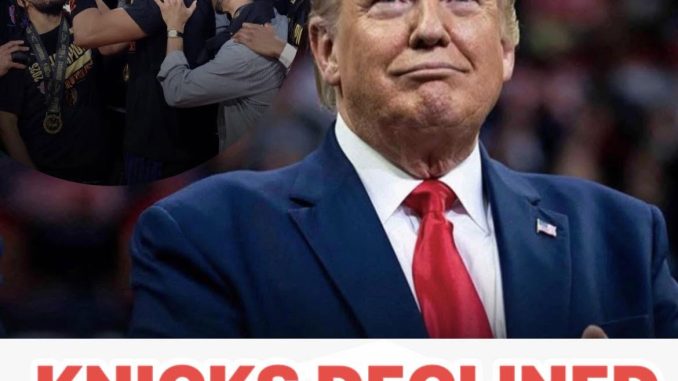
The celebration that followed the New York Knicks’ championship victory was expected to include all the traditional moments that come with reaching the summit of professional basketball. There would be championship parades through the streets of Manhattan, packed arenas filled with cheering fans, appearances on national television, and the usual honors that accompany a title-winning season. Yet one of the most recognizable traditions in American sports may not be taking place this year, as reports indicate that the Knicks have declined an invitation to visit the White House following their championship triumph.
According to sources familiar with the situation, tensions inside the organization reportedly intensified after President Donald Trump attended Game 3 of the championship series, a contest that ended in a disappointing loss for New York against the San Antonio Spurs. While the Knicks ultimately recovered from that setback and went on to secure the championship, the events surrounding that game appear to have contributed to a growing sense of discomfort within parts of the organization.
The reported decision marks a significant departure from one of the most longstanding customs in American sports. Championship teams from major professional leagues have traditionally been invited to the White House to be recognized by the sitting president. The visits have often served as a symbolic celebration of athletic achievement, bringing together players, coaches, executives, and government officials in a moment designed to honor excellence on the field or court.
For decades, these visits were largely viewed as ceremonial occasions that transcended sports. Teams from the NBA, NFL, MLB, NHL, and collegiate athletics routinely participated in White House ceremonies regardless of political affiliations or differences in personal viewpoints. However, over the last several years, such visits have increasingly become subjects of public discussion and debate, with athletes and organizations sometimes choosing to decline invitations or skip the events altogether.
The Knicks now find themselves at the center of another chapter in that evolving relationship between sports and politics.
The championship season itself was one of the most memorable in franchise history. For a fan base that had waited decades to see the team return to the top of the basketball world, the title represented the culmination of years of rebuilding, roster development, and organizational patience. New York entered the season with high expectations but also faced significant pressure given the competitive landscape of the NBA.
Throughout the regular season, the Knicks established themselves as one of the league’s most disciplined and resilient teams. They combined defensive toughness with balanced offensive production, earning victories against many of the league’s elite contenders. Their ability to perform consistently in high-pressure situations became one of the defining characteristics of their championship run.
The postseason presented its own challenges. The Knicks battled through multiple difficult series, overcoming injuries, hostile road environments, and talented opponents on their path to the NBA Finals. Each round seemed to strengthen the belief within the locker room that the team was capable of accomplishing something special.
By the time the championship series arrived, New York had become one of the hottest teams in basketball. Their matchup with the Spurs was widely viewed as a clash between two elite organizations, each featuring a unique blend of star power, coaching excellence, and championship aspirations.
Game 3 ultimately became one of the defining moments of the series. With President Trump in attendance, the contest attracted significant media attention even before the opening tip. Cameras frequently showed the president throughout the evening, and discussions about his presence quickly became a major talking point across sports and political media.
On the court, however, things did not go according to plan for the Knicks. The Spurs delivered one of their strongest performances of the series, capitalizing on key mistakes and controlling important stretches of the game. New York struggled to find offensive rhythm, while San Antonio executed efficiently on both ends of the floor.
The loss was disappointing not only because it came during the championship series but also because it temporarily shifted momentum toward the Spurs. Questions emerged about whether New York could respond under pressure and reclaim control of the matchup.
As it turned out, the setback became a turning point rather than a breaking point.
The Knicks responded with the poise that had defined their season. Veterans stepped up, younger players embraced larger responsibilities, and the coaching staff made critical adjustments. New York gradually regained momentum and ultimately captured the championship, delivering one of the most celebrated victories in recent franchise history.
Yet even amid the jubilation of winning a title, reports suggest that the events surrounding Game 3 continued to resonate within parts of the organization.
Sources indicate that discussions regarding a potential White House visit became increasingly complicated in the days and weeks following the championship victory. While championship visits are often announced shortly after a team secures a title, there reportedly was no immediate movement toward scheduling a ceremony.
As speculation grew, reports began to emerge suggesting that key figures within the Knicks organization were not enthusiastic about participating in the traditional visit. The reasons behind the reported decision remain varied, with individuals reportedly holding different perspectives regarding the matter.
Some within the organization are believed to have viewed the situation through a broader cultural lens, reflecting ongoing conversations throughout professional sports about social issues, civic engagement, and the role athletes play in public discourse. Others reportedly felt that declining the invitation was the best course of action given the circumstances surrounding the championship series.
The Knicks have not publicly released a detailed explanation regarding the reported decision, and there has been no official statement outlining the internal discussions that led to the outcome. Nevertheless, the reports have generated significant reactions across the sports world.
Fans have expressed a wide range of opinions. Some supporters believe the organization has the right to make its own decision regarding ceremonial events, particularly if team members feel strongly about the matter. Others argue that the White House visit should remain separate from politics and continue as a tradition recognizing athletic achievement.
The debate reflects larger conversations that have become increasingly common throughout professional sports over the past decade. Athletes today are more visible and influential than ever before. Social media platforms allow players to communicate directly with fans, express opinions on social issues, and engage in public conversations in ways that were not possible for previous generations.
As a result, organizations often find themselves navigating complex intersections between sports, culture, politics, and public perception.
The Knicks are hardly the first championship team to face scrutiny regarding a White House invitation. Numerous teams across various sports have encountered similar situations in recent years, whether through declining invitations, delaying visits, or having players choose not to attend.
Those decisions have frequently sparked passionate discussions about the purpose of the tradition and whether participation should be viewed as a celebration of athletic success, an endorsement of political leadership, or something in between.
For the Knicks, the timing of the reports adds another layer to an already remarkable championship story. The franchise’s return to prominence had been one of the defining narratives of the NBA season. After years of disappointment, New York finally delivered the championship many fans believed had remained elusive for far too long.
The city embraced the team in unforgettable fashion. Streets were filled with celebrations. Fans packed public viewing areas. Merchandise sales surged. Former players, celebrities, and basketball legends praised the achievement.
The championship represented more than simply winning games. It symbolized a revival of one of the NBA’s most historic franchises.
That accomplishment remains the centerpiece of the Knicks’ season regardless of what ultimately happens regarding the White House invitation.
Within basketball circles, many observers expect the team to shift its focus quickly toward defending its title. Championship windows in the modern NBA can be brief, and organizations understand that sustained success requires constant commitment.
Front-office executives are already evaluating roster decisions. Coaches are reviewing strategies from the championship run. Players are preparing for the challenges that come with being the defending champions.
The scrutiny will only increase moving forward.
Opponents will view every matchup against New York as an opportunity to measure themselves against the league’s reigning champion. National television appearances will become more frequent. Expectations from fans and media will rise dramatically.
Managing those expectations while handling off-court attention will be one of the key challenges facing the organization.
The White House controversy is unlikely to disappear immediately. Questions will continue to surface regarding the specifics of the reported decision, the viewpoints of individual players, and whether any future discussions could alter the situation.
At the same time, many around the league recognize that championship teams often become symbols that extend beyond sports. Success brings visibility, and visibility often leads to broader conversations about identity, values, and organizational culture.
For the Knicks, those conversations are now unfolding against the backdrop of one of the greatest achievements in franchise history.
What remains undeniable is that New York’s championship run captivated the basketball world. The team overcame adversity, responded to critical moments, and ultimately earned the right to call itself NBA champion. No decision regarding ceremonial traditions can diminish the accomplishment achieved on the court.
The players who battled through a demanding postseason, the coaches who crafted winning strategies, and the fans who supported the franchise through years of frustration all played roles in a journey that culminated with the Larry O’Brien Trophy returning to New York.
Whether the organization ultimately participates in any future White House-related event or continues to stand by its reported decision, the championship itself remains secure in NBA history.
As the offseason progresses, attention will undoubtedly return to basketball. Discussions about roster construction, championship defense, player development, and future title aspirations will once again dominate headlines. Yet the reported decision to decline a White House invitation has already ensured that the Knicks’ championship story will be remembered not only for what happened on the hardwood but also for the conversations that followed.
In many ways, that reflects the reality of modern sports. Teams are no longer judged solely by wins and losses. They operate in an environment where cultural influence, public engagement, and organizational values often become part of the broader narrative.
The Knicks’ reported choice has added another chapter to that ongoing evolution. While opinions will vary regarding whether the decision was appropriate, the discussion itself underscores the unique position professional sports occupy in American society.
For now, the reigning champions remain focused on the achievement that brought them to this moment. They climbed to the top of the NBA mountain, delivered a championship to one of basketball’s most passionate fan bases, and secured their place in franchise lore. Whatever follows regarding White House traditions, political reactions, or public debate, the banner hanging in New York will stand as the ultimate reminder of what this team accomplished during a season that will not soon be forgotten.
Be the first to comment