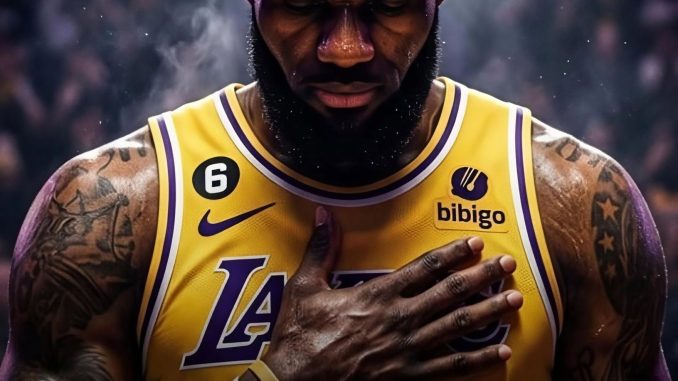
The NBA offseason has a way of turning even the boldest speculation into mainstream conversation, and few names generate more intrigue than LeBron James. As debates continue about the final chapters of one of basketball’s most celebrated careers, sports analyst and commentator Nick Wright has floated a blockbuster scenario that would instantly reshape the league’s balance of power and ignite discussions across every corner of the basketball world.
Wright recently proposed what he called the “ultimate legacy move” for James, envisioning a dramatic sign-and-trade agreement that would send the four-time NBA champion to the New York Knicks in pursuit of a fifth championship. While purely hypothetical, the proposal immediately captured attention because of its sheer magnitude and the implications it would carry for both franchises involved.
Under Wright’s scenario, James would sign a three-year contract worth $162 million with New York, joining a Knicks organization that has spent years trying to return to the NBA’s elite tier. In exchange, the Los Angeles Lakers would receive a package centered around Mikal Bridges, Mitchell Robinson, and the Knicks’ 2027 and 2031 first-round draft selections if New York ultimately failed to capture an NBA championship.
The proposal instantly sparked debate because it combines two of the league’s most iconic franchises with arguably the greatest player of his generation. James has already established an unmatched résumé that includes multiple championships, MVP awards, Finals MVP honors, scoring records, and countless playoff milestones. Yet despite all he has accomplished, conversations about his legacy continue to evolve, particularly as he approaches the latter stages of his playing career.
For Wright, the appeal of such a move extends beyond basketball. The analyst framed the hypothetical deal as an opportunity for James to accomplish something that few superstars in NBA history have even attempted. Winning a championship in New York would place James at the center of one of sports’ most historic and demanding markets, adding another remarkable chapter to a career already filled with defining moments.
The Knicks have long occupied a unique place within professional basketball. Despite their enormous popularity and the global reach of their brand, championships have been difficult to come by in recent decades. The franchise’s last title came in 1973, and generations of fans have waited for a return to the NBA mountaintop. Numerous stars have been linked to New York over the years, but few have arrived with the stature and championship pedigree that James would bring.
In Wright’s envisioned scenario, James would enter Madison Square Garden not simply as another star acquisition but as the centerpiece of a championship mission. The expectations would be immense. Every game would be scrutinized. Every playoff series would be analyzed through the lens of legacy. Yet those are circumstances James has navigated throughout his career.
From his early days with the Cleveland Cavaliers to championship runs with the Miami Heat and later a title-winning journey with the Lakers, James has repeatedly embraced situations carrying enormous pressure. Few athletes in modern sports history have faced comparable levels of attention while maintaining such a high standard of performance over two decades.
The financial component of Wright’s proposal is equally noteworthy. A three-year, $162 million contract would represent a significant commitment from New York, signaling a willingness to push all available resources toward maximizing a championship window. Such a deal would also acknowledge the reality that James, even in the later stages of his career, remains one of basketball’s most impactful players.
While age is often discussed whenever James’ future is evaluated, his production continues to defy conventional expectations. Season after season, he remains among the league’s most productive players, contributing as a scorer, facilitator, rebounder, and leader. His basketball IQ, durability, and ability to adapt have allowed him to remain relevant in an era increasingly populated by younger stars.
For the Knicks, the acquisition would represent an all-in approach toward championship contention. Pairing James with New York’s existing core would immediately elevate expectations. The franchise has steadily built a competitive roster through smart drafting, player development, and strategic acquisitions. Adding a player of James’ caliber would transform the organization from a contender into a team expected to compete for the Larry O’Brien Trophy from day one.
Of course, the proposed package heading to Los Angeles would not be insignificant.
Bridges has established himself as one of the NBA’s most respected two-way players. His combination of defensive versatility, perimeter shooting, durability, and professionalism has made him one of the league’s most valuable complementary stars. Any team acquiring Bridges would be obtaining a player capable of contributing immediately on both ends of the floor.
Robinson, meanwhile, remains one of the league’s premier rim protectors and rebounders when healthy. His size and defensive presence have been crucial components of New York’s identity. Adding a player with Robinson’s skill set would provide the Lakers with frontcourt depth and defensive stability.
The inclusion of future first-round draft picks further underscores the magnitude of the proposal. Draft assets remain among the most valuable commodities in today’s NBA, particularly for organizations seeking long-term flexibility. The possibility of receiving selections in 2027 and 2031 would provide Los Angeles with additional avenues for roster construction while helping offset the departure of one of the most influential players in franchise history.
From the Lakers’ perspective, the hypothetical deal raises fascinating questions about the future direction of the organization.
James arrived in Los Angeles in 2018 amid enormous expectations. Two years later, he delivered an NBA championship, helping restore the franchise to the top of the league. Throughout his tenure, he has remained the face of the organization, attracting global attention while continuing to perform at an elite level.
Yet every franchise eventually faces decisions about balancing present success with future planning. Acquiring a younger star such as Bridges, along with Robinson and valuable draft capital, could position the Lakers for sustained competitiveness beyond the James era.
That possibility is one reason Wright’s proposal has generated such widespread discussion. Unlike many blockbuster trade ideas that heavily favor one side, this scenario attempts to address the interests of both organizations. New York receives a transformational superstar capable of elevating championship aspirations, while Los Angeles gains a package designed to maintain relevance and flexibility moving forward.
Still, the emotional dimensions of the discussion may be even more compelling than the basketball considerations.
James’ relationship with the Lakers has become an important part of his legacy. Wearing the purple and gold carries a unique significance, and joining the franchise connected him to a lineage that includes legends such as Magic Johnson, Kobe Bryant, Shaquille O’Neal, and Kareem Abdul-Jabbar.
Leaving Los Angeles for New York would represent another major transition in a career already defined by landmark decisions. Each move James has made—from Cleveland to Miami, back to Cleveland, and eventually to Los Angeles—has altered the NBA landscape. A move to the Knicks would likely have a similar effect.
The New York market itself adds another layer to the conversation. Madison Square Garden remains one of the most iconic venues in sports, and the city’s passion for basketball is unmatched. Stars who succeed in New York often achieve a level of cultural significance that extends far beyond the game itself.
For years, Knicks fans have dreamed about landing a generational superstar capable of ending the franchise’s championship drought. Various names have surfaced in trade rumors and free-agency discussions, but none would compare to the impact of James arriving with the explicit goal of delivering a title.
Wright’s description of the move as the “ultimate legacy move” reflects that reality. Winning championships with multiple franchises is rare. Winning one for the Knicks after decades of frustration would carry enormous historical weight. It would provide James with an accomplishment that even many of basketball’s all-time greats never had the opportunity to pursue.
Naturally, questions remain about how such a roster would function on the court. Team chemistry, salary-cap implications, player roles, and long-term flexibility would all become significant topics of discussion. Building a championship team requires more than simply collecting talent.
However, James’ track record suggests he understands how to maximize championship opportunities. Throughout his career, he has demonstrated a unique ability to elevate teammates, adapt to different systems, and perform under pressure. Those qualities have allowed him to remain a central figure in championship conversations for more than twenty years.
The broader NBA landscape would also feel the impact.
A James-led Knicks team would instantly become one of the league’s most watched attractions. National television schedules would revolve around marquee matchups. Ticket demand would surge. Storylines involving conference rivals would dominate headlines throughout the season.
Meanwhile, the Lakers would enter a new era built around younger talent and future assets. Such a transition would undoubtedly generate its own intrigue as the organization sought to remain competitive while preparing for life after James.
Whether Wright’s proposal ever approaches reality remains uncertain. NBA history is filled with hypothetical trades that never materialized, and the complexities involved in a deal of this magnitude cannot be overstated. Contract structures, roster considerations, ownership priorities, and player preferences all play critical roles in determining whether blockbuster moves ultimately happen.
Nevertheless, the discussion itself highlights the enduring fascination surrounding James’ future. Even after two decades in the league, every potential move involving him commands attention unlike almost any other player in professional sports.
That reality speaks to the extraordinary career James has built. Few athletes have maintained relevance, excellence, and influence for as long as he has. Each season feels connected to a larger narrative about legacy, championships, and historical standing.
For Knicks fans, Wright’s hypothetical vision offers a glimpse of what could be the most ambitious championship pursuit in franchise history. For Lakers supporters, it presents a possible roadmap for transitioning into the future while remaining competitive. For the broader NBA community, it serves as another reminder that the league’s biggest stories often revolve around its biggest stars.
As the offseason continues and speculation inevitably intensifies, James remains at the center of basketball’s conversation. Whether he ultimately stays in Los Angeles, explores new opportunities, or charts an entirely different course, his decisions will continue to shape the NBA landscape.
And if Wright’s imagined blockbuster ever moved beyond speculation, it would rank among the most consequential transactions the league has ever witnessed—a move capable of redefining franchises, altering championship races, and adding yet another remarkable chapter to the legacy of one of basketball’s greatest players.
Be the first to comment