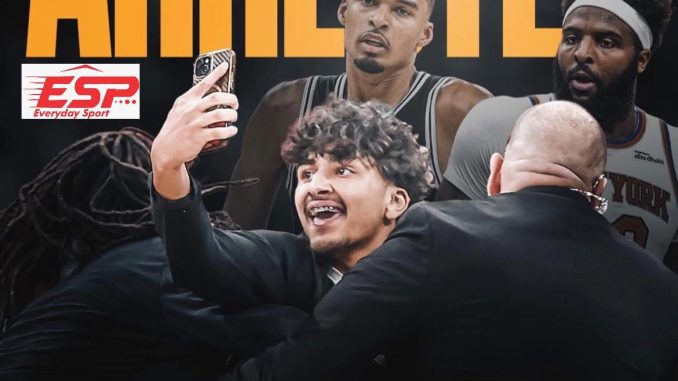
SAN ANTONIO — What was supposed to be a showcase of championship-caliber basketball in Game 1 of the NBA Finals was briefly interrupted by a moment that had nothing to do with X’s and O’s, but everything to do with security, control, and the growing tension between fan access and player safety at the sport’s biggest stage.
An NBA fan who ran onto the court during Game 1 of the Finals has been arrested and handed a lifetime ban from all NBA arenas, a league spokesperson confirmed on Thursday. In a further development that underscores the seriousness with which the league is treating the incident, another individual linked to the disruption will also receive a permanent ban from attending any NBA venue.
The incident occurred during a high-intensity stretch of the opening game between the New York Knicks and the San Antonio Spurs, a matchup already carrying the weight of legacy narratives, rising superstars, and the pressure of a Finals spotlight. But for a brief moment, the basketball stopped being the center of attention as security personnel rushed toward an individual who had managed to breach multiple layers of arena protection and make it onto the playing surface.
According to league sources, the fan entered the court area during live play, prompting immediate reaction from arena security and officials stationed along the baseline. Players on both teams were visibly alerted to the intrusion as play was halted, and security personnel quickly converged on the individual before they could make contact with any players or equipment.
While the disruption lasted only moments, its impact reverberated well beyond the immediate stoppage. The NBA has long maintained a strict policy regarding on-court interference, particularly during playoff games where emotions, stakes, and intensity are at their peak. In this case, league officials moved swiftly not only to detain the individual involved but also to implement one of the strongest disciplinary measures available: a lifetime ban from all NBA arenas.
“The safety of players, coaches, officials, and fans is our highest priority,” the league spokesperson said in confirming the disciplinary action. “Any behavior that compromises that safety or disrupts the integrity of the game will be addressed with the strongest possible response.”
The spokesperson also confirmed that a second individual connected to the incident would be subject to a permanent ban, though the league has not yet publicly detailed the nature of that person’s involvement. Early indications suggest that the second party may have assisted in planning or facilitating the breach of security, though investigations remain ongoing.
The NBA Finals are among the most heavily secured events in global sports, with multi-layered screening processes, courtside security personnel, and restricted access zones designed specifically to prevent exactly this type of disruption. That such an incident still occurred has raised immediate questions about how the individual was able to get close enough to the court to make a run toward the playing surface.
Arena officials in San Antonio have already begun reviewing security protocols, including entry-point screening procedures and the positioning of security personnel during live play. While no system is entirely foolproof, especially in high-capacity venues hosting tens of thousands of spectators, the expectation at this level of competition is near-total control of court access at all times.
The incident also reignited a familiar conversation around fan behavior in high-stakes sporting environments. While most disruptions in modern NBA arenas are minor—often limited to brief court-side intrusions or promotional stunts that are quickly contained—there remains an ever-present concern about the potential for more serious breaches that could threaten player safety or escalate into dangerous situations.
Over the past two decades, the NBA has steadily increased its security presence at games, particularly during the playoffs. High-profile incidents in other sports, including pitch invasions in soccer and court invasions in college basketball, have reinforced the importance of vigilance. Yet even with advanced surveillance systems and trained personnel stationed throughout arenas, the league continues to face the challenge of balancing an open, fan-friendly environment with strict security enforcement.
In this case, league officials acted decisively. The arrest was made on-site, and both individuals tied to the incident were removed from the arena and handed immediate bans pending further legal and administrative review. The lifetime ban from all NBA venues is among the most severe punishments available, effectively ending the individuals’ ability to attend games in person at any level of the league.
For players, the interruption was jarring but ultimately contained. Multiple reports from inside the arena indicated that athletes on both teams were quickly ushered back into focus once security regained control of the court. Coaches and officials worked in coordination to ensure that the game resumed safely, with minimal delay and no further disruption.
Still, moments like these carry an undercurrent of concern that extends beyond a single game. Players have increasingly voiced awareness of fan intrusions across sports, particularly in an era where viral moments and social media attention can incentivize risky behavior. A brief dash onto the court may seem harmless in isolation, but the potential consequences—for both the intruder and the athletes—can be severe.
League security experts often emphasize that the most dangerous moments are not necessarily prolonged incidents, but sudden, unpredictable movements that catch players mid-play. Even a harmless intention, such as attempting a selfie or seeking attention, can create chaos in an environment where athletes are moving at full speed and not expecting external interference.
The NBA has made clear in past seasons that it intends to take a zero-tolerance stance on court invasions, particularly during the postseason. In playoff settings, where stakes are heightened and arena atmospheres are more emotionally charged, even minor disruptions can have ripple effects on momentum, focus, and competitive balance.
Thursday’s announcement reinforces that position with unmistakable clarity. By issuing lifetime bans not only to the individual who entered the court but also to an associated party, the league is signaling that accountability will extend beyond the immediate act of intrusion and into any coordinated behavior that enables it.
The timing of the incident also adds a layer of sensitivity. Game 1 of the NBA Finals is traditionally one of the most watched and scrutinized events in global sports, setting the tone for the entire championship series. With the New York Knicks and San Antonio Spurs battling for early control of the series, every possession, timeout, and momentum swing is magnified under the national spotlight.
For league officials, maintaining the integrity of that stage is paramount. Any disruption, no matter how brief, risks overshadowing the on-court product and shifting attention away from the athletes and competition that define the Finals.
In the aftermath of the incident, security presence around the court is expected to be heightened for the remainder of the series. Additional personnel will likely be stationed closer to entry points, and league officials may implement further screening measures for courtside seating, which remains one of the most sensitive areas in any arena.
While fans at NBA games are encouraged to bring energy and passion, the league has repeatedly drawn a hard line when it comes to physical interference with the game itself. The message following this latest incident is consistent with that long-standing policy: there is no acceptable circumstance under which a spectator should enter the playing surface.
As the Finals continue, attention will inevitably return to basketball—matchups, adjustments, standout performances, and the pursuit of a championship. But the events of Game 1 will serve as a reminder that even on the sport’s biggest stage, the boundary between spectators and participants must remain absolute.
For the individuals involved, that boundary has now become permanent. A lifetime ban ensures they will never again experience an NBA game from inside the arena, a consequence the league hopes will serve both as punishment and deterrent.
And for the NBA, the incident stands as another test of its security infrastructure at a time when the global popularity of the game continues to grow, and with it, the challenges of keeping its most important moments safe, controlled, and focused where they belong—on the court.
Be the first to comment