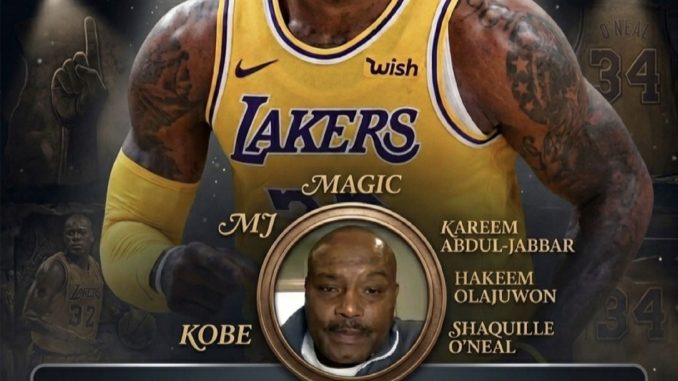
The NBA’s ever-simmering Greatest of All Time debate has flared up once again, and this time the conversation was reignited by comments from one of the league’s most respected veteran voices. Tim Hardaway Sr. has cast fresh doubt on whether LeBron James still belongs in the sport’s traditional top-five hierarchy, adding a new layer of intensity to an already polarizing discussion that refuses to fade with time.
Hardaway’s remarks, delivered during a recent media appearance, didn’t simply echo the familiar talking points that have surrounded LeBron’s legacy for years. Instead, they sharpened them. While acknowledging LeBron’s extraordinary longevity, statistical dominance, and championship résumé, Hardaway questioned whether the cumulative body of work still places him above other all-time greats when peak dominance and era-defining impact are weighed more heavily than sustained excellence alone.
The timing of Hardaway’s comments could not be more significant. LeBron continues to defy the aging curve in a way no superstar in NBA history has managed, still producing elite-level performances deep into his 20th season and beyond. Yet, even as he adds to his records and extends his all-time scoring lead, the broader narrative surrounding his place in the historical hierarchy appears to be shifting rather than settling. For every analyst or former player who elevates LeBron closer to, or even above, the likes of Michael Jordan, Kareem Abdul-Jabbar, Magic Johnson, Kobe Bryant, or Bill Russell in various combinations, there remains an equally vocal contingent that resists that elevation.
Hardaway’s stance appears rooted in that resistance. In his view, the “top five” conversation is not simply about longevity or cumulative statistics, but about peak dominance and defining a generation in a way that leaves no ambiguity. While LeBron’s résumé includes four NBA championships, multiple MVP awards, Finals MVPs across three different franchises, and unprecedented versatility across positions, Hardaway’s argument suggests that the totality of that success may still fall short when compared to the singular dominance of players who defined their eras in more concentrated bursts.
What makes the debate especially combustible is the way LeBron’s career itself challenges traditional evaluation metrics. Unlike earlier generations whose careers were often confined to a single franchise or a more rigid positional role, LeBron’s journey has been fluid and expansive. From his early days as a teenage phenom in Cleveland to his championship runs in Miami, his emotional return and title delivery to Cleveland, and his current chapter with the Los Angeles Lakers, LeBron has consistently reshaped expectations of what a superstar career can look like.
That versatility is precisely what supporters point to when defending his top-five status. They argue that no other player in NBA history has combined his level of scoring, playmaking, rebounding, defensive adaptability, and durability over such a prolonged period. His all-time scoring record is not merely a product of longevity but of sustained elite production, while his assist totals place him in rare air among primary facilitators despite being a forward for most of his career.
Yet critics like Hardaway often counter that the game is not solely about accumulation. They emphasize peak dominance, championship context, and the ability to elevate teammates in the most pressure-filled moments. In that framing, players such as Michael Jordan are often cited for their perfect Finals record and unmatched scoring titles, Kareem Abdul-Jabbar for his sustained dominance across decades and dual eras, and Magic Johnson for revolutionizing the point guard position while winning championships almost immediately upon entering the league.
Hardaway’s comments have therefore reopened a philosophical divide that has defined basketball discourse for decades: should greatness be measured by the highest peak, or the longest sustained excellence at an elite level? LeBron, more than any player before him, forces both arguments to coexist.
The reaction across the basketball community has been predictably divided. Some former players and analysts have rallied behind Hardaway’s perspective, suggesting that LeBron’s career, while unmatched in breadth, lacks the singular narrative clarity that defines the consensus top tier. Others have pushed back strongly, arguing that reducing LeBron’s accomplishments to anything outside the top five ignores the unprecedented scope of his impact on the modern game.
Part of what fuels this debate is the evolution of basketball itself. The era in which LeBron entered the league in 2003 is drastically different from the one in which many of the players commonly cited in GOAT discussions built their legacies. Pace, spacing, defensive rules, and player mobility have all shifted significantly. LeBron’s ability to dominate across these changes is often cited as evidence of adaptability, while skeptics argue that comparisons across eras are inherently flawed.
Still, LeBron’s statistical case remains one of the strongest in league history. His career totals in points, assists, and rebounds place him in a category no other player has approached simultaneously. His playoff resume is equally staggering, holding records for postseason points, Finals appearances, and multiple deep playoff runs across three franchises. Even in seasons where his teams have fallen short of championship expectations, his individual production has rarely wavered.
Hardaway’s skepticism, however, reflects a sentiment shared by a portion of former players who prioritize championship efficiency and peak dominance over volume-based achievements. In that light, LeBron’s Finals record—often scrutinized in GOAT debates—continues to serve as a focal point for criticism, despite the context of facing historically strong opponents in multiple championship series.
The broader question Hardaway’s remarks raise is whether the GOAT debate itself has become too rigid in its reliance on top-five lists. Basketball history, unlike many other sports, is uniquely layered. It spans vastly different eras, styles, and levels of competition. Attempting to compress that history into a definitive ranking often oversimplifies careers that are anything but simple.
LeBron’s case is particularly resistant to simplification. His career has not followed a linear arc but rather a series of reinventions. He entered the league as a teenage prodigy under unprecedented media scrutiny, transitioned into a championship leader alongside other stars in Miami, returned to deliver a historic title to his hometown franchise, and later extended his legacy with a championship in Los Angeles. Each phase has added complexity to his legacy rather than clarity.
Hardaway’s critique, therefore, does not necessarily diminish LeBron’s accomplishments, but it does challenge the way they are categorized. It forces a reconsideration of whether longevity-enhanced greatness should carry equal weight to peak dominance, or whether the latter should remain the defining benchmark for all-time rankings.
Within NBA front offices, coaching circles, and media analysis, this tension is familiar. Many executives privately acknowledge LeBron as the most complete player they have ever evaluated, while still stopping short of placing him above Jordan in all-time rankings. That disconnect illustrates how subjective the debate remains, even among those closest to the game.
What is clear, however, is that LeBron’s presence continues to shape not only the modern NBA but also its historical narrative. Every season he plays adds new data points to an already unprecedented résumé. Every milestone further complicates the task of comparing him to players whose careers have long been complete.
Hardaway’s comments may not ultimately change where LeBron sits in most rankings, but they do reinforce a reality that has defined his entire career: his greatness is constantly being measured, challenged, and redefined in real time. Unlike many legends whose legacies are fixed in retrospect, LeBron’s is still unfolding, still evolving, and still actively shaping the debate around it.
As the GOAT conversation continues to intensify, what remains undeniable is that LeBron James occupies a space in basketball history that no other player has ever filled. Whether that place is inside the top five, just outside it, or at the very top depends entirely on which criteria one chooses to prioritize. And as Tim Hardaway Sr.’s latest comments demonstrate, there is still no consensus—and perhaps there never will be.
Be the first to comment