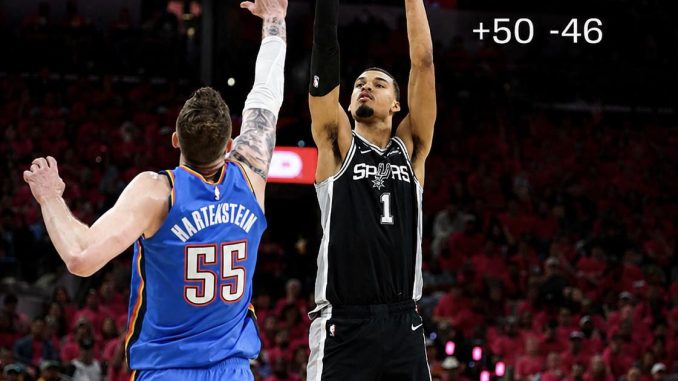
SAN ANTONIO — The Western Conference Finals have rarely felt this paradoxical, this sharply divided between what a single player is doing when he is on the floor and what happens when he is not. Yet that is exactly the storyline now defining the San Antonio Spurs’ series against the Oklahoma City Thunder, as Victor Wembanyama’s presence has morphed into something closer to a basketball split personality than a traditional superstar impact.
On one side is dominance that bends geometry, distorts defensive coverages, and forces Oklahoma City into offensive compromises they have not had to make all season. On the other is a Spurs team that, without him, has looked increasingly vulnerable, disjointed, and at times overwhelmed by the Thunder’s pace and physicality. The result is a series narrative that has shifted from matchup intrigue to something more existential: San Antonio’s fate appears to rise and fall with the gravitational pull of Wembanyama himself.
Through four games, the numbers have hardened into a stark reality. When Wembanyama is on the court, the Spurs have controlled stretches of the series with a net dominance that reflects both his rim protection and his offensive spacing effect. When he sits, the floor collapses. The Thunder, led by Shai Gilgeous-Alexander and a wave of relentless transition pressure, have consistently flipped games during those minutes, turning what should be rest periods for San Antonio’s star into momentum swings for Oklahoma City.
It has created a series inside the series: Spurs basketball with Wembanyama, and Spurs basketball without him. And the gap between those two versions has become the defining storyline of the Western Conference Finals.
Victor Wembanyama has been every bit the franchise cornerstone San Antonio envisioned when they built around him. His defensive presence alone has altered Oklahoma City’s shot profile in ways that go beyond traditional rim protection statistics. Drives that normally end at the rim are being rerouted into floaters and late-clock pull-ups. Corner threes are arriving under duress. Even the Thunder’s most confident attackers have begun to hesitate when he rotates into view, as if the air above the paint itself has been privatized.
Offensively, Wembanyama has functioned as both initiator and finisher, stretching Oklahoma City’s defensive scheme into uncomfortable shapes. The Thunder’s bigs are forced to choose between stepping out to the perimeter or surrendering clean looks at the rim. When they step out, San Antonio attacks downhill. When they stay back, Wembanyama punishes them from midrange or beyond the arc, creating a cascading effect that opens the floor for teammates who otherwise struggle to generate their own advantages.
In Game 1 and Game 2, this duality was enough to tilt possession battles in San Antonio’s favor for long stretches. Even in the Spurs’ Game 3 loss, Wembanyama’s impact was visible in the margins: defensive possessions that ended without clean looks, offensive sequences that bent Oklahoma City’s help defense into rotations they could not fully recover from.
But basketball is not played in isolation. And this series has increasingly punished San Antonio’s non-Wembanyama minutes with brutal efficiency.
When he sits, the Spurs’ identity fractures. The ball stops moving with the same purpose. Defensive rotations lose their precision. And most critically, the Thunder’s transition game begins to breathe freely.
Oklahoma City Thunder have capitalized on that breathing room with clinical consistency. Their offensive system thrives on pressure, and without Wembanyama anchoring the paint, the Spurs have been unable to contain the initial wave. Gilgeous-Alexander has exploited gaps at the top of the defense, collapsing San Antonio’s coverage before kicking out to shooters or finishing through contact in ways that swing momentum within minutes.
It is in those stretches that the series has truly tilted. Not necessarily in final score alone, but in emotional control. The Thunder have discovered that they do not need to outplay Wembanyama; they only need to survive him, then attack the minutes he is not on the floor.
The Spurs, for their part, have struggled to stabilize those non-Wembanyama possessions. The second unit, tasked with holding leads or limiting damage, has instead become a pressure point. Turnovers spike. Defensive rebounding slips. The spacing that feels so deliberate when Wembanyama orchestrates the floor becomes cramped and reactive without him.
This is where the narrative of “two Spurs” has taken hold.
With Wembanyama: a contender capable of dictating terms against one of the league’s most dynamic young teams.
Without Wembanyama: a team fighting to simply keep pace.
That contrast has not gone unnoticed inside the series. Oklahoma City’s coaching staff has leaned into rotational aggression, accelerating tempo whenever Wembanyama exits. The strategy is not subtle. It is built on endurance—forcing San Antonio to either extend its star’s minutes or risk hemorrhaging runs during his absence.
San Antonio’s response has been measured but imperfect. Head coach adjustments have attempted to stagger supporting scorers alongside Wembanyama to stabilize possession quality, but the underlying issue remains structural. Few teams in the league can withstand extended minutes without their defensive anchor, let alone in a conference finals setting against a top-tier transition offense.
Still, even within the volatility, Wembanyama’s influence has reshaped the Thunder’s calculus. Every possession against him carries extra weight. Drives are pre-planned to avoid him. Post touches are delayed or abandoned altogether. The mere threat of his presence compresses Oklahoma City’s offensive decision tree, forcing them into earlier reads and less comfortable shot profiles.
It is a rare defensive phenomenon in modern basketball: a player whose impact is felt not just in what he blocks or alters, but in what the opponent never even attempts.
Yet the Spurs’ reliance on that phenomenon has created an unavoidable tension. If Wembanyama must be everywhere for San Antonio to function, then every second he is not on the floor becomes a liability. And in a long playoff series, liabilities compound.
Game 4 crystallized this dynamic more sharply than any other contest. The Spurs were competitive, even dominant in stretches, when Wembanyama controlled both ends of the floor. But once he sat, Oklahoma City’s run began almost immediately. Defensive breakdowns turned into transition buckets. Half-court possessions devolved into rushed shots. The rhythm that defines San Antonio’s identity evaporated.
By the time Wembanyama returned, the momentum had already shifted, and the Thunder had seized control of the game’s emotional tempo. It was not a collapse so much as a gradual erosion—one possession at a time, one defensive miscue at a time, until the lead was no longer recoverable.
That pattern has become the central concern for San Antonio heading deeper into the series.
Because while Wembanyama’s dominance is undeniable, playoff basketball demands sustainability. Stars are measured not only by their peak impact, but by how their teams survive the minutes they are not in control.
And right now, that is where the Spurs are exposed.
For Oklahoma City, the blueprint is becoming clearer with each game. Stay attached to Wembanyama’s minutes. Absorb the damage. Then accelerate immediately when he rests. It is a strategy built on patience and precision, and it has already shifted the psychological balance of the series.
Still, dismissing San Antonio would be premature. A player like Wembanyama alters series math in ways that can break conventional logic. One extended dominant stretch, one game where supporting players stabilize the non-Wembanyama minutes, and the entire narrative can flip again.
That is the paradox of this matchup: the Spurs are both overmatched and uniquely positioned to control the series through a single player who bends the structure of the game itself.
As Game 5 approaches, the question is no longer whether Wembanyama can dominate. He already is. The question is whether the Spurs can survive the moments when he is not dominating the floor.
Because against Oklahoma City, those moments have proven just as decisive.
And until San Antonio solves that imbalance, the Thunder will continue to find oxygen in the very gaps that define the Spurs’ second identity—one that exists only in the absence of their generational anchor, and one that may ultimately decide the fate of the Western Conference Finals.
Be the first to comment