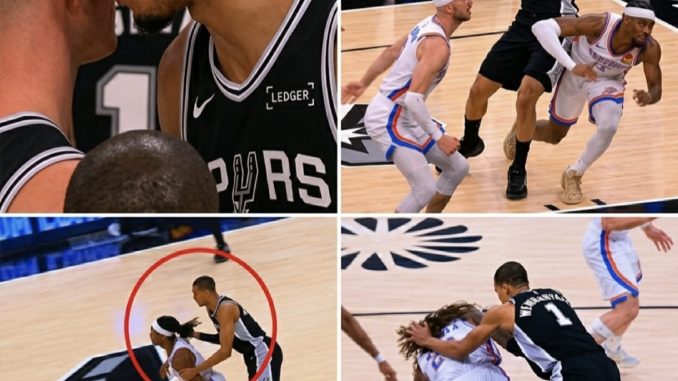
The Western Conference Finals shifted from high-level basketball to all-out warfare Friday night in San Antonio, where Victor Wembanyama and the Spurs delivered a bruising response to weeks of criticism surrounding physical play, officiating controversies, and accusations of flopping by the Oklahoma City Thunder. By the final buzzer of a chaotic Game 6, the scoreboard almost felt secondary to the emotion, hostility, and intimidation tactics that defined one of the most heated playoff battles in recent NBA memory.
The Spurs entered the night facing enormous pressure. With Oklahoma City threatening to close out the series and advance to the NBA Finals, San Antonio understood the margin for error had disappeared. But instead of approaching the game with desperation alone, the Spurs came out with something far more noticeable: controlled anger.
From the opening possession, every screen was harder, every drive more crowded, and every Thunder touch contested with playoff-level force. The tone was unmistakable. If Oklahoma City was going to continue benefiting from what many around San Antonio viewed as soft whistle calls throughout the series, then the Spurs were determined to make every foul count physically.
No player embodied that message more than Wembanyama.
The 7-foot-4 superstar was everywhere — barking instructions defensively, contesting shots with fury, battling for rebounds through traffic, and engaging in constant physical exchanges with Thunder players. Social media erupted early in the first quarter when television cameras appeared to catch Wembanyama directing teammates toward more aggressive defensive pressure after another foul call went against San Antonio.
Within minutes, Game 6 transformed into something closer to a street fight than a basketball game.
Every Thunder drive into the lane became a collision course. Shai Gilgeous-Alexander absorbed repeated bumps while navigating double teams. Lu Dort found himself tangled with Spurs players on multiple possessions, including one controversial sequence in which Wembanyama appeared to grab at Dort’s hair during a loose-ball scramble near the baseline. The officials reviewed the play briefly but opted not to assess a flagrant foul, a decision that only intensified frustrations on the Oklahoma City bench.
The loudest reactions, however, came from the crowd whenever rookie forward Carter Bryant entered the action.
Bryant, already developing a reputation for fearless defensive energy throughout the postseason, played like a man completely unconcerned with playoff nerves. Midway through the second quarter, he bulldozed through Gilgeous-Alexander on consecutive possessions, sending the Thunder star crashing to the floor both times. The Paycom Center crowd watching remotely exploded online, while the home fans in San Antonio roared their approval inside Frost Bank Center.
Thunder players immediately surrounded officials after the second collision, demanding harsher punishment. Instead, referees ruled both plays common fouls, allowing the game’s intensity to continue spiraling.
What made the atmosphere even more volatile was the growing narrative surrounding Oklahoma City’s style of play throughout the series. Spurs players and fans had quietly complained for days that the Thunder were receiving favorable whistles through exaggerated contact and theatrical reactions. While San Antonio publicly avoided directly accusing Oklahoma City of flopping, Game 6 looked very much like a team attempting to expose what they believed was an imbalance in officiating.
And they did it with unapologetic force.
“We wanted them to feel us tonight,” one Spurs player reportedly told reporters near halftime. “Every possession.”
That mentality showed itself possession after possession. Wembanyama met drivers at the rim with violent contests. Devin Vassell fought over every screen as if the season depended on it. Jeremy Sochan threw his body into rebounds with reckless abandon. Even San Antonio’s bench players entered the game appearing fully committed to turning every Oklahoma City touch into a battle.
The Thunder, to their credit, refused to back down.
Gilgeous-Alexander answered with poise despite absorbing relentless punishment. Every time the Spurs threatened to overwhelm Oklahoma City emotionally, the MVP candidate responded with timely baskets and calm decision-making. He attacked traps, absorbed contact, and repeatedly silenced the crowd with clutch midrange jumpers.
But frustration was clearly building.
Late in the second quarter, Dort and Sochan exchanged words following another physical rebound sequence that nearly escalated into a full confrontation near the scorer’s table. Coaches and teammates quickly intervened before things crossed the line completely, but the message was clear: basketball had become personal.
The officials struggled all night to maintain control. Whistles interrupted nearly every stretch of momentum, yet paradoxically, the physicality continued escalating. Players on both sides complained constantly, while coaches spent much of the evening gesturing angrily toward referees.
At the center of it all stood Wembanyama.
The young superstar played with a level of edge rarely seen during his early NBA career. Known primarily for his skill, finesse, and generational versatility, Wembanyama embraced the uglier side of playoff basketball in Game 6. He battled for deep post position, delivered hard fouls when necessary, and celebrated defensive stops with visible emotion.
One sequence midway through the third quarter perfectly captured the night’s energy.
After blocking a Gilgeous-Alexander layup attempt into the stands, Wembanyama sprinted back downcourt screaming toward the crowd before colliding shoulder-to-shoulder with Chet Holmgren in transition moments later. Neither player backed away. Both exchanged words before officials separated them.
The arena felt ready to explode.
Fans inside Frost Bank Center sensed their team feeding off the chaos. Every hard foul generated louder cheers. Every Thunder complaint drew mocking reactions from the crowd. San Antonio wasn’t simply trying to win Game 6 — they were attempting to impose psychological pressure on a young Oklahoma City roster suddenly facing genuine hostility.
For stretches, it worked.
The Thunder offense appeared rattled by the constant collisions and emotional pressure. Oklahoma City committed several uncharacteristic turnovers in the third quarter, many stemming from rushed decisions against San Antonio’s aggressive traps and physical perimeter defense.
Meanwhile, the Spurs fed off the energy.
Wembanyama dominated both ends during a critical third-quarter stretch, swatting shots into the crowd while finishing through heavy contact offensively. Bryant continued delivering hard-nosed minutes defensively, while Keldon Johnson provided emotional firepower off the bench.
But as intense as the basketball became, the conversation surrounding Game 6 quickly evolved into something larger: had the Spurs crossed the line?
Across social media and television broadcasts, reactions became sharply divided. Some praised San Antonio for matching Oklahoma City’s perceived gamesmanship with old-school playoff toughness. Others accused the Spurs of intentionally turning the game dangerous.
The debate centered largely around intent.
Were the Spurs simply playing playoff basketball at maximum intensity, or were they deliberately trying to intimidate and punish the Thunder physically?
The answer likely depends on perspective.
From San Antonio’s viewpoint, the Spurs were responding to weeks of frustration. They believed Oklahoma City had benefitted from lighter contact whistles throughout the series, and they decided the only response was to eliminate any ambiguity. If fouls were going to be called regardless, then San Antonio would ensure every foul carried consequences physically.
From Oklahoma City’s side, however, the Spurs appeared dangerously close to abandoning basketball entirely in favor of intimidation.
Thunder coach Mark Daigneault spent much of the second half visibly furious with officials. Multiple Oklahoma City players repeatedly held conversations with referees during dead balls, while television cameras captured assistant coaches pleading for greater control of the game.
Yet despite the tension, the basketball itself remained extraordinary.
Wembanyama delivered one of the grittiest playoff performances of his career, combining elite defense with emotional leadership. Gilgeous-Alexander answered every run with superstar composure. Holmgren battled through contact inside. Vassell knocked down crucial perimeter shots. Every possession carried postseason intensity.
The fourth quarter elevated the chaos even further.
With the season hanging in the balance for San Antonio, every defensive stop triggered playoff-level celebrations. Every whistle generated outrage from one side or the other. Players routinely needed separating after dead-ball situations.
Then came perhaps the defining moment of the night.
With under five minutes remaining, Wembanyama rotated over to contest another Thunder drive and delivered a thunderous block that sent both players crashing to the floor. As Oklahoma City players argued for a foul, Wembanyama stood over the play screaming in celebration before teammates rushed toward him.
The crowd erupted into complete madness.
Moments later, Dort committed a hard foul in transition that nearly sparked another altercation near midcourt. Officials immediately intervened before reviewing the sequence for possible flagrant penalties.
By that stage, Game 6 felt less like a basketball contest and more like an emotional endurance test.
The Spurs thrived in it.
San Antonio’s defensive identity fully emerged under pressure, with Wembanyama anchoring one of the most physically dominant performances of the postseason. The Spurs challenged every pass, every drive, and every rebound with playoff desperation.
And perhaps most importantly, they never backed down emotionally.
For a young Spurs team still developing playoff experience, Game 6 represented a statement about mentality as much as talent. San Antonio showed it could survive ugly postseason basketball, respond to controversy, and embrace physical warfare when necessary.
Whether the league office will view certain moments differently remains to be seen.
Several sequences from the game are certain to draw review, particularly the hair-grab incident involving Wembanyama and Dort, along with multiple hard collisions involving Bryant and Gilgeous-Alexander. Given the emotional volatility throughout the night, additional fines or warnings would hardly be surprising.
Still, inside San Antonio’s locker room, the focus remained simple: survival.
The Spurs entered Game 6 facing elimination and responded with force, emotion, and unapologetic aggression. They transformed the series atmosphere entirely and reminded Oklahoma City that playoff basketball often extends beyond pure skill.
It becomes psychological.
It becomes emotional.
It becomes personal.
And on Friday night, nobody embodied that reality more than Wembanyama.
The 21-year-old phenom didn’t merely dominate statistically or defensively. He controlled the emotional temperature of the entire arena. Every gesture, every block, every collision, and every confrontation carried weight.
That’s what superstars do in defining playoff moments.
Whether critics view his approach as inspirational toughness or reckless aggression, one thing became undeniable by the end of Game 6: Wembanyama has fully arrived as the emotional centerpiece of postseason basketball.
For Oklahoma City, the challenge now becomes responding mentally as much as physically. The Thunder remain one of the NBA’s most talented young teams, but Game 6 exposed how quickly playoff basketball can evolve into something far nastier than regular-season rhythm and spacing.
The Spurs made certain of that.
San Antonio didn’t just extend its season Friday night. It dragged the Thunder into a fight.
And as the final buzzer sounded following one of the most chaotic playoff games of the year, the lasting image wasn’t simply the score or the series implications.
It was Wembanyama standing near center court, chest heaving, emotions boiling over, surrounded by exhausted teammates after 48 minutes of basketball violence that felt destined to be remembered long after this series ends.
Be the first to comment