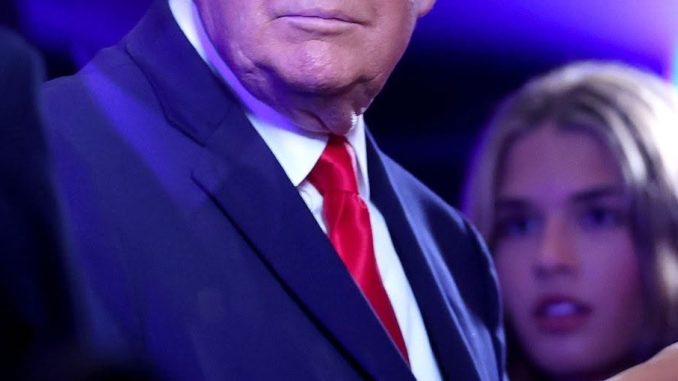
President Donald Trump added another unprecedented chapter to the intersection of politics and sports Monday night, becoming the first sitting United States president to attend an NBA Finals game when he arrived at Madison Square Garden for Game 3 between the San Antonio Spurs and New York Knicks.
The historic appearance immediately became one of the defining storylines surrounding the NBA’s championship stage, drawing attention from basketball fans, political observers, and historians alike. While American presidents have long been associated with major sporting events—from ceremonial first pitches at Major League Baseball games to appearances at college football contests and championship celebrations at the White House—none had ever attended an NBA Finals game while actively serving in office.
Trump’s arrival at Madison Square Garden generated a wave of excitement throughout the iconic arena, which was already buzzing as New York hosted its first Finals game in decades. The atmosphere surrounding the event reflected the significance of the moment, with heightened security measures, a packed celebrity crowd, and a national audience watching one of the most anticipated games of the year.
Accompanying the president were several members of his administration and family, including Interior Secretary Doug Burgum, EPA Administrator Lee Zeldin, Transportation Secretary Sean Duffy, granddaughter Kai Trump, and senior adviser Jared Kushner. Their presence underscored the significance the administration attached to the occasion as the NBA Finals became the latest major sporting event to feature a sitting president in attendance.
Madison Square Garden has long been regarded as one of the most famous arenas in sports, hosting countless historic basketball moments, championship fights, concerts, and political gatherings. Yet even within its rich history, Monday night represented something unique. The arena has welcomed former presidents, world leaders, and countless celebrities over the years, but never before had it hosted a sitting U.S. president during an NBA Finals contest.
The game itself carried enormous significance before Trump ever entered the building. The Knicks, seeking their first NBA championship in generations, were hosting a Finals game in New York for the first time in decades. Fans had waited years for the opportunity to witness championship basketball at Madison Square Garden, and the atmosphere reflected that anticipation from the moment doors opened.
As spectators filed into the arena hours before tipoff, conversations frequently centered on both the championship stakes and the historic nature of the presidential visit. Security around the building was noticeably enhanced, with federal, local, and league officials coordinating efforts to ensure the event proceeded smoothly.
The NBA has often occupied a unique place within the broader American cultural landscape. Unlike many professional sports leagues, it has frequently served as a platform where sports, entertainment, social issues, and politics intersect. Players have used their visibility to advocate for causes, owners have weighed in on national debates, and league executives have navigated issues extending far beyond basketball.
Trump’s relationship with professional sports has also been well documented throughout his public life. Long before entering politics, he was associated with major sporting events and athletes. During his political career, he has attended football games, UFC events, college sporting contests, and other high-profile competitions. Yet the NBA Finals remained a notable absence from that list until Monday night.
His attendance also comes against the backdrop of a complicated history between Trump and portions of the basketball community. Throughout both of his presidencies, various NBA players, coaches, and executives have expressed differing opinions regarding his policies and leadership. At the same time, others within the sports world have maintained relationships with the president or supported his initiatives.
Despite those past dynamics, the focus Monday night remained largely on the championship matchup and the historic nature of the attendance. Fans throughout the arena reacted when Trump appeared on video boards and was shown to the crowd. As is often the case during appearances by prominent political figures at sporting events, reactions varied across the audience, reflecting the diverse viewpoints represented among the nearly 20,000 fans in attendance.
For the NBA, the evening represented another reminder of the league’s growing cultural influence. The Finals have increasingly become must-watch events that extend beyond basketball, attracting celebrities from film, music, business, and politics. The presence of a sitting president only reinforced the significance of the league’s championship showcase.
Players from both teams attempted to maintain their focus on the court despite the extraordinary circumstances surrounding the event. Championship basketball requires a level of concentration that leaves little room for distractions, and both the Spurs and Knicks entered the game understanding the magnitude of the opportunity before them.
The Spurs, led by a young and talented core, arrived in New York looking to regain momentum in the series. The Knicks, meanwhile, sought to capitalize on their home-court advantage and move closer to a championship that their passionate fan base has dreamed about for decades. Against that backdrop, Trump’s attendance became part of the spectacle rather than the central focus for those competing on the floor.
The significance of the moment extends beyond a single game. Presidential appearances at sporting events often serve as markers of cultural relevance. Historically, presidents have gravitated toward events that capture national attention, and few sporting occasions command a larger audience than the NBA Finals.
The league’s championship series has evolved into one of the most watched annual sporting events in North America. Millions tune in across television and digital platforms, while international audiences follow the action from around the globe. The NBA’s reach continues to expand internationally, making the Finals a truly global event.
Trump’s decision to attend highlights that visibility. By appearing at Game 3, he inserted himself into a sporting event that attracts attention far beyond traditional political circles. The move also reflects the continued importance of sports as a unifying element within American society, where fans from different backgrounds gather to share a common experience.
Throughout American history, presidents have frequently recognized the symbolic value of sports. From throwing ceremonial first pitches to honoring championship teams, athletic competition has often provided opportunities for leaders to connect with the public in informal settings. Sporting events can transcend political divisions, creating moments where shared enthusiasm takes precedence over partisan differences.
Madison Square Garden provided the perfect stage for such a moment. Known worldwide as “The World’s Most Famous Arena,” the venue has hosted countless unforgettable occasions across multiple generations. Monday night added another chapter to that history, combining championship basketball with a presidential first.
The attendance also generated significant discussion across social media platforms, where fans, journalists, and public figures reacted in real time. Images and videos of Trump arriving at the arena quickly circulated online, further amplifying the historic nature of the event.
Within NBA circles, the conversation centered on what the moment said about the league’s standing in American culture. Decades ago, professional basketball occupied a different place in the sports hierarchy. Today, the NBA sits among the nation’s most influential sports properties, capable of attracting audiences that include everyone from celebrities and business leaders to heads of state.
That growth has been fueled by generations of stars who helped elevate the league’s profile. From legends such as Michael Jordan, Magic Johnson, and Larry Bird to modern icons like LeBron James and Stephen Curry, the NBA has transformed into a global entertainment powerhouse.
The Finals represent the culmination of that evolution. Every June, the championship series captures widespread attention, bringing together sports fans, celebrities, media figures, and now, for the first time, a sitting president.
As the game unfolded, the historical significance of Trump’s presence remained evident. Regardless of political affiliation or basketball loyalties, those inside Madison Square Garden witnessed something that had never happened before in the league’s nearly eight-decade history.
Moments like these often become footnotes in broader sports history, remembered years later as part of the context surrounding a championship series. Future NBA Finals will undoubtedly feature celebrity attendees, prominent public figures, and perhaps even other presidents. But Trump’s appearance ensured that Game 3 of the 2026 NBA Finals will forever hold a unique distinction.
For the Knicks and Spurs, the primary objective remained the pursuit of a championship. Yet beyond the competition on the court, the evening demonstrated how sports can serve as a stage for historic milestones that extend beyond wins and losses.
As fans departed Madison Square Garden following the game, many reflected on more than just the final score. They had witnessed a convergence of sports, politics, history, and culture unlike anything previously seen at an NBA Finals contest. Whether remembered for the basketball, the atmosphere, or the unprecedented attendance of a sitting president, Game 3 secured its place in the record books.
Trump’s appearance marked a milestone not only for the presidency but also for the NBA itself. The league has spent decades growing into a global phenomenon, and the presence of the nation’s highest elected official at its championship showcase served as another indicator of that influence. In a venue already steeped in history, on a night already overflowing with significance, the NBA Finals added yet another first to its legacy—one that will be remembered long after the final buzzer sounded.
Be the first to comment