The political arena and the sports world often intersect in unexpected ways, particularly when discussions turn to winning percentages, streaks, momentum, and the ability to influence outcomes. While athletes and coaches are typically judged by their records on the court, elected officials and political figures are often evaluated through election results and public support. In that regard, former U.S. President Donald Trump continues to build a remarkable record when it comes to one particular metric: the success rate of candidates he endorses.
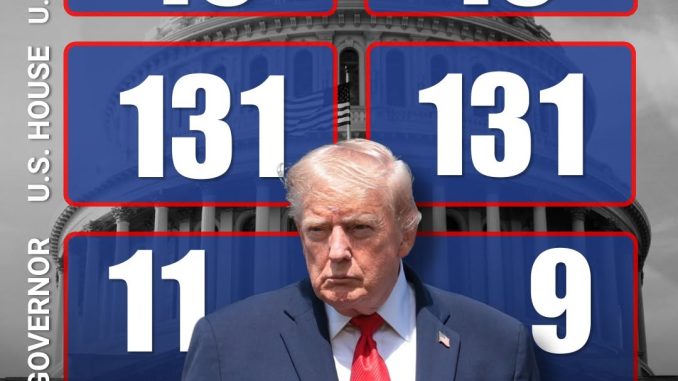
Following Tuesday night’s primary elections, Trump’s endorsement record added another chapter to what supporters describe as one of the most dominant streaks in modern American politics. According to the latest results, candidates who received Trump’s backing emerged victorious in 156 of the 158 races in which he offered an endorsement, producing a success rate that sits just shy of 99 percent.
Numbers like that are rare in any competitive environment. Whether examining professional sports, business leadership, or political campaigns, sustaining a winning percentage at such a high level across more than 150 contests is an achievement that naturally attracts attention. For many political observers, the latest results reinforce the continuing influence Trump maintains within the Republican Party and among a significant segment of the American electorate.
Tuesday’s primaries were viewed by many analysts as another test of Trump’s political strength. Every election cycle presents new challenges, changing voter priorities, and different regional dynamics. Yet once again, the majority of candidates who carried his endorsement crossed the finish line successfully, extending a trend that has become one of the most closely watched storylines in contemporary American politics.
The significance of endorsements has long been debated. Political endorsements can provide candidates with increased visibility, fundraising opportunities, media attention, and credibility among voters. However, endorsements alone do not guarantee success. Campaigns still require organization, messaging, voter outreach, and strong local support. That reality makes Trump’s endorsement record even more notable to many observers, as the consistency of the results suggests that his backing continues to resonate strongly with Republican primary voters.
Much like a championship-caliber team establishing a culture of winning, Trump’s endorsement history has developed into a narrative of its own. Every new race becomes another opportunity for supporters and critics alike to measure the extent of his influence. When endorsed candidates win, advocates point to the results as evidence that his political standing remains powerful. When endorsed candidates lose, opponents argue that those defeats reveal limitations to his reach. With only two losses among 158 endorsed races, however, the numbers continue to favor those who believe his influence remains substantial.
The comparison to sports becomes difficult to ignore when examining the raw statistics. In professional basketball, a team winning nearly 99 percent of its games over an extended stretch would be considered historically dominant. Even the greatest dynasties in NBA history never approached that level of consistency over a comparable sample size. While politics and sports operate under very different circumstances, the concept of sustained success remains a common language understood by both worlds.
Supporters of Trump were quick to celebrate the latest victories, highlighting the endorsement record as proof that voters continue to trust his judgment when selecting candidates. Many argued that the results demonstrate not only personal popularity but also an ability to identify contenders capable of connecting with Republican voters in competitive races.
Critics, meanwhile, have pointed out that many endorsed candidates entered their races as favorites, making victory more likely regardless of who endorsed them. They contend that endorsement statistics do not always capture the full complexity of political campaigns and caution against viewing the numbers in isolation. Nevertheless, even critics acknowledge that maintaining such a successful track record across so many races is difficult to dismiss outright.
Throughout American political history, endorsements from prominent figures have often played important roles in shaping election outcomes. Presidents, governors, senators, and influential party leaders have frequently used endorsements to help preferred candidates gain momentum. Few, however, have generated the same level of attention around endorsement records as Trump has in recent years.
His endorsements have become major campaign events in their own right. Candidates routinely highlight Trump’s support in advertisements, fundraising appeals, campaign rallies, and social media messaging. In many Republican primaries, securing his endorsement can instantly elevate a campaign’s profile and attract national media coverage.
That dynamic was once again evident during the latest round of primary contests. Candidates endorsed by Trump entered election day carrying the weight of that support, and the results largely followed the pattern that has become increasingly familiar. One victory after another added to an already impressive record, further strengthening the narrative that Trump remains one of the Republican Party’s most influential figures.
Political strategists often emphasize that momentum matters. In sports, a winning streak can boost confidence, energize fan bases, and create a psychological edge over opponents. Politics can function similarly. Every successful endorsement adds another data point supporting the perception of influence and effectiveness. That perception, in turn, can encourage future candidates to seek endorsements while reinforcing confidence among supporters.
For Republican candidates considering future campaigns, Trump’s endorsement record is likely to remain a significant factor. Many aspiring officeholders view his support as a valuable asset that can help differentiate them from opponents in crowded primary fields. The latest results are unlikely to change that calculation. If anything, they may strengthen the belief that securing his endorsement remains one of the most important objectives for candidates seeking Republican nominations.
The broader implications extend beyond individual races. Endorsements often help shape the ideological direction of political parties by elevating certain candidates and policy priorities. When an endorsement carries substantial influence, it can affect not only who wins elections but also the future identity and leadership structure of the party itself.
As the Republican Party continues preparing for upcoming elections, Trump’s role remains a central topic of discussion. His endorsement success rate provides tangible evidence for those who argue that he continues to hold significant sway over the party’s grassroots voters. Every new primary serves as another measurement of that influence, and the latest numbers suggest little evidence of decline.
The political landscape, of course, is constantly evolving. Voter concerns shift. New candidates emerge. Unexpected events reshape campaigns. What appears dominant today may face challenges tomorrow. Yet the current endorsement record stands as one of the most impressive statistical achievements in contemporary politics.
For campaign professionals, the numbers also present an intriguing case study. Understanding why endorsed candidates continue to succeed at such a high rate has become an area of interest for strategists across the political spectrum. Some attribute the success to Trump’s personal popularity among Republican voters. Others point to his ability to command media attention and drive campaign narratives. Many believe the explanation lies in a combination of factors rather than any single element.
Whatever the underlying reasons may be, the outcomes remain difficult to dispute. Winning 156 of 158 races represents a level of consistency rarely seen in highly competitive environments. Each election involves unique local conditions, distinct voter demographics, and varying political challenges. Yet despite those differences, the overall trend has remained remarkably steady.
In sports journalism, records often tell stories more effectively than words alone. A championship banner, a winning streak, or a statistical milestone can capture years of effort and achievement in a single number. In the political world, Trump’s endorsement record has become one of those defining statistics. Supporters view it as proof of enduring influence. Opponents see it as a challenge they must overcome. Neutral observers recognize it as an important indicator of his standing within the Republican Party.
Tuesday night’s primary results added another successful chapter to that ongoing story. With 156 victories in 158 endorsed races, the streak remains intact, and the conversation surrounding Trump’s influence is likely to continue intensifying as future elections approach.
As campaigns begin looking ahead to the next wave of contests, attention will once again focus on where Trump chooses to lend his support. Candidates will seek endorsements, voters will evaluate their choices, and political analysts will scrutinize every result. For now, however, the latest numbers speak loudly.
The scoreboard shows another successful night for Trump-backed candidates, another addition to an already impressive record, and another reminder that in the highly competitive world of American politics, few endorsement streaks have generated as much attention—or produced as many victories—as the one currently associated with Donald Trump. With nearly a 99 percent success rate across 158 races, the former president’s endorsement power remains one of the most significant forces shaping Republican primary elections, and Tuesday’s results provided the latest evidence that his influence continues to translate into victories at the ballot box.
Be the first to comment