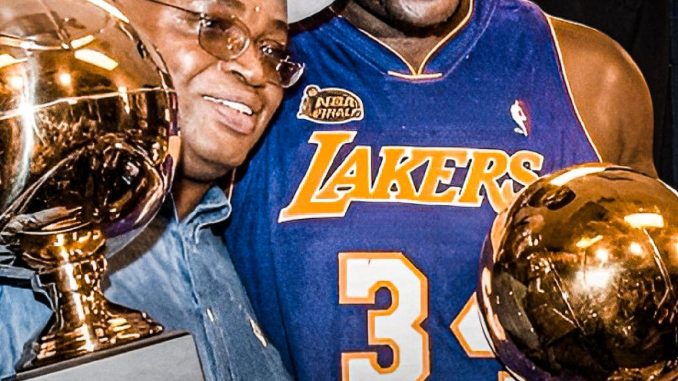
The lights inside Madison Square Garden had a way of swallowing everything in sight, even the confidence of giants. For a young Shaquille O’Neal, stepping onto that floor for his first true confrontation with the weight of New York basketball was not just a debut moment—it was a collision between expectation and reality, between raw talent and an atmosphere that demanded instant dominance. Long before he became a two-time champion and one of the most unstoppable forces in NBA history, Shaq experienced something in that building that would stay with him far longer than the box score: pressure in its purest form.
Years later, reflecting on that night and the emotional lesson that followed, Shaquille O’Neal would trace much of his mental toughness back to an unexpected source—his army stepfather, a strict disciplinarian who instilled in him a definition of pressure that had nothing to do with basketball arenas or roaring crowds. It was a definition built on responsibility, discipline, and accountability, one that would ultimately reshape how he viewed failure, especially in hostile environments like New York.
That early matchup against the New York Knicks, led by the towering presence of Patrick Ewing, became the crucible in which those lessons were tested. It wasn’t just a game—it was an initiation.
Shaq’s arrival in the league had already been accompanied by immense hype. He was supposed to be the next dominant big man, a franchise-altering force who would shift the balance of power wherever he landed. But Madison Square Garden has never been a place for patience. It is a stage where reputations are either validated or questioned within minutes, where rookies are not eased in but examined under a microscope that magnifies every weakness.
On that night, Shaq felt every ounce of it.
The Knicks’ defense was physical, deliberate, and unrelenting. Ewing anchored the paint with veteran poise, refusing to yield space or comfort. Every time Shaq touched the ball, he was met with resistance that felt personal. The crowd reacted not just to plays but to body language, to hesitation, to the smallest sign that the young big man might not yet belong in that environment.
For Shaq, it was overwhelming in a way he had not fully anticipated. He had dominated at every previous level of basketball, but this was different. The pace was sharper, the contact more intentional, and the psychological warfare unmistakable. Every missed shot was met with noise that seemed to echo beyond the arena. Every defensive stand by Ewing felt like a statement directed not just at the game, but at his arrival in it.
And for the first time in his basketball life, Shaq left a court not simply disappointed, but unsettled.
In later reflections, he would admit that what made that night so difficult was not just the performance, but the feeling that he had been emotionally unprepared for the weight of expectation. The Garden didn’t just test his skills—it tested his identity.
That is where his stepfather’s influence entered the story in a way Shaq did not fully understand at the time. Raised under the structure of military discipline, Shaq had grown up hearing a version of pressure that did not involve arenas or fans. His stepfather’s version of pressure was about survival, responsibility, and control under strict conditions. It was about showing up regardless of comfort, regardless of emotion, regardless of circumstance.
“You don’t get to choose when pressure shows up,” was the essence of what Shaq later recalled. “You only choose how you respond to it.”
At the time of that Knicks debut, those words had not yet fully matured in his mind. But the experience at Madison Square Garden forced them to surface. The loss, the frustration, and the overwhelming intensity of the environment created a mental checkpoint that Shaq would revisit repeatedly throughout his career.
He began to realize that what he experienced against the Knicks was not failure—it was exposure. It revealed the gap between physical talent and emotional readiness. It showed him that dominance in basketball required more than strength and skill; it required a psychological armor that could withstand environments designed to break rhythm and confidence.
The Knicks, in that era, were built precisely for that purpose. Their identity was defense, toughness, and control. With Ewing as their centerpiece, they represented a standard that demanded opponents earn every inch. Against Shaq, that identity was amplified. They were not just trying to win; they were trying to test whether the league’s newest phenom could survive a night where nothing came easy.
Shaq did not.
But he learned.
What followed that experience was not retreat, but transformation. In later matchups, Shaq returned to New York with a different presence. The hesitation that once surfaced in crowded paint defenses was replaced by decisiveness. The emotional weight that once slowed him down was replaced by acceptance of the chaos. He no longer viewed Madison Square Garden as a place where pressure was imposed on him, but as a place where pressure was expected—and therefore neutralized.
That shift did not happen overnight. It was gradual, shaped by repetition, film study, and an evolving understanding of how mental resilience operates at the highest level of sport. But the foundation of that transformation, Shaq would argue, was laid in that first encounter with Ewing and the Knicks.
Patrick Ewing himself represented a different kind of lesson. A veteran star with years of experience in the league, Ewing played with a calm authority that contrasted sharply with Shaq’s early volatility. He did not need to dominate emotionally; he controlled the game through positioning, timing, and discipline. Every possession was deliberate. Every defensive stand was measured.
For Shaq, that contrast was eye-opening. It revealed that greatness did not always look like force—it could also look like control. And in that realization, another layer of his development began to form.
As Shaq’s career progressed, he would go on to dominate the league in ways few centers ever have. Championships, MVP honors, and historic playoff performances would define his legacy. But beneath all of it was a mindset forged in early discomfort, shaped by military discipline at home and sharpened under the brightest lights in basketball.
When he speaks about pressure now, it is not with fear or hesitation. It is with familiarity. He often reflects on the idea that pressure is not something to be avoided, but something to be understood. And for him, understanding began in moments where he was not yet ready, in arenas where he was not yet fully formed, and against opponents who represented the standard he would eventually surpass.
Madison Square Garden remains central to that story. Not because it broke him, but because it introduced him to the version of himself that still needed development. It was there that he first learned that talent alone does not shield a player from the emotional reality of the NBA. It must be built into something stronger.
The army stepfather’s lessons and the Knicks’ intensity became intertwined in Shaq’s memory, forming a dual blueprint for how to approach adversity. One taught structure, discipline, and accountability. The other delivered real-world pressure in its most public form.
Together, they shaped a player who would eventually redefine dominance in the league.
Looking back, Shaquille O’Neal does not describe that night with regret. Instead, he frames it as necessary. The kind of experience that cannot be replicated in practice or simulated in training camps. The kind that forces a young athlete to either adjust or fade.
He adjusted.
And in doing so, he turned a difficult debut against the Knicks and Patrick Ewing into one of the earliest chapters of a career built not just on physical supremacy, but on mental evolution.
In the end, what Madison Square Garden revealed was not a limitation in Shaq’s game, but a gap in his preparation. And once that gap was exposed, it became impossible to ignore. It became the foundation for everything that followed.
Pressure, as his stepfather taught him, was never the enemy. It was the teacher. And for Shaquille O’Neal, the lesson began in New York, under lights too bright for comfort, against a team built to test everything he thought he knew about himself.
Be the first to comment