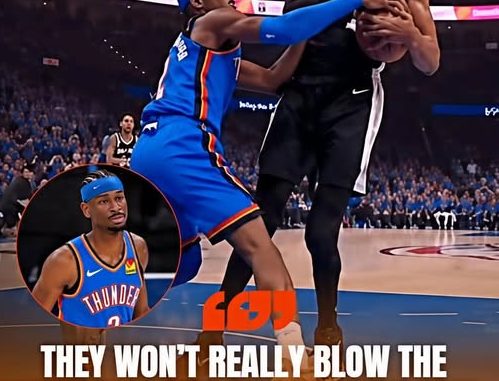
Shai Gilgeous-Alexander did not hide his frustration after Game 1, delivering a pointed postgame assessment that centered on what he believed were missed foul calls that disrupted his rhythm and ultimately altered the flow of a tightly contested playoff opener. The Oklahoma City Thunder star, typically composed in his postgame remarks, struck a noticeably more candid tone as he addressed reporters, suggesting that the officiating consistency—or lack thereof—played a significant role in how the game unfolded down the stretch.
The Thunder entered Game 1 with high expectations, riding the momentum of a strong regular season and carrying the confidence of a group that has built its identity around pace, defensive pressure, and the steady offensive leadership of Gilgeous-Alexander. From the opening tip, Oklahoma City looked engaged, pushing tempo early and attacking the paint with intent. Gilgeous-Alexander in particular set the tone, probing the defense with his usual blend of hesitation moves, controlled acceleration, and footwork that has made him one of the most difficult guards to contain in isolation situations.
But as the game progressed, the physicality increased, and the whistle tightened—or, from the Thunder perspective, disappeared in key moments. Gilgeous-Alexander absorbed contact on multiple drives that went uncalled, according to both his in-game reactions and his postgame comments. Those sequences, he suggested, did more than just deny him free-throw opportunities; they disrupted the rhythm of Oklahoma City’s half-court offense and forced the team into tougher, more contested shots than they would normally settle for.
“You try to adjust to how the game is being called, but when the contact is consistent and it’s not being called consistently, it changes how you can play,” Gilgeous-Alexander said after the game, reflecting on the physical tone of the matchup. His frustration was not framed as a blanket criticism of officiating, but rather as an appeal for consistency, particularly in high-stakes playoff environments where every possession carries amplified importance.
Throughout the night, Oklahoma City’s offensive structure often depended on Gilgeous-Alexander’s ability to bend the defense. When he gets downhill and forces help defenders to collapse, the Thunder’s perimeter shooters benefit from cleaner looks. However, when he is absorbed by contact without a whistle, defenses are able to recover more effectively, shrinking passing lanes and forcing Oklahoma City into late-clock scenarios. That shift was evident in the second and third quarters, when the Thunder’s offensive efficiency dipped as possessions became more stagnant and isolation-heavy.
The opposing defense, meanwhile, deserves credit for its disciplined approach. They crowded Gilgeous-Alexander’s driving lanes, used length to contest without fouling—or at least without being called for fouls—and consistently made him finish through traffic. The strategy was clear: force Oklahoma City’s secondary creators to beat them rather than allowing Gilgeous-Alexander to dictate the game entirely. For stretches, it worked.
Still, the Thunder star maintained that the difference in whistle timing had a psychological and tactical impact. When a player of his usage rate and offensive responsibility feels that contact is going unrecognized, it can subtly change decision-making. Instead of fully committing to contact in the paint, players may begin to fade away from the rim, alter angles, or rush decisions to avoid taking hits without reward. Over the course of a playoff game, those micro-adjustments compound.
Oklahoma City head coach Mark Daigneault offered a measured response when asked about his star’s comments. While he did not directly criticize the officiating crew, he acknowledged the challenge of adapting to playoff physicality. He emphasized that the Thunder must maintain composure regardless of how the game is called and focus on controlling what they can—execution, spacing, and defensive discipline.
“It’s a physical series, and that’s how playoff basketball goes,” Daigneault said. “We have to be able to play through it, adjust, and stay consistent in how we approach the game.”
Behind the frustration, however, lies a broader reality that the Thunder are confronting as a young contender in a high-pressure postseason environment. Game 1 losses often expose not just tactical weaknesses, but emotional ones as well. For Oklahoma City, the challenge is balancing Gilgeous-Alexander’s aggressive style—central to their identity—with the need to avoid letting officiating perception influence their overall execution.
Gilgeous-Alexander has built his reputation on drawing fouls through craft rather than exaggeration. His footwork in the midrange, his ability to decelerate at full speed, and his body control in traffic have made him one of the league’s premier scorers and one of its most efficient isolation threats. That style naturally invites contact, and by extension, frequent trips to the free-throw line. When that element is reduced, his offensive profile shifts, and so does Oklahoma City’s ceiling in a given game.
Game 1 highlighted that dependency. When Gilgeous-Alexander was able to get to the line early, the Thunder’s offense flowed more naturally. The floor spacing opened, and secondary scorers like Jalen Williams and Chet Holmgren benefited from cleaner driving and catch-and-shoot opportunities. But as the game wore on and the whistle became less frequent on drives to the rim, Oklahoma City’s offense became increasingly perimeter-oriented, allowing the defense to pack the paint and contest jumpers more aggressively.
The final stretch of the game underscored the issue. In clutch moments, when possessions slow and execution becomes paramount, Gilgeous-Alexander repeatedly drove into congestion without reward. Whether those were missed calls or marginal contact situations is likely to be debated extensively, but from Oklahoma City’s perspective, the lack of consistency disrupted their closing rhythm.
Veteran observers of playoff basketball often note that officiating tendencies can shift from quarter to quarter, game to game, and series to series. Early rounds are frequently characterized by a “let them play” approach, where marginal contact is allowed to go unwhistled in an effort to maintain game flow. While that style can benefit physical defenses, it can also frustrate elite perimeter creators who rely on drawing contact to generate efficiency.
For Gilgeous-Alexander, the adjustment is not unfamiliar. Throughout his career, he has adapted to varying defensive schemes and officiating styles. What makes this situation particularly significant is the timing: Game 1 of a playoff series often sets the tone for how both teams interpret physical boundaries moving forward. If Oklahoma City believes the standard has been set at a certain level of contact tolerance, it will influence how aggressively Gilgeous-Alexander attacks the rim in subsequent games.
Inside the Thunder locker room, the focus quickly shifted to adjustments. Players expressed confidence that they can generate better offensive rhythm simply by improving ball movement and avoiding isolation-heavy possessions that allow the defense to load up on Gilgeous-Alexander. There is also recognition that playoff defenses are designed to take away a team’s primary option, forcing others to step forward.
Still, there is no denying Gilgeous-Alexander’s importance. When he is operating at peak efficiency—getting downhill, drawing fouls, and collapsing defenses—the Thunder look like one of the most dangerous teams in the postseason. When that rhythm is disrupted, even partially, Oklahoma City must rely heavily on its supporting cast to compensate.
The physical toll of Game 1 was also evident. Gilgeous-Alexander took repeated hits driving into the lane, absorbing contact from multiple defenders collapsing at the point of attack. While he avoided any mention of injury or fatigue, the accumulation of physical pressure is something that could influence how he approaches Game 2. Whether that means adjusting angles, increasing midrange attempts, or accelerating earlier in possessions remains to be seen.
For now, the Thunder are left with both a tactical and psychological challenge. They must process a narrow loss, address offensive inefficiencies, and manage the emotional response of their star player, all while preparing for a quick turnaround in a series where momentum can shift rapidly.
What remains unchanged is Gilgeous-Alexander’s central role in Oklahoma City’s ambitions. His ability to control tempo, generate efficient scoring, and stabilize the offense under pressure is the foundation of everything the Thunder do. Game 1 may have ended in frustration, but it also reinforced just how much responsibility rests on his shoulders.
As the series moves forward, the conversation around missed fouls and officiating consistency will likely continue, but Oklahoma City’s response will ultimately define the narrative. Whether Gilgeous-Alexander’s frustration fuels a sharper, more dominant performance in Game 2—or lingers as a distraction—could determine how far the Thunder advance in this postseason journey.
Be the first to comment