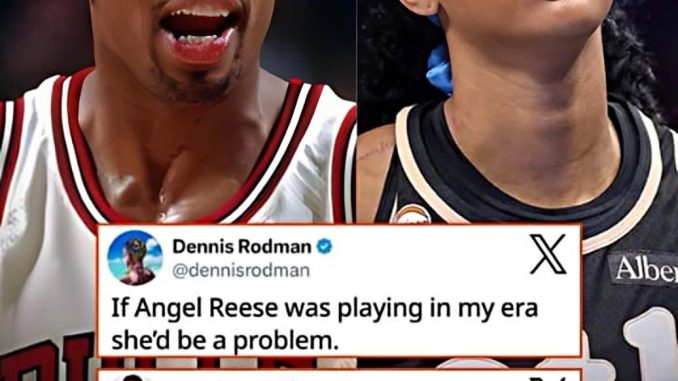
The basketball world erupted this week after Hall of Fame icon Dennis Rodman unleashed a fiery critique aimed directly at rising WNBA star Angel Reese, igniting one of the most talked-about cross-generational clashes the sport has seen in years. What began as a heated discussion about toughness, rebounding, and the modern state of basketball quickly transformed into a viral showdown that has divided fans, analysts, former players, and social media alike.
Rodman, never one to hold back his opinions, delivered a series of blunt remarks during a recent appearance discussing the evolution of women’s basketball. The five-time NBA champion questioned whether today’s younger stars truly understand the grind and sacrifice that defined previous generations. While Rodman acknowledged Reese’s talent and relentless motor on the court, he also accused the young forward of “loving the spotlight too much” and prioritizing celebrity culture over basketball fundamentals.
The comments immediately sent shockwaves through the sports community because Reese has become one of the biggest faces in modern women’s basketball. Since her rise to national prominence during her championship run at Louisiana State University, Reese has embraced a bold personality, becoming a social media phenomenon while simultaneously emerging as one of the most dominant rebounders in the game. Her swagger, confidence, and unapologetic presence have earned admiration from younger fans while also drawing criticism from old-school basketball voices.
Rodman’s criticism struck a nerve partly because of the similarities many fans see between the two stars. Throughout his legendary NBA career with teams like the Chicago Bulls and Detroit Pistons, Rodman built a reputation as basketball’s ultimate disruptor. He thrived on chaos, intimidation, rebounding dominance, and media attention. His colorful hairstyles, controversial antics, and rebellious personality made him one of the most recognizable athletes of the 1990s.
Ironically, many observers believe Reese embodies some of those same traits. She plays with emotion, celebrates aggressively, embraces trash talk, and rarely backs away from confrontation. That connection is exactly why Rodman’s comments felt especially personal to fans who view Reese as carrying the torch for a new generation of expressive basketball stars.
During the interview, Rodman reportedly labeled Reese “too focused on becoming an influencer,” adding that “real legends let the game speak first.” The remarks spread across social platforms within minutes, with clips circulating rapidly on basketball pages and debate shows. Fans immediately began arguing about whether Rodman was offering legitimate criticism or unfairly targeting a young female athlete navigating unprecedented levels of visibility.
Supporters of Reese were quick to point out that the WNBA’s growth has been fueled in large part by personalities willing to market themselves beyond the hardwood. Reese, alongside stars such as Caitlin Clark, has helped generate record-breaking attention for women’s basketball. Television ratings, ticket sales, merchandise demand, and online engagement have all surged during the league’s recent rise in popularity.
Critics of Rodman argued that modern athletes are expected to build brands in ways previous generations never faced. Unlike many NBA stars of the 1990s who benefited from massive league-driven exposure, today’s WNBA players often rely on social media visibility, endorsement deals, podcasts, and personal branding to maximize their earnings and influence. Reese has excelled in that environment, turning herself into one of the most marketable young athletes in America.
Still, Rodman’s comments resonated with some old-school basketball purists who believe the modern era places too much emphasis on celebrity culture. Those supporters argued that Rodman’s message was less about Reese personally and more about a broader concern regarding modern basketball priorities. They pointed to the Hall of Famer’s obsession with rebounding, defense, hustle, and sacrifice during his own career as evidence that he values substance over style.
The backlash intensified when Reese appeared to respond indirectly through social media. Without naming Rodman explicitly, Reese posted a cryptic message emphasizing that “confidence scares people who don’t understand growth.” Fans immediately interpreted the statement as a response to the Hall of Famer’s criticism. The post quickly accumulated millions of views, further fueling speculation and online debate.
Current and former players also weighed in on the controversy. Several WNBA veterans defended Reese’s right to express herself freely, arguing that women athletes have historically been criticized no matter how they present themselves. If they show emotion, they are called dramatic. If they remain quiet, they are accused of lacking personality. Reese’s supporters insisted she should not be punished for helping elevate the sport’s visibility.
Others viewed Rodman’s comments through a generational lens. Basketball culture has changed dramatically since Rodman dominated the NBA in the 1990s. Today’s athletes operate in a nonstop digital environment where every quote, gesture, and performance is instantly amplified online. For younger stars like Reese, building a public identity is no longer optional — it is part of the profession.
The timing of the controversy added even more intensity because Reese has been playing some of the best basketball of her young professional career. Her rebounding numbers continue to place her among the league’s elite, and her physical style has become a defining element of her game. Every matchup involving Reese now carries extra attention, especially after her highly publicized college rivalry with Clark transitioned into the professional ranks.
Many fans also pointed out the apparent contradiction in Rodman criticizing attention-seeking behavior considering his own history. During his playing career, Rodman frequently generated headlines with controversial fashion choices, celebrity relationships, media stunts, and outspoken interviews. He became famous not only for his basketball brilliance but also for embracing spectacle in ways few athletes ever had before.
That irony was impossible for social media users to ignore. Memes comparing Rodman’s eccentric career moments with his criticism of Reese flooded the internet. Some joked that Reese was simply following the blueprint Rodman himself helped create decades earlier. Others argued that Rodman, more than anyone, should understand the pressure of balancing athletic greatness with public scrutiny.
Despite the criticism surrounding his comments, Rodman has never been afraid to embrace controversy. Throughout his life and career, he has built a reputation for speaking bluntly regardless of public reaction. Whether discussing basketball, politics, or celebrity culture, Rodman has consistently positioned himself as someone unconcerned with public approval.
That authenticity is precisely why some basketball fans appreciated his remarks even if they disagreed with them. To supporters, Rodman was simply expressing concern about preserving the gritty mentality that once defined elite basketball competitors. They believe his challenge to Reese was intended to push her toward even greater greatness rather than tear her down.
For Reese, however, the episode represents another chapter in a career already filled with public scrutiny. Since her college days, she has become one of the most polarizing athletes in sports. Admirers praise her passion, confidence, and fearlessness, while critics sometimes accuse her of excessive theatrics. Yet through every controversy, Reese has continued to thrive under pressure.
That resilience may explain why so many younger fans have rallied behind her during this latest clash. In an era where athletes are constantly judged online, Reese’s willingness to remain unapologetically herself has become central to her appeal. To many supporters, she represents a generation refusing to shrink itself to satisfy traditional expectations.
The controversy also reignited broader conversations about gender dynamics in sports criticism. Some commentators questioned whether male athletes displaying Reese’s level of confidence would receive the same scrutiny. Basketball history is filled with outspoken male stars celebrated for swagger and emotional intensity. Critics argued that women athletes often face harsher judgment for similar behavior.
At the same time, others insisted Reese’s visibility naturally invites stronger opinions. With stardom comes criticism, and Reese’s emergence as one of the faces of women’s basketball means every move she makes will generate discussion. From that perspective, Rodman’s comments reflected Reese’s growing cultural importance rather than disrespect.
As the debate intensified, television networks and sports podcasts dedicated entire segments to analyzing the feud. Some analysts sided with Rodman’s emphasis on basketball fundamentals and humility. Others defended Reese as a transformative figure helping revolutionize women’s sports marketing and popularity.
One major point repeatedly raised was Reese’s actual on-court production. Even critics who questioned her style admitted her effort level remains undeniable. Reese attacks rebounds relentlessly, plays through contact, and competes with visible passion every night. Those traits mirror many of the qualities Rodman himself once embodied.
That parallel continues to fascinate basketball fans. Both Rodman and Reese built identities around toughness, emotion, rebounding, and psychological warfare. Both embraced villain roles at times. Both understood how to command attention far beyond the box score. In many ways, the clash feels less like opposites colliding and more like two eras confronting each other.
Former players have suggested that Rodman may even see parts of himself in Reese, which could explain the intensity of his remarks. Legends often challenge younger stars they believe possess extraordinary potential. Sometimes criticism from older icons comes from a place of respect mixed with frustration. Rodman may genuinely believe Reese has the ability to become one of the defining players of her generation.
Whether Reese chooses to respond directly remains unclear. So far, she has largely allowed her performances and subtle social media posts to speak for themselves. But every game she plays now carries additional intrigue because fans are watching closely to see how she channels the controversy.
Meanwhile, the WNBA continues benefiting from unprecedented attention. Rivalries, personalities, and emotional storylines are helping push the league deeper into mainstream sports culture. Reese stands at the center of that movement, and controversies like this only magnify her visibility.
Ultimately, the explosive exchange between Rodman and Reese highlights basketball’s evolving identity. Older generations often emphasize discipline, grit, and humility, while newer stars embrace branding, individuality, and social influence alongside athletic achievement. Neither perspective completely cancels the other out. Instead, the tension between them reflects the sport’s ongoing transformation.
For Rodman, the comments reinforced his status as one of basketball’s most unpredictable voices. For Reese, the moment further cemented her place as one of the most discussed athletes in sports today. Love her or criticize her, Angel Reese continues commanding attention at a level few basketball players can match.
And perhaps that is the biggest irony of all. Dennis Rodman, one of the most controversial and unforgettable personalities basketball has ever produced, may have unintentionally validated Angel Reese’s rise by treating her like a star powerful enough to challenge the old guard itself.
Be the first to comment