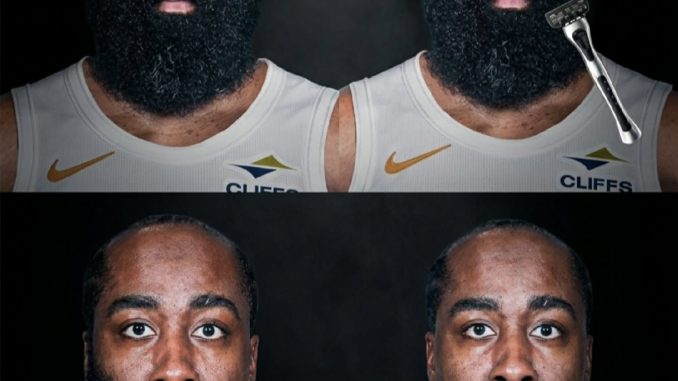
“Same Story, Different Year”: James Harden’s Playoff Struggles Return 👀
Once again, as the postseason spotlight intensifies and possessions slow into half-court chess matches, James Harden finds himself at the center of a familiar and uncomfortable narrative. The regular-season brilliance, the rhythm scoring bursts, the orchestrated pick-and-roll mastery that has defined much of his career—none of it disappears completely. But in the playoffs, when defensive schemes tighten, rotations shrink, and every possession becomes a referendum on star power, Harden’s production has once again come under the microscope.
This year’s playoff run was supposed to be different. That was the expectation, at least from the outside looking in. A refreshed opportunity, a restructured role, and a chance to redefine how his postseason legacy is remembered. Instead, what has emerged feels strikingly similar to past chapters: stretches of offensive hesitation, scoring volatility, and the lingering question of whether his game can fully translate when the pressure reaches its peak.
For much of the regular season, Harden showed flashes of vintage control. He manipulated defenses with the same patience that once made him one of the most unguardable perimeter players in basketball. His ability to read double-teams, probe mismatches, and generate offense without expending excessive energy was again on display. There were nights where he dictated tempo from the opening tip, turning the offense into a slow burn that opponents simply couldn’t contain.
But the playoffs are not the regular season. They never have been, and Harden’s career arc has repeatedly underscored that divide.
As the postseason series unfolded, opposing defenses wasted no time adjusting. The game plan was clear: pick him up higher, force him into quicker decisions, and deny him the comfortable rhythm dribbles that often serve as the foundation of his playmaking. More physical point-of-attack defense became the norm. Help defenders shaded toward his driving lanes. And in those moments where he once thrived by drawing fouls and controlling tempo, the whistle has not come as consistently, further complicating his offensive flow.
The result has been uneven performances that swing between controlled orchestration and prolonged stretches of offensive stagnation. At times, Harden still looks like the veteran floor general capable of dissecting coverage with surgical precision. But in other stretches, he appears hesitant—less decisive in attacking closeouts, less aggressive in hunting mismatches, and more reliant on late-clock improvisation than early offensive command.
The scoring numbers tell part of the story, but not the full picture. What stands out more is the rhythm—or lack thereof. In the playoffs, elite guards typically impose themselves early, establishing either scoring aggression or playmaking dominance that forces defenses to react. Harden’s postseason games this year have often lacked that early assertion, leaving his teams to chase momentum rather than dictate it.
Critics have pointed to a recurring pattern that has followed Harden through multiple playoff campaigns. It is not simply about shooting percentages or turnover totals, but about timing. When the pace slows and defensive pressure intensifies, his offensive assertiveness has sometimes fluctuated in ways that contrast sharply with his regular-season consistency. In games where he starts aggressively—getting downhill, hunting contact, and forcing defensive rotations—his impact remains undeniable. But those games have not come with consistent frequency.
Compounding the scrutiny is Harden’s evolving role. No longer the undisputed offensive centerpiece he once was in Houston, he now operates within more distributed systems where responsibility is shared among multiple creators. This shift has benefits, especially in terms of preserving energy and reducing defensive attention. However, it also means that when the game tightens, there is less margin for passive stretches. Every decision carries amplified weight.
In playoff environments, star hierarchy matters. Possessions are shorter, coaching adjustments are sharper, and opponents are quicker to exploit any perceived reluctance. For Harden, whose game has always balanced scoring aggression with elite facilitation, the challenge becomes finding the precise equilibrium between orchestrator and attacker. When that balance tilts too far toward facilitation, critics argue that offensive pressure dissipates.
Former players and analysts have repeatedly highlighted this dynamic in postseason breakdowns over the years. The consensus is not that Harden is ineffective—far from it. Rather, it is that his impact can fluctuate within games in a way that becomes magnified under playoff conditions. A six-minute stretch without a shot attempt or an extended period of passive playmaking can shift momentum dramatically when every possession is magnified.
Yet, it is also important to recognize the defensive attention he still commands. Even in moments where his shot is not falling or his aggression appears muted, defenses continue to account for him heavily. His passing gravity remains significant, and his ability to draw help defenders still creates opportunities for teammates. The issue, however, is that playoff defenses are often willing to live with those secondary consequences if it means limiting his direct scoring threat.
That strategic compromise has been a recurring theme throughout Harden’s postseason history. Teams are willing to concede some playmaking angles if it reduces his ability to dictate the game as a scorer. And when Harden does not counter that strategy with sustained aggression, the offensive pressure can tilt in favor of the defense.
Another layer to this narrative is fatigue management. Harden’s usage profile has changed over the years, but the physical toll of his style—heavy ball-handling, constant probing, and defensive attention—still accumulates over a playoff series. As games extend into deeper rotations of scouting adjustments, maintaining explosiveness becomes increasingly difficult. In those moments, efficiency often dips, and decision-making can appear more conservative.
Still, it would be inaccurate to reduce Harden’s entire playoff performance to a single storyline of decline. There are still possessions where his brilliance is unmistakable. Step-back threes that force defensive resets. Pocket passes that split double-teams. Transition reads that ignite fast breaks before the defense is set. These are not relics of the past—they remain present, even if inconsistently deployed.
The tension lies in expectation versus execution. Harden is no longer being evaluated as a rising star or a system-dependent scorer. He is judged as a veteran cornerstone, someone expected to stabilize offenses when defensive pressure peaks. That expectation raises the stakes for every quiet stretch, every passive possession, and every late-game sequence where aggression appears delayed.
Coaches, meanwhile, continue to adjust his responsibilities accordingly. In some lineups, he is tasked with initiating offense primarily for others, functioning as a connective passer rather than a primary scorer. In others, he is asked to reclaim scoring aggression and collapse defenses. The inconsistency of role definition can sometimes mirror the inconsistency in performance, making evaluation more complex than raw statistics suggest.
But playoffs are ultimately about clarity. The clearest versions of star players tend to define series outcomes. When Harden is assertive, decisive, and rhythm-driven, his teams are demonstrably harder to guard. When he is passive or inconsistent, offensive flow becomes harder to sustain against elite defensive units.
That duality is what continues to fuel the “same story, different year” narrative. It is not a dismissal of his talent, nor an erasure of his accomplishments. Instead, it is a reflection of how starkly his postseason performances contrast with the expectations that accompany a player of his caliber.
As the series progresses and the margin for error shrinks further, every possession involving Harden will be analyzed through that historical lens. Analysts will watch for early aggression. Coaches will look for sustained offensive pressure. Opponents will continue to test his willingness to attack through contact and over extended defensive possessions.
And fans, accustomed to both brilliance and frustration in equal measure, will once again wait to see which version emerges when the stakes rise even higher.
Because in the playoffs, narratives are not just written—they are reinforced. And for James Harden, that narrative remains as complicated, debated, and closely watched as ever.
Be the first to comment