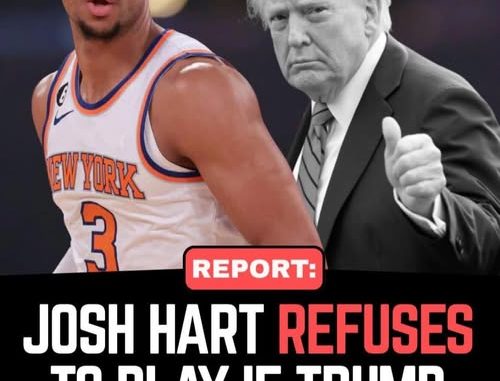
A report suggesting that Josh Hart would be willing to sit out a potential NBA Finals Game 3 if former President Donald Trump attends at Madison Square Garden has quickly ignited debate across the basketball world, placing the New York Knicks veteran at the center of a conversation that stretches far beyond the court.
The report surfaced as the Knicks continue what has become one of the most remarkable postseason runs in franchise history. New York currently finds itself battling the San Antonio Spurs in the NBA Finals, with the championship series carrying enormous significance for a fan base that has waited decades to see the organization return to basketball’s biggest stage. Every game has become must-watch television, every possession magnified under the spotlight, and every storyline amplified by the intense attention surrounding the Finals.
Against that backdrop, any suggestion that a key member of the Knicks rotation could voluntarily miss a Finals game instantly became headline news.
Hart has built his reputation throughout the league as one of basketball’s toughest and most reliable competitors. Since entering the NBA, he has earned praise from coaches, teammates, and opponents alike for his relentless effort, physical defense, rebounding prowess, and willingness to sacrifice individual statistics for team success. Whether with the Los Angeles Lakers, New Orleans Pelicans, Portland Trail Blazers, or now the Knicks, Hart has consistently been viewed as the type of player who embraces the biggest moments rather than avoids them.
That reputation is one reason why the report generated such strong reactions. For many observers, the idea of Hart willingly missing a Finals contest seemed almost unimaginable given his history of toughness and availability. Others viewed the report through the broader lens of athletes increasingly using their platforms to express personal and political convictions.
The intersection between sports and politics has become one of the defining themes of modern professional athletics. Over the past decade, NBA players have been among the most vocal athletes in American sports regarding social issues, political developments, and matters of public policy. From player-led activism during the 2020 NBA bubble to individual statements made throughout recent election cycles, basketball players have shown a willingness to engage in discussions that extend well beyond wins and losses.
Hart himself has never shied away from expressing opinions on social media. Like many players of his generation, he has used digital platforms to communicate directly with fans and comment on issues that matter to him. That openness has occasionally generated headlines, though rarely on a scale comparable to what a potential NBA Finals absence would create.
If such a scenario were ever to materialize, the ramifications would be significant for both the Knicks and the league as a whole.
From a basketball perspective, Hart’s value to New York cannot be overstated. While he may not receive the same national attention as some of the league’s biggest stars, his impact on winning has become impossible to ignore. Throughout the postseason, Hart has served as one of the emotional engines of the Knicks, providing energy, defensive versatility, and critical rebounding in key moments.
His ability to guard multiple positions allows New York’s coaching staff flexibility in defensive matchups. Offensively, he contributes through hustle plays, transition opportunities, and timely shooting. More importantly, his competitiveness often sets the tone for the rest of the roster.
Championship teams frequently rely on players who embrace difficult assignments without seeking recognition, and Hart has become a textbook example of that role. Losing a player of his caliber during the Finals would force major adjustments regardless of the opponent.
The timing would be especially noteworthy because Game 3 traditionally represents one of the most pivotal contests in any Finals series. When a championship matchup shifts locations, momentum can change dramatically. Teams often view the first home game of a Finals appearance as an opportunity to energize the crowd and establish control of the series.
Madison Square Garden, already one of the most famous arenas in sports, would provide an electric backdrop for such a game. The venue has hosted countless iconic basketball moments over the decades, but a Knicks Finals game carries a level of anticipation rarely seen in modern New York sports.
The possibility of a high-profile political figure attending would only increase the media attention surrounding the event.
Donald Trump’s relationship with sports has long generated headlines. As a former president and one of the most recognizable political figures in the world, his appearances at sporting events routinely attract widespread coverage. Whether attending football games, UFC events, college competitions, or professional sporting contests, Trump’s presence often becomes part of the broader narrative surrounding the event itself.
That dynamic has frequently produced mixed reactions from athletes, fans, and commentators. Some welcome the attention and symbolism associated with presidential attendance. Others believe sports should remain separate from political discussions. The resulting debates often dominate social media and sports talk shows for days afterward.
For the NBA, navigating those moments has become increasingly familiar. League officials have consistently emphasized the importance of respecting differing viewpoints while maintaining focus on the game itself. At the same time, the NBA has generally allowed players considerable freedom to express personal beliefs.
If a Finals participant were to miss a game due to political objections connected to a spectator’s attendance, however, it would represent a unique and potentially unprecedented situation in modern league history.
The reaction among fans would likely be sharply divided.
Supporters of Hart would argue that athletes, like all citizens, possess the right to act according to their personal convictions. They might point to numerous examples throughout sports history in which athletes took principled stands despite potential professional consequences. From protests against racial injustice to boycotts and public demonstrations, sports have often served as a platform for larger societal conversations.
Critics, meanwhile, would likely contend that players have an obligation to teammates, coaches, organizations, and fans, particularly during the NBA Finals. They would argue that the championship stage represents the culmination of a season’s worth of effort and sacrifice, making voluntary absences difficult to justify regardless of the underlying issue.
Such a debate would almost certainly dominate sports media coverage.
Television networks, radio programs, podcasts, and social media platforms would dissect every aspect of the situation. Analysts would examine Hart’s role on the court, discuss athlete activism, and debate whether political considerations should influence participation in championship competition.
Former players would undoubtedly weigh in as well. Some might applaud a willingness to stand by personal principles. Others, particularly those who spent years chasing championship opportunities, could question passing up the chance to compete for a title.
The Knicks organization would also face enormous scrutiny.
Team officials would likely be pressed for comment regarding their stance on the matter. Coaches would need to answer questions about lineup adjustments and locker-room dynamics. Teammates would be asked repeatedly whether they support Hart’s decision or believe basketball should remain the primary focus.
Managing those distractions during the Finals would present a significant challenge.
Championship teams often emphasize maintaining concentration amid external noise. Every Finals participant deals with heightened media attention, but few situations could create a larger off-court storyline than a player potentially sitting out because of the attendance of a political figure.
For Hart personally, the consequences would extend beyond the immediate series.
Professional athletes increasingly understand that decisions made on the biggest stages can shape public perception for years. Whether celebrated or criticized, actions taken during the NBA Finals become part of a player’s legacy.
Hart has spent years cultivating a reputation as a competitor who does whatever is necessary to help his team win. Any decision to miss a Finals game would inevitably be evaluated alongside that reputation. Supporters would frame it as a demonstration of conviction. Opponents would question whether personal beliefs should supersede competitive commitments.
The broader historical context makes the conversation even more compelling.
Sports history is filled with athletes who used their platforms to address issues they considered important. Some were initially criticized only to be celebrated later. Others faced backlash that persisted long after their playing careers ended. In nearly every case, public opinion evolved over time.
The NBA, in particular, has a long tradition of player activism. Generations of stars have spoken on issues ranging from civil rights to voting access, education, criminal justice reform, and community development. Current players have inherited that tradition while adapting it to an era dominated by social media and instant communication.
That environment means reports and rumors can spread rapidly, generating massive discussion before official confirmation ever arrives.
As of now, the focus for New York remains squarely on pursuing a championship. The Knicks have captivated fans throughout the postseason with their resilience, physicality, and determination. Hart has been a central figure in that journey, contributing in ways that often transcend the box score.
His teammates consistently praise his toughness. Coaches highlight his versatility. Fans appreciate the effort he brings every night.
Those qualities are precisely why the report generated such widespread attention.
In many ways, the story reflects the reality of modern sports, where athletes occupy increasingly influential positions within public discourse. No longer confined solely to their performances on the court, players are routinely asked to navigate social, cultural, and political questions that previous generations may have avoided.
Whether one agrees or disagrees with a potential decision, the discussion underscores how deeply interconnected sports and society have become.
For now, Knicks fans will continue hoping that the conversation ultimately remains hypothetical and that attention returns to basketball itself. The NBA Finals represent the pinnacle of the sport, and every game carries enormous stakes for players chasing a championship dream.
If Hart takes the floor, he will likely continue doing what he has done throughout his career—diving for loose balls, battling for rebounds, defending multiple positions, and providing the relentless energy that has made him such a valuable piece of New York’s success.
If circumstances were ever to lead him in a different direction, the resulting debate would almost certainly become one of the defining stories of the Finals.
Either way, the report has already accomplished one thing: it has sparked a nationwide conversation about the role of personal conviction, political expression, and professional responsibility at the highest level of sports. In an era where the boundaries between athletics and public discourse continue to blur, that conversation is unlikely to disappear anytime soon.
Be the first to comment