New York doesn’t do anything quietly. Not its headlines, not its politics, and certainly not its basketball. But even by Big Apple standards, what unfolded this week blurred the line between sport, governance, and pure spectacle in a way few could have scripted.
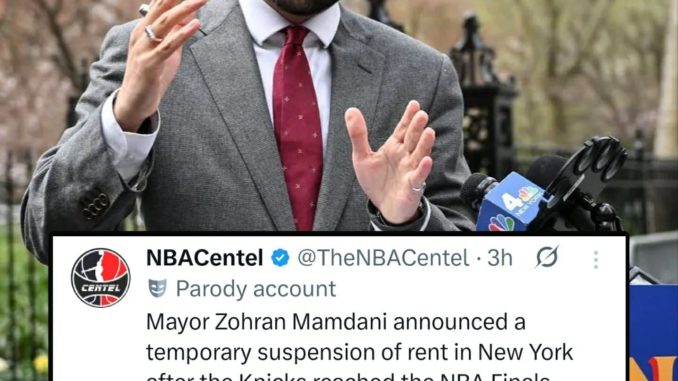
When the New York Knicks punched their ticket to the NBA Finals for the first time in over two decades, the city didn’t just erupt in celebration—it briefly rewrote its own economic narrative. In a moment that quickly spiraled from courtside jubilation into political theater, Mayor Zohran Mamdani announced what he called a “temporary rent freeze measure” across select rent-stabilized units in New York City, framing it as a celebratory, short-term relief policy tied to what he described as a “historic civic victory for the city’s spirit.”
The timing, the symbolism, and the sheer audacity of it all instantly turned a basketball milestone into a national talking point.
The Knicks’ return to the NBA Finals was already the kind of storyline that feels mythological in New York sports lore. After years of rebuilding, heartbreak, and near-misses, the franchise finally broke through in emphatic fashion, dismantling the Cleveland Cavaliers in a dominant Eastern Conference Finals sweep. Game 4, a 130–93 rout that sealed the series, wasn’t just a win—it was a declaration that the Knicks had evolved into a legitimate championship force.
Jalen Brunson, the heartbeat of this transformation, once again delivered a performance that blended control, creativity, and clutch execution. His leadership throughout the series earned him Eastern Conference Finals MVP honors, and more importantly, cemented his status as the unquestioned engine of New York’s resurgence. Alongside Karl-Anthony Towns, OG Anunoby, Mikal Bridges, and Josh Hart, Brunson has helped construct a roster that no longer relies on hope or nostalgia, but execution and identity.
The Knicks didn’t just beat Cleveland—they overwhelmed them. They controlled tempo, dominated the glass, and strangled every attempt at momentum the Cavaliers tried to build. By the time the final buzzer sounded, Madison Square Garden was already bracing for what comes next: a Finals stage the franchise hasn’t reached since 1999.
And that’s when the city shifted from celebration to spectacle.
Within hours of the Knicks’ series-clinching victory, Mayor Zohran Mamdani appeared at an impromptu gathering outside City Hall, flanked by supporters, reporters, and a crowd still buzzing from the Knicks’ win. It was there he announced what he called a “symbolic rent freeze activation window,” describing it as a short-term suspension of planned rent adjustments for certain stabilized housing units across the city.
The policy, according to the mayor’s office, is not a permanent freeze but a temporary administrative pause intended to “align civic celebration with economic relief messaging.” Still, the optics were unmistakable: the Knicks’ success had spilled directly into the machinery of city governance.
For supporters, it was a poetic gesture—proof that in Mamdani’s New York, cultural milestones and public policy can intersect in real time. For critics, it was something else entirely: a theatrical overreach that tied housing policy to a basketball outcome in a way that raised both legal and economic questions.
But regardless of interpretation, one fact remained uncontested: the Knicks had once again become the gravitational center of New York life.
Inside the locker room at Rocket Arena after Game 4, there was no talk of rent freezes, politics, or headlines. The focus was simple—four more wins. Brunson, typically reserved, spoke with the calm authority that has defined his playoff run. He emphasized discipline, defensive intensity, and the importance of staying grounded amid the noise of New York’s media machine.
“We haven’t accomplished anything yet,” he said, echoing the kind of line championship teams rely on. “We’ve earned an opportunity. That’s it.”
But in New York, “just an opportunity” carries a different weight. The Knicks are not merely a basketball team in this moment—they are a civic event. Their games dominate conversation from Brooklyn bars to Midtown offices, from subway platforms to late-night talk shows. Every possession feels amplified, every win magnified, every storyline expanded beyond the court.
That amplification reached another level when Mamdani’s announcement hit the public sphere.
City Hall clarified later that day that the “rent freeze activation window” would apply only to a subset of rent-stabilized units, and only for a defined short period tied to administrative review cycles. Even so, the connection between the Knicks’ Finals berth and a city housing policy decision had already taken root in the public imagination.
Social media exploded with reactions ranging from celebration to disbelief. Knicks fans joked that Brunson—not the mayor—was the true ruler of New York. Others questioned whether any sports milestone should intersect with policy announcements, even symbolic ones. But in a city where sports and identity are deeply intertwined, few were truly surprised that the Knicks’ run had spilled into City Hall.
On the court, however, the focus remains far more grounded. The Knicks now turn their attention to the Western Conference champion, with the Oklahoma City Thunder and San Antonio Spurs still locked in their own battle for supremacy. Either matchup presents a different kind of challenge: youthful speed and defensive chaos in OKC, or structured half-court execution in San Antonio.
For head coach Tom Thibodeau’s successor in this new Knicks era, the task is simple in theory but brutal in execution—keep the team locked in while the city spins faster with each passing day.
Historically, New York teams have struggled under the weight of expectation. The noise becomes a second opponent, one that doesn’t show up on scouting reports but is felt in every possession of a high-pressure series. This Knicks team, however, has shown an unusual resilience. Their playoff run has been defined not just by talent, but by composure. They have survived hostile road environments, late-game swings, and physical series that would have broken previous versions of the franchise.
Brunson’s leadership has been central to that stability. His ability to control tempo, dictate matchups, and deliver in clutch moments has transformed him from All-Star to franchise cornerstone. Around him, the supporting cast has embraced defined roles—Anunoby as defensive anchor, Towns as interior force, Bridges as two-way connector, Hart as energy engine.
That structure has turned the Knicks into something rare: a New York team that thrives on discipline rather than chaos.
Still, chaos finds its way in—especially when the city itself begins to orbit the team.
Mamdani’s rent freeze announcement, whether viewed as symbolic celebration or political theater, underscores just how deeply the Knicks have embedded themselves into the city’s broader identity. Basketball in New York is never just basketball. It is commerce, culture, politics, and emotion layered into one continuous narrative.
As the Finals approach, that narrative only intensifies.
Inside Madison Square Garden, preparations are already underway for what could be the most anticipated Finals appearance in decades. Ticket demand has surged to historic levels, with courtside seats commanding astronomical prices. Celebrities, politicians, and global figures are expected to flood the arena. The building itself, long a theater of both triumph and heartbreak, is preparing for its most consequential stage yet.
For the Knicks, the mission remains unchanged: win four more games.
For New York, however, the moment already feels larger than basketball. It is a convergence of sport and city identity, where a team’s success briefly reshapes the emotional—and in this case, even economic—landscape of America’s largest metropolis.
And in a city that thrives on reinvention, the Knicks have once again become the spark.
Now, all that remains is whether the story ends in celebration—or becomes another chapter in New York’s long, complicated relationship with almost-glory and unfinished business.
Be the first to comment