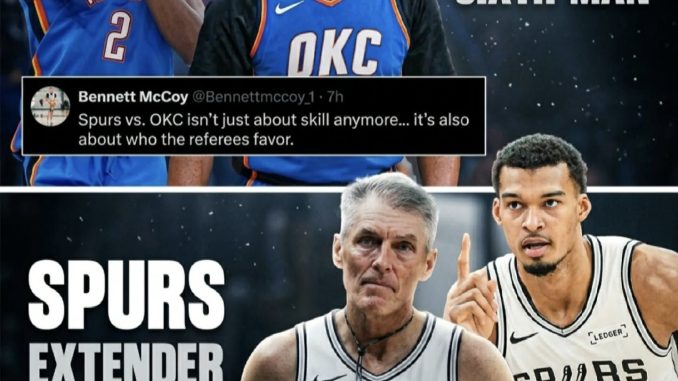
The tension surrounding the Western Conference Finals between the San Antonio Spurs and the Oklahoma City Thunder has officially spilled beyond basketball strategy, player matchups, and coaching adjustments. What was once framed as a high-level chess match between two rising contenders has now turned into a full-scale conversation about officiating, control of the game, and what both sides are calling an invisible “sixth man” shaping the outcome of the series.
As Game 7 approaches, the noise around refereeing decisions has reached a fever pitch, with coaches, players, analysts, and even former officials weighing in on what has become one of the most controversial postseason series in recent memory. The debate is no longer just about who executes better on the floor—it’s about who feels they are surviving a game environment they cannot fully control.
The Spurs’ dominant 118–91 victory in Game 6 on Thursday night, which forced the decisive Game 7, was supposed to be remembered as a defensive masterclass and a statement win. Instead, much of the postgame conversation shifted immediately to whistles, non-calls, and the consistency of contact rules that have fluctuated wildly from game to game. San Antonio’s physical approach, particularly on Oklahoma City’s perimeter initiators, drew both praise and criticism, depending on which side of the rivalry one is aligned with.
Inside the Spurs locker room, the message was clear: they were not going to adjust their physicality based on perceived officiating trends. One veteran described the approach as “playing through whatever the game becomes,” a subtle but pointed acknowledgment that the series has developed its own rhythm that extends beyond basketball execution. The Spurs have leaned into a style that prioritizes bodying up ball handlers, shrinking driving lanes, and challenging every catch with aggressive closeouts that toe the line of legality.
On the other side, the Thunder have been increasingly vocal—carefully but unmistakably—about what they believe is inconsistent officiating impacting their offensive flow. After Game 6, frustration was evident in the Thunder’s body language, particularly from their star guard Shai Gilgeous-Alexander, who spent much of the night navigating physical pressure that Oklahoma City felt crossed the threshold of allowable postseason defense. While the team stopped short of outright accusations, the tone suggested a growing belief that the whistle has not been applied evenly across both ends of the floor.
This tension has fueled the now-viral “sixth man” debate that has taken over social media, sports talk shows, and analyst segments. The phrase, originally used loosely to describe home-court energy and crowd influence, has evolved in this series into a sharper critique—one that suggests officiating itself is becoming a factor as impactful as any player on the court. Whether fair or exaggerated, the narrative has become unavoidable heading into Game 7.
League sources have pushed back strongly against the idea of systemic bias or manipulation, emphasizing that officiating crews rotate and are evaluated continuously throughout the playoffs. Still, even neutral observers have acknowledged that the Spurs-Thunder series has featured unusual swings in foul calls, particularly in how contact is interpreted on drives to the basket and in the post. What was called in Game 2 has not always been called in Game 5, and that inconsistency has become the central frustration for both coaching staffs.
For San Antonio, the argument is rooted in physical identity. They believe playoff basketball historically allows for greater contact, and they have adjusted accordingly. Their defensive scheme thrives when allowed to extend possessions, disrupt rhythm, and force opponents into uncomfortable decisions under pressure. From their perspective, they are not benefitting from officiating—they are simply adapting faster to the playoff environment.
Oklahoma City, however, sees it differently. The Thunder’s offensive system is built on spacing, tempo, and precision timing. When that rhythm is disrupted by hand checks, off-ball bumps, or marginal contact that goes unwhistled, their execution suffers. The concern in their camp is not just about individual calls but about cumulative effect—the slow erosion of offensive flow that doesn’t always show up in box scores but becomes evident over the course of a game.
Game 6 magnified that contrast. The Spurs controlled the paint, dictated physical matchups, and forced Oklahoma City into a half-court grind that neutralized much of their transition advantage. The Thunder shot inconsistently, struggled to establish early offense, and found themselves reacting rather than initiating. By the fourth quarter, frustration had become visible, and the game’s competitive balance had already tilted decisively.
Yet even as San Antonio celebrated leveling the series at 3–3, conversations outside the arena were dominated by officiating breakdowns and frame-by-frame analysis of key possessions. Analysts replayed sequences where contact in the lane was either ignored or penalized differently depending on context. Former players chimed in, split between those who believe playoff basketball should allow more physicality and those who argue consistency—not interpretation—is the real issue.
The league office, as always, remains publicly silent on specific games, but internally, there is awareness that the narrative surrounding this series has escalated beyond typical postseason controversy. Game 7 assignments are expected to be under the strictest scrutiny, with expectations that the officiating crew will be instructed to establish early consistency and avoid allowing emotional momentum from dictating foul distribution.
Coaches on both sides are preparing for that reality in different ways. San Antonio’s staff is emphasizing discipline—avoiding unnecessary fouls while maintaining defensive pressure that has defined their recent success. They understand that Game 7 environments often tighten whistles in the opening minutes before settling into a more physical rhythm. Their goal is to withstand any early officiating emphasis without abandoning identity.
Oklahoma City’s approach is more psychological. The Thunder have spent portions of practice focusing on composure, specifically in response to non-calls and physical contact. The coaching staff has stressed that emotional reaction can become as damaging as defensive pressure itself, particularly in a Game 7 where momentum swings can define entire careers. For them, controlling frustration may be as important as controlling the ball.
Meanwhile, the broader NBA world is watching closely. This series has already delivered everything expected of a conference finals matchup: star performances, tactical adjustments, blowouts, and responses. But the officiating discourse has added an unpredictable layer that now threatens to overshadow the basketball itself. Whether fair or not, it has become part of the story that neither team can escape.
The Spurs enter Game 7 with confidence rooted in physical dominance and a belief that they have successfully imposed their style over stretches of the series. The Thunder enter with urgency and conviction that when they play clean, fast, and free, they are the more dynamic team. Both sides believe they are right. Both sides believe the series has validated their identity.
But underneath those competing narratives lies the unresolved tension that has defined the last three games: what is playoff basketball supposed to look like, and who gets to decide how it is called?
Game 7 will not answer that question definitively, but it will likely amplify it. Every whistle will be analyzed. Every non-call will be replayed. Every momentum shift will be filtered through the lens of officiating scrutiny. And if the game comes down to the final minutes, the debate that has simmered all series long may reach its loudest point yet.
For now, the only certainty is that the Spurs and Thunder are no longer just battling each other. They are battling perception, narrative, and the invisible force that has come to define this series as much as any superstar performance or coaching adjustment. And as the ball goes up for Game 7, that “sixth man” debate will be waiting right alongside tipoff.
Be the first to comment