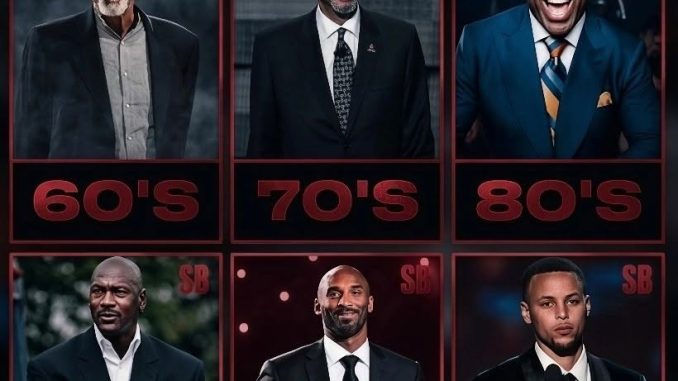
No arguments are necessary when discussing the players who came to symbolize each era of NBA basketball. Every decade has produced countless stars, Hall of Famers, champions, and cultural icons, but only a select few managed to rise above their peers and become the defining face of their generation. Their dominance extended beyond statistics and trophies; they shaped how the game was played, how it was marketed, and how future generations understood greatness. From the early days of professional basketball to the modern era of global superstardom, certain players stand out as the undisputed representatives of their respective decades.
The 1960s belonged to Bill Russell. While the decade featured extraordinary talents such as Wilt Chamberlain, Russell’s impact on winning remains unmatched. Leading the Boston Celtics to an astonishing run of championships, Russell transformed the concept of team basketball. His defensive brilliance, leadership, and relentless pursuit of victory made him the centerpiece of the NBA’s first dynasty. Though Chamberlain produced statistical feats that still seem impossible today, including a 100-point game and season averages that may never be duplicated, Russell consistently found ways to win when it mattered most. The Celtics’ dominance throughout the decade cemented Russell’s place as the defining figure of the era.
The 1970s represented a more competitive and balanced period in NBA history, but one player stood above the rest: Kareem Abdul-Jabbar. Emerging as a dominant force after entering the league in 1969, Kareem spent the next decade establishing himself as basketball’s most unstoppable player. His skyhook became the most reliable offensive weapon the sport has ever seen, and opponents spent years searching unsuccessfully for a way to stop it. Whether with the Milwaukee Bucks or later the Los Angeles Lakers, Kareem’s production remained elite. He collected MVP awards, championships, scoring titles, and widespread respect as the league’s premier superstar. Throughout a decade filled with talented players and changing styles of play, Kareem’s consistency and excellence made him the defining player of the 1970s.
The 1980s ushered in one of the NBA’s most transformative periods, driven by the rivalry between two iconic figures. Yet if one player had to represent the decade, it would be Magic Johnson. The charismatic point guard revolutionized basketball with his unique combination of size, vision, and leadership. Standing 6-foot-9, Magic played every position on the court and orchestrated the legendary “Showtime” Lakers teams that captivated fans around the world. His rivalry with Larry Bird helped rescue the NBA from a period of declining popularity and transformed the league into a major entertainment product. Magic’s five championships, three MVP awards, and unforgettable playoff performances defined an era that many still consider one of the golden ages of basketball.
The 1990s belong unquestionably to Michael Jordan. No player has ever dominated a decade in quite the same manner. Jordan was more than basketball’s best player; he became a global phenomenon whose influence transcended sports. Leading the Chicago Bulls to six championships in eight seasons, Jordan established a standard for excellence that continues to serve as the benchmark for greatness. His scoring ability, defensive intensity, competitiveness, and clutch performances created countless memorable moments. From “The Shot” to “The Flu Game” and the final jumper against Utah, Jordan authored a collection of legendary performances that elevated him into a category all his own. By the end of the decade, Jordan had become the face of basketball worldwide and arguably the most recognizable athlete on the planet.
The 2000s were defined by the relentless brilliance of Kobe Bryant. While players such as Tim Duncan and Shaquille O’Neal enjoyed remarkable success, Kobe’s influence on the decade was impossible to ignore. After helping the Lakers secure a three-peat alongside Shaq, Bryant evolved into the unquestioned leader of the franchise and one of the game’s most feared competitors. His 81-point masterpiece against Toronto remains one of the greatest individual scoring performances in league history. More importantly, his relentless work ethic and “Mamba Mentality” inspired an entire generation of players. By the close of the decade, Bryant had won multiple championships, MVP honors, and earned recognition as the league’s premier superstar. His combination of skill, determination, and iconic moments made him the defining player of the 2000s.
The 2010s introduced one of the most fascinating debates in basketball history, but the decade ultimately belonged to LeBron James. Entering the decade already considered one of the game’s elite players, LeBron elevated his legacy to historic levels over the next ten years. His runs with the Miami Heat, Cleveland Cavaliers, and later the Los Angeles Lakers showcased unprecedented longevity and versatility. LeBron reached eight consecutive NBA Finals from 2011 through 2018, a feat nearly unimaginable in the modern era. His championship triumph with Cleveland in 2016, highlighted by overcoming a 3-1 deficit against the Golden State Warriors, remains one of the greatest accomplishments in sports history. Throughout the decade, LeBron consistently ranked among the league leaders in scoring, assists, and overall impact, further strengthening his claim as one of the greatest players ever.
The 2020s are still unfolding, but one player has emerged as the defining force of the decade so far: Nikola Jokic. The Serbian center has redefined expectations for his position and transformed modern offensive basketball. Combining elite passing, scoring efficiency, rebounding, and basketball intelligence, Jokic has become the engine behind the success of the Denver Nuggets. His MVP awards and championship success have elevated him into rare company, while his unique style of play continues to influence how teams evaluate big men. Unlike traditional centers who dominated through athleticism or physical force, Jokic controls games through timing, vision, and extraordinary skill. Although the decade still has several years remaining and stars such as Giannis Antetokounmpo, Luka Doncic, and Victor Wembanyama continue to build their resumes, Jokic currently stands as the player most synonymous with the era.
What makes these selections particularly compelling is that each player represented more than individual excellence. Russell embodied winning. Kareem represented consistency and unstoppable skill. Magic symbolized entertainment and creativity. Jordan became the standard for competitive greatness. Kobe defined obsession and work ethic. LeBron showcased versatility and longevity. Jokic represents innovation and basketball intelligence.
Each player also influenced the generations that followed. Russell’s defensive principles laid the foundation for modern team defense. Kareem’s professionalism and durability became a model for future stars. Magic inspired oversized playmakers who could handle and distribute the ball. Jordan’s competitive spirit influenced nearly every elite player who followed him. Kobe’s dedication to improvement became legendary among younger athletes. LeBron’s all-around game reshaped expectations for superstars. Jokic’s success has encouraged teams to rethink traditional positional roles and offensive structures.
Perhaps the most remarkable aspect of this progression is how each decade reflects the evolution of basketball itself. The league moved from Russell’s defensive dynasties to Kareem’s dominant individual excellence. It then transitioned into Magic’s fast-paced entertainment era before reaching Jordan’s global explosion. Kobe carried the league into a new millennium defined by individual brilliance and relentless competitiveness. LeBron ushered in an age of versatility and player empowerment. Today, Jokic’s rise highlights a modern NBA built on spacing, skill, and playmaking from every position on the floor.
Debates will always exist regarding certain decades. Many will argue that Chamberlain deserves the 1960s, Bird deserves the 1980s, Duncan deserves the 2000s, or that another star may ultimately claim the 2020s. Those discussions are part of what makes basketball history so fascinating. However, when examining influence, success, cultural impact, and overall dominance, the players who best defined their respective decades become increasingly difficult to dispute.
Basketball history is ultimately told through its icons. While championships, statistics, and awards matter, the players who truly define an era are those whose presence becomes inseparable from the decade itself. Mention the 1960s and Russell immediately comes to mind. Mention the 1980s and Magic’s smile and Showtime brilliance remain unforgettable. Mention the 1990s and Jordan’s silhouette still towers over the sport. Every era has its stars, but only one player becomes the symbol of an entire generation.
No arguments needed. These are the players who defined NBA basketball decade by decade, leaving legacies that continue to shape the game long after their playing days ended. Their influence stretches beyond wins and losses, beyond championships and trophies. They became the faces of their eras, the standard-bearers of greatness, and the names that future generations will forever associate with the evolution of professional basketball.
Be the first to comment