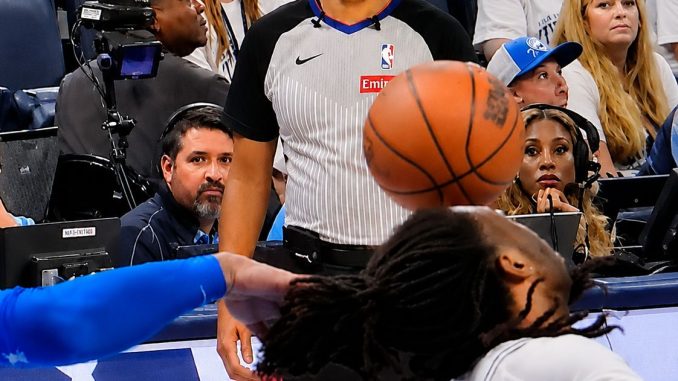
The outrage arrived instantly.
One moment, the arena was roaring through another tense playoff possession. The next, millions of NBA fans were staring in disbelief after replay angles appeared to show a player’s hair being violently yanked during live action — with no whistle, no stoppage, and no explanation from the officials. Within seconds, social media exploded into chaos as viewers demanded answers from the referees and the league office alike.
What should have been remembered as another dramatic postseason battle instead became dominated by one controversial sequence that ignited debates about officiating consistency, player safety, and the NBA’s handling of physicality during the playoffs. Fans from across the basketball world flooded timelines with screenshots, slow-motion clips, and furious reactions after the apparent hair pull occurred directly in front of an official who chose not to intervene.
The incident immediately became one of the most talked-about moments of the postseason, not necessarily because of its effect on the scoreboard, but because of how obvious it appeared on replay. The player’s head jerked backward as the defender reached in during a scramble, and television cameras captured strands of hair being pulled while the action continued uninterrupted.
For fans watching live, the non-call felt almost impossible to believe.
“HOW DO YOU MISS THAT?” one viral post read.
Another fan wrote, “If that’s not a foul, what exactly are refs looking at?”
Others questioned whether the NBA would later issue a statement or admit the officials made a mistake. Several former players and basketball analysts also chimed in online, pointing out that the league has previously emphasized protecting players from unnecessary contact involving the head and neck area.
The controversy quickly overshadowed the actual game itself, a postseason matchup already packed with tension, physical defense, and emotional momentum swings. Players had been battling through aggressive possessions all night, but the hair-pulling sequence crossed a line for many viewers who believed the contact was far beyond ordinary playoff intensity.
The replay only intensified the backlash.
Broadcast crews revisited the moment repeatedly, with commentators audibly stunned that no whistle had been blown. Multiple angles appeared to show clear grabbing contact, and each replay fueled even more anger online. Fans paused frames, zoomed in on screenshots, and compared the incident to past technical fouls or flagrant calls issued for significantly less severe contact.
The timing of the play also mattered. In playoff basketball, every possession carries enormous weight, and emotions are already amplified. When fans feel a crucial moment is mishandled by officials, frustrations escalate immediately. But this felt different because the visual evidence seemed so blatant.
For years, NBA officiating has remained one of the league’s most polarizing topics. Every postseason brings heated arguments over foul calls, missed travels, illegal screens, or superstar treatment. Yet certain moments rise above ordinary complaints and become league-wide flashpoints. This one joined that category almost instantly.
The league has worked aggressively in recent seasons to improve officiating transparency. The NBA introduced coach’s challenges, expanded replay systems, and continued releasing Last Two Minute Reports to evaluate late-game officiating decisions. But critics argue that none of those mechanisms matter if obvious infractions are still missed in real time during the sport’s biggest games.
Fans repeatedly pointed to the positioning of the nearest referee during the sequence. According to viewers, the official had an unobstructed line of sight and still allowed play to continue. That detail intensified criticism because it eliminated the common defense that referees simply could not see the contact amid traffic.
Instead, fans believed the officials saw it and chose not to call it.
That distinction turned ordinary frustration into genuine outrage.
Social media platforms became flooded with sarcastic reactions mocking the referees. Memes spread rapidly, including freeze-frame images of the hair pull alongside jokes about “playoff rules” and the supposed disappearance of foul standards in the postseason. Others accused the NBA of encouraging excessive physicality during playoff games because officials are often reluctant to disrupt the flow with frequent whistles.
Former NBA players weighed in as well, with several suggesting that while postseason basketball naturally becomes more physical, pulling a player’s hair should never be ignored. Many argued that regardless of game situation, the act should have resulted in at least a personal foul and potentially a flagrant review depending on intent.
The debate eventually shifted toward player safety.
Hair pulling may sound minor in comparison to dangerous collisions or hard fouls at the rim, but many fans argued the issue was about respect and control. Basketball players are trained to absorb contact to the chest, shoulders, or arms. Grabbing someone by the hair introduces a completely different type of vulnerability and can easily escalate emotions on the floor.
Several viewers pointed out that if players retaliated after such incidents, referees would likely respond immediately with technical fouls or ejections. That double standard frustrated many observers who believed officials failed to prevent tensions from escalating in the first place.
The NBA playoffs have already featured multiple heated moments this season. Tempers have flared across several series as teams battle through high-pressure environments where every possession matters. Physical defense, trash talk, and emotional reactions are expected. But fans believe there is still a clear line between hard basketball and unacceptable contact.
For many watching, the hair-pulling incident crossed that line.
The controversy also reignited broader conversations about consistency in officiating. One of the biggest frustrations among NBA fans is not necessarily that mistakes happen, but that similar plays often receive wildly different rulings depending on the game, crew, or star players involved.
Throughout the regular season, officials frequently whistle touch fouls on the perimeter while allowing far more aggressive contact in the playoffs. Some fans enjoy the increased physicality because it creates tougher, more intense basketball. Others believe the standard becomes too inconsistent and rewards overly aggressive defense.
This latest controversy became the perfect example for critics who feel playoff officiating sometimes spirals out of control.
Television analysts later broke down the play frame by frame, highlighting the moment the player’s head snapped backward. Some analysts attempted to defend the officials by arguing the action occurred quickly in a crowded area of the court. But even those explanations failed to calm public frustration because the replay angles appeared so clear.
One former player turned analyst remarked that if the roles were reversed and a superstar had been involved, the whistle likely would have come instantly. That comment triggered another avalanche of debate online regarding star treatment and officiating bias.
Whether fair or not, perception matters enormously in professional sports.
Fans want consistency. They want accountability. And most importantly, they want confidence that the biggest games are being officiated fairly. When controversial moments dominate headlines after playoff games, it shifts attention away from the athletes and toward the referees — the exact scenario leagues hope to avoid.
The players themselves largely avoided escalating the controversy publicly after the game, though body language during the incident suggested immediate frustration. Teammates appeared to react toward the officials while the game continued, and fans noticed visible confusion from players on both sides.
That silence afterward may reflect the reality many athletes face regarding officiating criticism. The NBA can fine players or coaches for public comments attacking referees, which often leads teams to choose carefully worded responses instead of openly venting frustrations.
Still, the internet had no such restraint.
Clips of the incident accumulated millions of views within hours. Basketball influencers, podcast hosts, and fan accounts repeatedly reposted the play while debating whether the league owed an explanation. Several users compared it to infamous missed calls from previous postseasons that continued haunting fans years later.
What makes controversial officiating moments especially powerful in the social media era is speed. Years ago, debates unfolded through postgame television coverage or newspaper columns the next morning. Today, outrage becomes instantaneous and global within seconds of the replay airing.
Every angle is clipped. Every frame is analyzed. Every decision becomes public evidence.
That environment places enormous pressure on officials, whose jobs are already incredibly difficult given the speed and complexity of NBA basketball. Referees must make split-second decisions involving elite athletes moving at extraordinary pace. Mistakes are inevitable.
But fans tend to accept difficult judgment calls more easily than obvious misses.
The hair-pulling controversy felt obvious to viewers, which is why reactions became so intense. Even neutral fans with no rooting interest appeared shocked that play continued uninterrupted.
The NBA now faces the familiar challenge of moving attention back toward the basketball itself. The postseason has delivered thrilling storylines, rising stars, dramatic finishes, and intense rivalries. Yet moments like this risk overshadowing everything else.
League officials will likely review the play internally, as they do with all controversial sequences. Whether the NBA publicly addresses it remains unclear. The league traditionally avoids making major public statements about officiating unless absolutely necessary, preferring internal evaluations instead.
Still, fans are unlikely to let the moment disappear quietly.
In today’s sports culture, controversial clips live forever online. They become part of playoff history, replayed repeatedly whenever discussions about officiating arise. This particular moment may now join the growing archive of postseason controversies fans reference for years.
The larger issue for the NBA is maintaining trust in the product during the most important stretch of the season. Playoff basketball represents the league at its highest level — the biggest stars, the largest audiences, and the most emotional moments. When officiating controversies dominate headlines, they threaten to undermine that experience.
And yet, controversy has always been intertwined with sports.
Missed calls become part of rivalries. Debates fuel fan engagement. Anger creates conversation. In many ways, moments like this deepen emotional investment because fans care so intensely about fairness and competition.
That passion was visible everywhere after the hair-pulling incident.
Some fans demanded suspensions. Others called for expanded replay authority allowing officials to review obvious non-calls involving excessive contact. A few even argued the NBA should consider additional officiating reforms during the offseason.
Whether any changes come from the incident remains uncertain.
But one thing became undeniable the moment the replay hit television screens: NBA fans were furious. The image of a player’s hair being yanked while referees swallowed the whistle instantly transformed into one of the defining controversies of the postseason.
And in a league where every playoff possession is magnified under the brightest lights imaginable, that single missed call became bigger than the game itself.
Be the first to comment