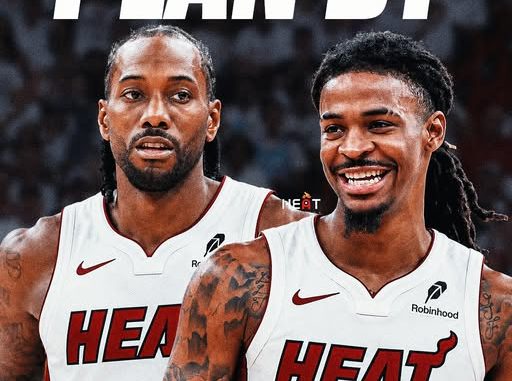
The Miami Heat’s long-standing reputation for star hunting has once again collided with the league’s most compelling speculative storyline, and according to veteran South Florida insider Ira Winderman, the franchise may already be preparing contingency plans if its long-anticipated pursuit of Giannis Antetokounmpo fails to materialize. In a league where patience is thin and windows close quickly, the conversation around Miami’s next move has shifted from aspiration to strategy, and from one generational superstar to a broader map of elite targets that could reshape the franchise’s future.
At the center of the chatter is Giannis Antetokounmpo, the two-time MVP whose combination of size, speed, and unstoppable paint dominance has made him one of the most coveted players of his era. For years, the Miami Heat have been loosely linked to the idea of acquiring a transcendent force to pair with their championship infrastructure, and Giannis has consistently been the name that looms largest over any such discussion. But as Winderman notes, the reality of prying a player of his stature away from the Milwaukee Bucks remains highly complicated, dependent on timing, organizational direction, and circumstances that are often outside Miami’s control.
That uncertainty is precisely why, according to Winderman, the Heat are expected to remain aggressive but flexible, ready to pivot quickly if the Giannis dream reaches a dead end. The franchise, led by a front office long praised for its opportunistic mindset, is not expected to sit idle if its top target proves unattainable. Instead, attention would immediately shift toward other high-impact stars who could alter the competitive trajectory of a roster that has oscillated between contention and reinvention in recent seasons.
Two names have emerged prominently in that secondary tier: Kawhi Leonard and Ja Morant. Both represent vastly different archetypes of stardom, yet each carries the kind of franchise-altering potential Miami covets. Kawhi Leonard, a two-time Finals MVP known for his two-way dominance and playoff pedigree, represents a proven commodity when healthy. Ja Morant, meanwhile, offers explosive athleticism, playmaking creativity, and the type of dynamic guard presence that can redefine an offense overnight.
Winderman’s framing of the situation reflects a broader truth about the modern NBA: superstar acquisition is no longer linear. Teams are no longer simply waiting for free agency cycles or traditional trade windows to dictate their plans. Instead, organizations like the Heat are constantly evaluating layered contingencies, preparing for multiple possible outcomes at once. The Giannis pursuit, in this context, is not a singular plan but the top of a cascading decision tree.
Inside Miami’s organizational philosophy, flexibility is not just a strategy—it is identity. The Miami Heat have built their reputation on maximizing undrafted talent, developing overlooked prospects, and positioning themselves to strike when star players become available. That approach has yielded deep playoff runs and multiple Finals appearances over the past decade, but it has also underscored the importance of landing a definitive superstar to consistently break through in an increasingly stacked Eastern Conference.
The pursuit of Giannis Antetokounmpo, should it become viable, would represent the clearest expression of that ambition. His ability to dominate both ends of the floor would instantly transform Miami’s ceiling, giving them a centerpiece capable of anchoring both transition offense and defensive schemes. However, league sources and analysts alike have repeatedly emphasized the difficulty of engineering such a move, particularly given Milwaukee’s historical commitment to building around him and the massive trade package required to even initiate serious discussions.
That is where the strategic pivot comes into focus. If Giannis remains out of reach, Winderman suggests Miami would not hesitate to redirect its resources toward Kawhi Leonard or Ja Morant, depending on availability, health considerations, and organizational willingness from their respective franchises.
Kawhi Leonard’s situation is perhaps the most nuanced. A champion with both the San Antonio Spurs and Toronto Raptors, Leonard’s legacy is already secure, but his tenure with the Clippers has been defined by both brilliance and injury management. When on the floor, his two-way impact remains among the most efficient in the league. His mid-range scoring, defensive anticipation, and playoff composure make him a rare asset for a team like Miami, which thrives in structured, half-court postseason environments. Yet durability remains the central question that any acquiring team must confront. The Heat, known for their rigorous conditioning standards and cautious injury management philosophy, would have to weigh whether Leonard’s availability aligns with their long-term expectations.
Still, there is a natural basketball fit between Leonard and Miami’s system. The Heat’s emphasis on defensive versatility, switching schemes, and late-game execution mirrors the environment in which Leonard has historically excelled. In theory, his arrival would immediately restore Miami’s status as a top-tier contender in the Eastern Conference, especially if paired with the organization’s established core.
Ja Morant presents a completely different proposition. The electrifying guard for the Memphis Grizzlies is one of the league’s most dynamic offensive forces, capable of collapsing defenses with his speed, vertical explosion, and fearlessness attacking the rim. His playstyle, however, is more volatile and system-dependent than Leonard’s methodical dominance. For Miami, Morant would represent not just a talent acquisition but a philosophical shift toward pace, creativity, and guard-centric offense.
Winderman’s inclusion of Morant in the conversation reflects the Heat’s growing awareness that the modern NBA increasingly rewards perimeter-driven stars who can generate offense independently. While Miami has often built around wing defense and structured half-court execution, the league’s evolution demands more explosive shot creation, particularly in playoff series where half-court scoring becomes increasingly difficult.
The idea of Morant in a Heat uniform would instantly transform Miami’s offensive identity. His ability to penetrate defenses, draw help, and create transition opportunities would open the floor for shooters and secondary creators in ways the current roster has struggled to consistently replicate. However, as with all star-level pursuits, questions around availability, consistency, and long-term fit would loom large in any internal discussions.
What makes Winderman’s reporting notable is not simply the names involved, but the organizational posture it reveals. The Heat are not operating under the illusion that any single acquisition is guaranteed. Instead, they are functioning within a multi-path framework where Giannis represents the ideal outcome, but Leonard and Morant represent legitimate, high-level alternatives should circumstances shift.
This approach reflects the broader evolution of front office strategy across the NBA. Teams are increasingly forced to balance patience with urgency, particularly in markets like Miami where expectations remain championship-driven regardless of roster composition. The Heat’s history of bold moves—from the acquisition of LeBron James and Chris Bosh in the formation of their Big Three era to more recent attempts to land additional stars alongside Jimmy Butler—underscores a consistent willingness to chase greatness when opportunity presents itself.
Yet the current landscape is more complex than ever. Salary cap constraints, player empowerment, and the scarcity of truly available superstars mean that even aggressive franchises must prepare for multiple outcomes simultaneously. Winderman’s report, in that sense, is less about immediate action and more about long-term positioning.
For now, Giannis Antetokounmpo remains the dream scenario. His combination of youth relative to superstardom, championship pedigree, and two-way dominance makes him the kind of player who can redefine a franchise’s trajectory for half a decade or more. But dreams in the NBA are often fragile, shaped by playoff results, organizational direction, and timing that cannot always be controlled.
If that dream fades, Kawhi Leonard and Ja Morant stand as two radically different but equally compelling alternatives. One represents precision, experience, and championship-tested composure. The other embodies youth, explosiveness, and the possibility of an entirely new offensive identity. For the Miami Heat, the challenge is not just identifying talent, but anticipating the exact moment when opportunity aligns with availability.
As the offseason landscape continues to evolve, Miami’s front office is expected to remain active, evaluating scenarios, monitoring league developments, and positioning itself for whatever shift may come next. Whether the outcome ultimately involves Giannis Antetokounmpo or a pivot toward Kawhi Leonard or Ja Morant, the Heat’s message remains consistent: they are not waiting for change—they are preparing to trigger it.
And in a league defined by superstar movement and sudden transformations, that preparation may be the most valuable asset of all.
Be the first to comment