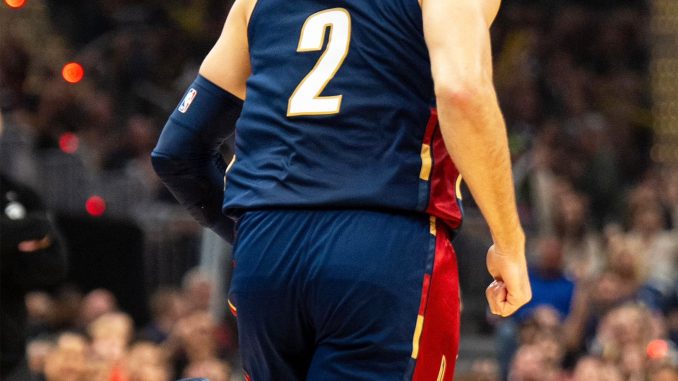
Max Strus entered Game 3 carrying more than just the weight of a playoff series. He carried the expectation of stability for a struggling Cleveland Cavaliers offense that has wavered under pressure, the responsibility of spacing the floor against a disciplined defense, and the quiet burden of trying to keep Cleveland’s identity intact as the series tightened on the road. By the time the final buzzer sounded, the Cavaliers had fallen again in the Eastern Conference Finals, but Strus had delivered one of the most resilient, all-around efforts of the night—an embodiment of persistence in a game where nothing came easy.
The loss to the New York Knicks in Game 3 was not simply another mark in the loss column; it was a continuation of a growing problem for Cleveland. Their offense, once fluid and unpredictable in the regular season, has increasingly become bogged down by isolation stretches, contested perimeter shots, and possessions that stall under playoff pressure. Yet amid that collective struggle, Strus played with a clarity that contrasted sharply with the chaos around him.
From the opening minutes, Strus set a tone that Cleveland desperately needed. He moved without hesitation, sprinting through off-ball screens, probing defensive gaps, and firing quickly when opportunities arose. It was the kind of assertive rhythm that has defined his value since joining the Cavaliers—an unsung connector who can stretch defenses horizontally and vertically. Even when shots didn’t immediately fall, his presence forced the Knicks to stay honest on the perimeter, preventing them from collapsing fully into the paint.
But this game was never going to be about clean looks or rhythm shooting. The Knicks’ defense, anchored by physical point-of-attack pressure and disciplined rotations, made sure of that. Every Cavaliers possession felt like a negotiation rather than an execution. And yet, Strus continued to engage, refusing to let defensive pressure dictate his impact.
What separated his performance from the rest of the Cavaliers’ perimeter group was his willingness to do the dirty work when the offense stagnated. When shots weren’t available, he attacked closeouts. When driving lanes closed, he kicked out decisively rather than forcing contested attempts. When the game turned physical, he absorbed contact and still competed on the glass, a facet of his game that often goes unnoticed but proved critical in keeping Cleveland afloat during stretches when momentum threatened to fully swing away.
Strus also provided key defensive minutes that don’t always show up in traditional box score readings. Tasked with chasing multiple Knicks perimeter scorers through screens, he absorbed miles of movement on the defensive end. He fought through staggered actions, contested without fouling, and remained engaged even as the game’s pace tilted in New York’s favor. The Knicks tested him repeatedly in isolation and pick-and-roll actions, but Strus held his ground more often than not, competing with the kind of physical discipline that playoff basketball demands.
Still, basketball games are rarely decided by effort alone. And for all of Strus’ steadiness, the Cavaliers’ offensive issues persisted in ways that effort could not fully mask. The spacing tightened as possessions slowed. Driving lanes collapsed as help defenders arrived early. And the Cavaliers, for long stretches, struggled to find consistent shot creation outside of broken plays or individual bursts.
The absence of rhythm was particularly evident in half-court sets, where Cleveland’s ball movement often stalled at the second or third action. Strus found himself repeatedly repositioning, trying to re-angle himself into passing lanes or relocate behind the arc, but the ball simply didn’t swing with the same urgency that has defined elite playoff offenses. As a result, his impact became fragmented—still meaningful, but not fully maximized.
The Knicks, meanwhile, leaned into their identity. They controlled tempo, dictated physicality, and forced Cleveland into a grind. Every defensive possession felt like a test of patience. Every offensive set required precision. And in that environment, the Cavaliers’ margin for error shrank considerably.
Even so, Strus found moments to shift energy. One sequence in the second quarter stood out: after a missed Cavaliers possession, he immediately sprinted back, rotated to cut off a baseline drive, and forced a contested miss that led to a transition opportunity. Though Cleveland did not fully capitalize on the possession, the play reflected his commitment to influencing the game beyond scoring.
Another sequence in the third quarter showcased his adaptability. With the Cavaliers struggling to generate clean perimeter looks, Strus began attacking more decisively off the dribble, putting pressure on closeouts and forcing the Knicks’ defense to rotate. That subtle adjustment created brief pockets of space for teammates, even if the resulting shots did not consistently fall. It was the type of in-game adjustment that reflects a player reading the flow rather than waiting for a system to deliver him opportunities.
But the broader issue for Cleveland remained unchanged: sustained offensive execution under playoff pressure. Strus’ efforts, while commendable, highlighted the gap between individual competitiveness and team cohesion. The Cavaliers could compete in bursts, but stringing together consistent possessions against New York’s defensive structure proved elusive.
As the game progressed into its final stages, the Cavaliers attempted to rally. The energy lifted slightly, and Strus remained central to those efforts. He continued to move without the ball, continued to communicate on defensive switches, and continued to compete on every rebound opportunity. But the Knicks, sensing control, tightened their grip on the game, responding to every Cleveland push with composure and execution.
By the fourth quarter, the rhythm of the game had settled into a familiar pattern: Cleveland pressing, New York responding. Strus never stopped working, but the margin had already widened beyond what hustle alone could repair. When the final buzzer confirmed the Cavaliers’ defeat, the frustration was evident—but so was the recognition that not all performances in a loss are created equal.
For Strus, Game 3 became a study in persistence without payoff. His stat line may not dominate headlines, but his influence threaded through nearly every phase of the game. He was Cleveland’s most consistent perimeter mover, one of its more reliable defensive competitors on the wing, and one of the few players who maintained aggression regardless of scoreboard pressure.
That kind of performance matters in a series like this, even if it doesn’t immediately shift outcomes. Playoff basketball often rewards teams that can maintain identity under stress, and Strus, even in defeat, embodied that standard more than most.
The Cavaliers now face a deeper question as the series continues: how to convert individual resilience into collective execution. Strus has done his part in stabilizing stretches of chaos, but Cleveland’s offensive structure must evolve if they are to extend the series or shift momentum. Ball movement must quicken. Spacing must improve. And the supporting cast must find ways to complement the stars more effectively.
For Strus, the path forward remains clear. Continue to move. Continue to defend. Continue to take and make the shots that come within rhythm. His role is not to overhaul the Cavaliers’ system, but to anchor it with reliability when everything else becomes unstable. In playoff environments where margins are razor-thin, that role is often the difference between survival and collapse.
There is also an emotional dimension to his performance that cannot be ignored. Strus plays with visible urgency, the kind that suggests awareness of both opportunity and limitation. He knows the Cavaliers are searching for answers. He knows the spotlight intensifies with each passing game. And yet, he continues to operate within his role, never forcing beyond what the defense allows, but never shrinking from responsibility either.
That balance is not always glamorous, but it is essential. Teams that advance in May and June are often defined not only by their stars, but by players like Strus who sustain competitiveness when games become messy and unpredictable. Game 3 was messy. It was unpredictable. And in that environment, Strus was one of the few constants Cleveland could rely on.
As the series shifts forward, the Cavaliers must decide how to amplify that consistency. Whether through tactical adjustments, improved ball movement, or increased secondary creation, they need to turn effort into execution. Because while Strus can battle through slumps and stabilize stretches, he cannot single-handedly correct the broader offensive struggles that have defined the series.
For now, Game 3 stands as another reminder of how thin the line is between competitiveness and control in the postseason. The Cavaliers competed. They fought. They had players, like Strus, who refused to fade. But the Knicks executed more cleanly when it mattered most, and that difference ultimately decided the night.
Strus walked off the floor having done his job in the only way he could—by competing relentlessly in a game that demanded nothing less. The box score will tell part of the story, but not the full one. The full story is that in a game Cleveland lost, he was still moving, still defending, still fighting for structure in a team searching for stability. And in a series that is slipping, that kind of effort remains the foundation of whatever hope the Cavaliers still carry moving forward.
Be the first to comment