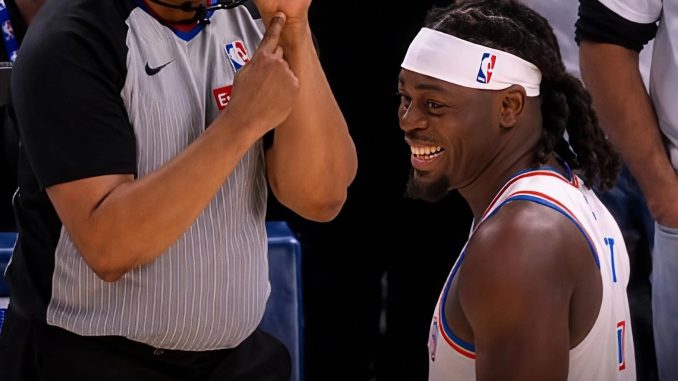
Lu Dort’s name trended across NBA social media timelines late in Game 5 of the Western Conference Finals, not because of a buzzer-beating shot or a defensive masterclass, but because of a brief courtside exchange with veteran official Tony Brothers that quickly spiraled into a full-blown online referendum on officiating, player interactions, and the fine line between explanation and escalation in high-stakes playoff basketball.
What began as a routine whistle in a tightly contested possession between the Oklahoma City Thunder and San Antonio Spurs turned into one of the most debated referee-player moments of the postseason. Within minutes, clipped footage of Dort standing near Brothers, gesturing and receiving what appeared to be an explanation of a call, began circulating widely across social platforms. Interpretations diverged almost immediately. Some viewers saw a standard officiating moment: a veteran referee explaining a foul to a defensive specialist who lives on the margins of physicality. Others saw something more symbolic, projecting frustration with officiating consistency in a series already under a microscope.
As with most modern NBA flashpoints, the truth of the moment became secondary to the narrative built around it.
The Thunder-Spurs matchup itself provided fertile ground for controversy. Physical, emotional, and tightly officiated from the opening tip, Game 5 carried the weight of a series that had already shifted momentum multiple times. Oklahoma City entered the night with confidence after a strong showing in Game 4, while San Antonio responded with renewed defensive pressure, particularly on the perimeter where Dort’s assignments often dictate the tone of OKC’s defensive identity.
Dort, long regarded as one of the league’s premier point-of-attack defenders, spent much of the night battling through screens, hand checks, and constant motion designed to pull him away from primary scorers. His role, as it has been throughout the playoffs, required a delicate balance: play aggressive enough to disrupt rhythm, but disciplined enough to avoid foul trouble in a game where every possession felt magnified.
It was in that environment that the moment with Tony Brothers occurred. A foul call late in a defensive sequence prompted Dort to approach the official for clarification. Cameras caught the exchange, and at one point Brothers appeared to gesture toward the area of contact while speaking to the Thunder guard. Dort’s reaction—part conversation, part visible disagreement—was brief, but in the modern NBA ecosystem, brevity is irrelevant. Context is often reconstructed in real time by millions of viewers who see only a few seconds of interaction.
Almost immediately, interpretations diverged online. One angle of discussion suggested Brothers was calmly explaining the location of contact on the play, a routine part of officiating communication that players frequently seek during stoppages. Another angle, fueled by frustration with broader officiating inconsistencies throughout the playoffs, framed the exchange as emblematic of a larger problem: perceived uneven whistle standards in a series that has already seen heated debates over free throw disparities, replay decisions, and late-game foul interpretations.
Social media reaction intensified as fans replayed the clip repeatedly, slowing it down, zooming in, and assigning meaning to gestures that, in real time, lasted only seconds. That amplification loop is now a familiar feature of playoff basketball coverage, where referees—once background figures—have become central characters in the story of the game.
But within the Thunder locker room, the focus remained more grounded. Oklahoma City has built its identity this season on defensive versatility, and Dort is at the center of that philosophy. His assignments are rarely glamorous but almost always essential. Whether matched up against primary scorers or tasked with navigating off-ball screens, he is often asked to absorb contact on both ends of the floor without the benefit of consistent whistle protection that offensive stars receive.
That dynamic has long fueled debate about how physical perimeter defenders are officiated in the modern NBA. Coaches praise players like Dort for their toughness and willingness to embrace difficult defensive assignments, but those same traits often place them in constant proximity to foul trouble. In playoff environments, where officiating tends to tighten and star players draw increased attention, the tension between defensive aggression and foul avoidance becomes even more pronounced.
Game 5, in that sense, was not an outlier. It was a continuation of a season-long conversation about how physicality is interpreted at the highest level of competition. And Dort, by virtue of his role, frequently finds himself at the center of those conversations whether he intends to or not.
Tony Brothers, meanwhile, is no stranger to scrutiny. One of the league’s most experienced referees, he has officiated hundreds of high-profile games, including multiple playoff series and Finals assignments. His on-court demeanor—direct, controlled, and often visibly communicative—has made him a recognizable figure among players and fans alike. That visibility cuts both ways. When interactions occur between Brothers and players in emotionally charged moments, they are rarely viewed neutrally by the public.
In this case, the lack of a single definitive camera angle showing full context only intensified speculation. Some broadcasts focused on the foul that preceded the exchange, others on the aftermath. Depending on which clip a viewer saw first, the interpretation of the moment shifted dramatically. In one version, it was a referee calmly explaining a call. In another, it was a player expressing frustration at what he perceived as inconsistency.
That duality has become a defining feature of modern NBA discourse, where highlights and controversies are often divorced from full-game context.
As the game continued, the incident did not escalate further on the court. Dort remained engaged defensively, continuing to take on difficult matchups and contest shots at the rim and on the perimeter. The Thunder, for their part, adjusted their defensive rotations as the game wore on, attempting to limit penetration and reduce late-clock fouls that had already become a point of emphasis in the series.
Still, by the time the final buzzer sounded, the conversation had already shifted away from scheme adjustments and toward officiating interpretation. The Thunder-Spurs matchup, already under intense scrutiny due to its physical nature and high stakes, had added another entry to its growing list of debated moments.
Postgame discourse followed a familiar pattern. Analysts and fans revisited the clip repeatedly, some arguing that Dort’s frustration reflected broader player concerns about consistency, others insisting the exchange was routine and being overanalyzed. In between those poles lay a more nuanced reality: playoff basketball is emotional, referees are constantly communicating with players, and brief interactions are often magnified into symbols of larger grievances.
For Oklahoma City, the focus remains on execution rather than interpretation. Dort’s value to the team is not measured in viral clips but in his ability to disrupt opposing stars, fight through screens, and anchor defensive possessions that rarely show up in box scores. His presence allows the Thunder to switch coverages, trust help rotations, and maintain pressure without collapsing defensively when opponents initiate action at the point of attack.
San Antonio, meanwhile, continues to test that structure with motion-heavy sets designed to force rotations and create mismatches. The result has been a series defined as much by defensive discipline as offensive creativity, with both teams probing for advantages that often come down to single possessions.
In that context, the exchange between Dort and Brothers becomes less an isolated controversy and more a snapshot of the environment itself: tense, scrutinized, and relentlessly dissected. Every whistle carries weight. Every gesture is recorded. Every reaction is interpreted through the lens of fan allegiance and playoff anxiety.
Whether the moment was routine communication or something more contentious depends largely on perspective. What is undeniable is that it resonated far beyond its brief duration, becoming part of the ongoing narrative of a series that has already delivered physical battles, momentum swings, and mounting emotional stakes.
And as Game 6 approaches, both teams understand that attention will continue to sharpen—not just on the players deciding the outcome, but on every interaction surrounding them, however small, however brief, and however open to interpretation.
Be the first to comment