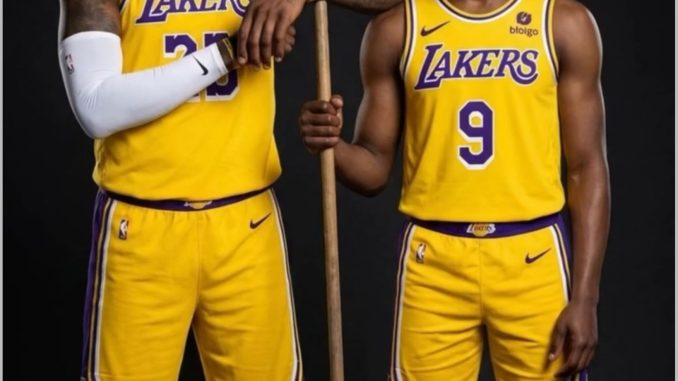
In the NBA, legacy is never just a storyline—it’s a shadow that follows players from their first dribble to their final whistle. It lives in gym rafters where retired jerseys hang like permanent reminders, and it echoes in arenas where familiar surnames draw louder reactions than the first buckets they ever score. Every generation believes it is building something new, yet basketball has a long memory. It remembers fathers and now watches their sons arrive with the same bounce in their step, the same competitive fire, and often, the same impossible expectations.
That reality has never felt more vivid than in the current era, where the league is witnessing a growing wave of second-generation talent stepping into the spotlight. The phrase “like father, like son” is no longer just a sentimental cliché—it has become an evolving chapter in modern NBA identity, where basketball bloodlines are shaping scouting reports, draft conversations, and the emotional architecture of fanbases across cities like those of the NBA.
The most visible symbol of this shift is the increasing presence of sons who are not merely riding their fathers’ coattails but attempting to carve out their own legitimacy in a league that rarely grants patience. The transition is rarely smooth. It begins long before draft night, often in childhood gyms where fathers once played, or in training facilities where old teammates now return as mentors. It continues through high school dominance, AAU circuits, and eventually into the crucible of college basketball or the developmental pipeline, where comparisons become unavoidable and expectations grow heavier with every viral highlight.
For some, the journey starts under a spotlight that never dims. The son of a former All-Star or champion enters the league already analyzed, dissected, and debated before ever setting foot on an NBA court. Scouts don’t just evaluate athleticism or shot mechanics—they measure composure under inherited pressure. They ask whether greatness is genetic, whether court vision can be taught through backyard drills with a father who once orchestrated playoff runs, or whether confidence can be inherited the same way height and wingspan are.
In today’s NBA landscape, franchises are more willing than ever to take calculated risks on legacy prospects. Front offices understand the marketing appeal, but more importantly, they recognize the intangible value of basketball upbringing. A player raised in an NBA household often grows up with a deeper understanding of professionalism: film study habits, recovery routines, media discipline, and the quiet grind that separates rotation players from stars. That education begins early, long before any draft combine measures vertical leap or shuttle speed.
Still, the emotional weight is undeniable. For every success story, there is a narrative of pressure that becomes too heavy to carry. The league has seen sons who embraced the challenge and others who struggled to step beyond their surname. The difference often comes down to identity. The most successful second-generation players are those who learn to respect the past without becoming trapped by it.
Basketball history offers no shortage of examples. The league has long been shaped by families where talent seems to replicate itself across generations. From coaching sidelines to executive offices to hardwood floors, the game has always been familial. But in the modern era, with social media amplifying every performance and every comparison, the scrutiny is sharper, faster, and more relentless than ever.
Inside locker rooms, veterans often describe the experience of watching legacy players develop as something uniquely layered. There is admiration, because the foundation is often elite. There is curiosity, because the game feels familiar yet distinct in their approach. And there is empathy, because even seasoned professionals understand what it means to be measured against a legacy that you did not create but are expected to uphold.
What makes this generation particularly compelling is that many of these young players are no longer content to simply match their fathers’ accomplishments. They are openly ambitious about surpassing them. That confidence reflects a broader cultural shift in the league, where younger athletes are more outspoken, more self-assured, and more willing to define greatness on their own terms rather than inherit it passively.
The conversation inevitably circles back to iconic NBA families who helped set the template. The idea of a father-son duo sharing the same professional league once felt rare; now it feels increasingly inevitable. Training access has improved, global scouting has expanded, and basketball knowledge is being passed down with greater precision than ever before. The result is a pipeline of talent that feels less like coincidence and more like continuation.
Yet the emotional reality remains complex. Fathers who once dominated arenas now sit in courtside seats watching their sons navigate the same league. The pride is visible, but so is the tension. Every missed shot feels amplified. Every breakout performance feels like a validation of years spent in training gyms and driveway courts. And every interview where a son is asked about his father becomes a balancing act between gratitude and independence.
Within franchises like the San Antonio Spurs, the Oklahoma City Thunder, and the New York Knicks, player development staff increasingly acknowledge that legacy players bring a different emotional blueprint into the building. They arrive with expectations already formed by years of exposure to professional environments. They understand media obligations before signing their first contract. They often speak the language of spacing, defensive schemes, and pace not as learned concepts but as lived experiences.
But understanding the game is only part of the equation. The real challenge is surviving it.
Because the NBA does not care about surnames once the ball is tipped.
The league has always been a meritocracy disguised as mythology. It celebrates stories of inheritance, but it rewards performance. That contradiction sits at the heart of every father-son narrative in basketball. A legacy can open doors, but it cannot guarantee minutes, shots, or trust from a coaching staff trying to win games in a brutally competitive environment.
And yet, the emotional resonance of these stories continues to grow because they reflect something deeply human. Basketball is one of the few global sports where familial continuity can be tracked in real time, across televised games, highlight reels, and social media timelines. Fans who once watched fathers compete now debate the potential of their sons with equal intensity, comparing playing styles, statistical output, and clutch moments as if time has folded in on itself.
What makes the current era particularly compelling is the convergence of generations. Some fathers are still connected to the league as coaches, analysts, or executives, creating a dynamic where professional evaluation and parental instinct intersect. Others remain household names whose careers are still replayed in highlight compilations that young fans study before ever seeing their sons play live.
In many ways, this is the NBA’s most emotionally rich era of continuity. The league is no longer just producing stars—it is producing timelines. Each legacy player represents a bridge between eras, connecting the physicality and pace of past generations with the spacing, skill, and versatility of today’s game.
But beneath the nostalgia lies a quieter truth: no legacy guarantees belonging.
Every son who steps into the league must eventually answer the same question—not “whose son are you?” but “what kind of player are you?” That moment, when identity separates from inheritance, defines careers more than any draft position or pregame introduction ever could.
For those who succeed, the reward is profound. They do not erase their fathers’ legacy; they extend it. They turn family history into shared history, adding new chapters to a story that began long before they were born. For those still finding their footing, the journey remains ongoing, shaped by patience, persistence, and the slow construction of an identity that stands on its own merit.
The NBA has always been a league of stories, but few are as enduring as those written within families. The crowd may cheer for the name on the back of the jersey, but somewhere in the background, another name echoes through time—one that built the foundation, set the standard, and now watches as the next generation attempts to rise beyond it.
Like father, like son is no longer just a phrase in basketball. It is a living narrative, unfolding in real time across arenas, training courts, and playoff stages. And as long as the game continues to be passed down through generations, the league will never stop being shaped by the powerful, complicated, and deeply human pursuit of legacy.
Be the first to comment