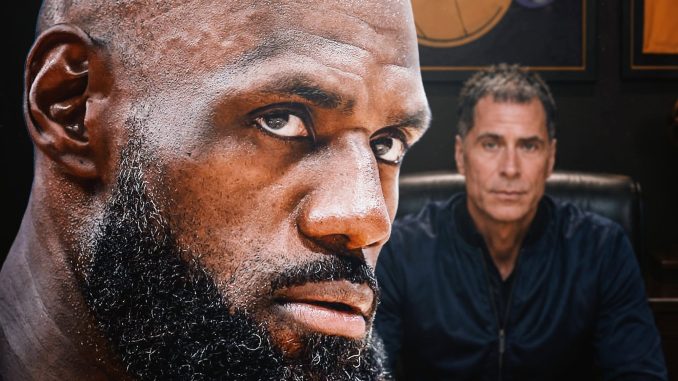
As the Los Angeles Lakers prepare for what could become one of the most consequential offseasons in franchise history, attention around the organization continues to center on one question that will shape every major decision moving forward: what comes next for LeBron James?
League sources around the NBA expect James to pursue a maximum contract extension or opt into a financial arrangement that keeps him among the league’s highest-paid players, a move that places the Lakers in a difficult position as they attempt to balance short-term championship aspirations with long-term organizational planning. The situation is expected to dominate discussions inside the front office throughout the summer, especially as the franchise weighs the realities of building around a player who remains elite but is entering the latter stages of one of the most remarkable careers professional sports has ever seen.
For more than two decades, James has consistently defied expectations regarding longevity. At an age when most NBA legends have long since retired, he continues to produce numbers that would qualify as All-NBA caliber for players a decade younger. His impact on the court remains undeniable. He still serves as one of basketball’s premier playmakers, remains a highly efficient scorer, and continues to elevate teammates through his leadership and basketball intelligence.
Yet despite those accomplishments, the Lakers face a challenge that virtually every organization eventually encounters when led by a generational superstar. Determining how long to commit significant salary cap resources to an aging icon becomes increasingly complicated, particularly under the NBA’s new collective bargaining agreement, which places stricter penalties on teams operating above the league’s luxury-tax thresholds.
For the Lakers, the stakes are especially high because the franchise finds itself at a crossroads. On one side lies a continued commitment to maximizing James’ championship window. On the other stands the possibility of gradually transitioning toward a future beyond the four-time NBA champion.
The difficulty is that both timelines currently exist simultaneously.
James remains productive enough to justify a massive financial commitment. Few executives around the league would argue otherwise. Even in his 40s, he continues to impact winning at a level that most franchises would gladly pay for. However, every dollar committed to James also affects the Lakers’ flexibility in building the roster around him.
That balancing act has become increasingly important as the organization evaluates its championship chances in an extremely competitive Western Conference. Teams across the league have become younger, deeper, and more athletic. While James continues to perform at an elite level, maintaining a championship-caliber roster requires significant investment in surrounding talent.
The Lakers have spent the last several years attempting to strike that balance. Since capturing the 2020 NBA championship, the franchise has repeatedly reshaped its roster through trades, free-agent signings, and coaching changes in an effort to remain competitive. Some moves have generated positive results, while others have failed to produce the desired outcome.
Now, the organization once again faces critical decisions regarding roster construction, financial flexibility, and overall direction.
A major factor influencing those discussions is James himself.
Throughout his career, James has consistently leveraged his status as one of basketball’s biggest stars to maintain significant influence over team-building decisions. His presence instantly raises expectations. Any franchise employing James is expected to compete for championships rather than merely develop young talent.
That expectation has followed him from Cleveland to Miami, back to Cleveland, and eventually to Los Angeles. It has helped produce championships everywhere he has played, but it has also created pressure to prioritize immediate success.
The Lakers understand that reality better than most.
Since James arrived in Los Angeles in 2018, the franchise has transformed into one of the NBA’s premier destinations once again. National television appearances increased. Global attention intensified. Sponsorship opportunities expanded. The Lakers became a consistent headline-generating organization largely because of James’ presence.
Those benefits extend far beyond the basketball court.
James remains one of the most recognizable athletes in the world. His value to the Lakers encompasses ticket sales, merchandise revenue, television ratings, marketing opportunities, and overall franchise visibility. When evaluating a potential maximum contract, the Lakers are not simply assessing a player’s statistical production. They are evaluating an entire business ecosystem built around one of sports’ most influential figures.
From that perspective, retaining James remains an attractive proposition.
However, basketball considerations cannot be ignored.
The Lakers’ front office must determine whether allocating maximum-level money to James aligns with the team’s long-term championship strategy. The answer is not necessarily straightforward.
A maximum contract commitment could limit financial flexibility at a time when the organization may need additional resources to improve the supporting cast. The Western Conference continues to feature several contenders with younger cores and greater roster depth. Competing against those teams requires smart asset management and careful salary-cap planning.
At the same time, allowing James to leave or refusing to meet his contract expectations could create an entirely different set of problems.
Beyond the obvious public-relations implications, losing James would signal the end of an era and potentially accelerate a rebuilding process the franchise may not yet be prepared to undertake. Such a scenario would force the Lakers to rethink virtually every aspect of their organizational strategy.
The presence of Anthony Davis further complicates matters.
Davis remains one of the league’s premier two-way players and is still capable of serving as the foundation of a championship contender. The Lakers must evaluate whether maintaining a partnership between Davis and James provides the best path toward another title or whether future roster decisions should increasingly prioritize Davis’ timeline.
For years, Davis and James have formed one of the NBA’s most recognizable star duos. Their partnership delivered a championship and numerous playoff appearances. Yet as James advances deeper into his career, questions about succession planning naturally become more prominent.
How aggressively should the Lakers invest in the future while still trying to win now?
How much financial flexibility should be sacrificed in pursuit of one more championship run with James?
And perhaps most importantly, how long can the organization realistically sustain its current approach?
Those questions have no easy answers.
League executives widely believe James still views himself as a championship-level player capable of competing for titles. His performance suggests that confidence is justified. Few players in NBA history have maintained such a high level of excellence for so long.
Throughout the most recent season, James continued to produce impressive scoring numbers while serving as a primary offensive initiator. His ability to control the pace of games, create opportunities for teammates, and deliver in critical moments remained evident.
Opposing coaches continue to game-plan extensively for him. Defenders still struggle to contain him in transition. His basketball IQ remains unmatched by most players in the league.
Those realities strengthen the argument that James deserves another lucrative contract.
From his perspective, pursuing maximum compensation represents a logical position. He has earned that leverage through decades of elite performance. Every major contract negotiation throughout his career has reflected his status as one of basketball’s most valuable assets.
The Lakers therefore face a familiar scenario.
They understand James’ value.
James understands his value.
The challenge lies in determining how that value fits into the franchise’s broader vision.
Adding another layer of intrigue is the uncertainty surrounding the Lakers’ competitive outlook. While the team remains talented, questions persist regarding roster depth, perimeter defense, shooting consistency, and overall durability. Addressing those issues may require significant offseason moves.
Any major acquisition, however, will likely be influenced by James’ contract situation.
Potential trade targets, free agents, and rival executives will closely monitor the Lakers’ financial decisions. A substantial commitment to James could impact what additional moves become feasible.
Nevertheless, there remains a strong belief throughout league circles that the Lakers and James ultimately share a mutual interest in continuing their partnership.
The relationship has been beneficial for both sides.
James achieved one of the most significant accomplishments of his career by helping restore championship relevance to the NBA’s most glamorous franchise. The Lakers, meanwhile, secured a transformational superstar whose arrival immediately altered the trajectory of the organization.
That history creates a foundation for continued collaboration.
Still, sentiment alone cannot drive decision-making in today’s NBA.
The league’s financial landscape has evolved dramatically. Front offices now operate under stricter constraints than ever before. Every contract decision carries significant ramifications.
For the Lakers, those ramifications extend beyond the upcoming season.
The franchise must consider where it wants to be three years from now, five years from now, and even a decade from now. Maintaining competitiveness today cannot come at the expense of completely compromising future flexibility.
Yet championship opportunities are precious and often fleeting.
Organizations spend years searching for players capable of leading title pursuits. James remains one of those players. Even at this stage of his career, few executives would willingly move on from a superstar of his caliber if a realistic path to contention still exists.
That reality may ultimately determine the outcome of this offseason’s negotiations.
The Lakers are not simply negotiating with an aging veteran. They are negotiating with arguably the most accomplished active player in basketball, a global icon whose impact transcends statistics.
Every conversation surrounding James inevitably involves both basketball and legacy.
The next contract could represent one of the final major agreements of his career. It could define how the closing chapters of his NBA journey unfold. It could also shape how the Lakers transition into their next era.
Whether that era begins immediately or remains several years away depends largely on decisions made in the coming months.
As offseason discussions intensify, league observers expect James to seek the maximum value available to him. Such a stance would hardly be surprising given his résumé, production, and continued influence around the league.
The Lakers must now determine how aggressively they are willing to invest in extending a championship window built around one of the greatest players the sport has ever seen.
For a franchise defined by stars, championships, and ambitious expectations, the decision carries enormous significance.
The outcome will not only impact the Lakers’ roster for next season but could ultimately shape the future direction of one of basketball’s most storied organizations.
As negotiations loom and speculation grows, one thing remains clear: the next chapter of the Lakers’ future begins with LeBron James, and the choices made this offseason may define the franchise for years to come.
Be the first to comment