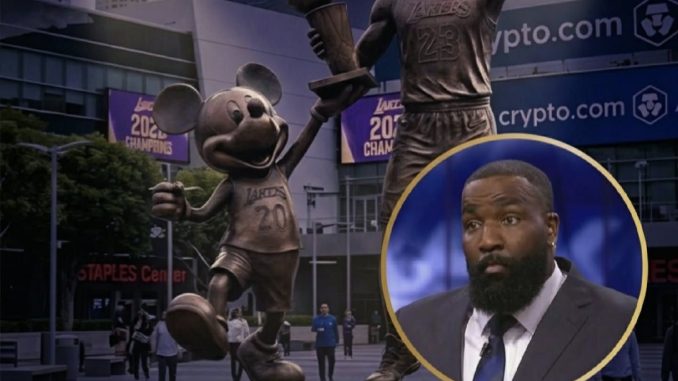
When former NBA champion and current analyst Kendrick Perkins speaks about the league’s biggest names, the conversation rarely stays small. It often stretches into legacy, permanence, and the kind of basketball immortality that only a handful of players ever truly reach. His latest stance on LeBron James falls firmly into that category, as Perkins made it clear he believes the Lakers superstar has done more than enough to earn one of the highest honors in sports culture: a statue outside Crypto.com Arena.
The statement, simple on the surface, lands with significant weight given the history attached to the building and the franchise LeBron James has helped define in the modern era. In the city of Los Angeles, where legends are not only made but permanently cemented in bronze and stone, the idea of a statue is not just symbolic—it is a declaration of generational impact. And in Perkins’ eyes, that declaration has already been written.
For Perkins, the argument begins with resume, but it does not end there. LeBron James arrived in Los Angeles in 2018 with expectations that bordered on impossible. The Lakers were in the midst of a transitional phase, searching for identity after the post-Kobe Bryant era. The pressure that comes with wearing the purple and gold is already immense, but adding the shadow of championship expectations only intensified the spotlight. Within two years, James delivered exactly what the franchise had been chasing: a championship inside the NBA bubble in 2020, a title that carried both emotional and historical weight during one of the most unusual seasons in league history.
That championship alone, Perkins has often argued, would have been enough to secure James a permanent place in Lakers lore. But the résumé stretches far beyond that single triumph. Since joining the franchise, LeBron has continued to defy the typical aging curve, producing All-NBA caliber seasons deep into his late 30s while simultaneously redefining what longevity in professional basketball can look like. For Perkins, that sustained excellence is part of the statue conversation just as much as any trophy or Finals MVP award.
The idea of statues in Los Angeles basketball history is not taken lightly. The most iconic tribute outside the arena belongs to Kobe Bryant, whose legacy is deeply woven into the fabric of the Lakers franchise. Any discussion of adding another statue inevitably invites comparisons, scrutiny, and emotional debate among fans who see each monument as a sacred representation of greatness. Perkins, however, has never shied away from placing LeBron in that same echelon of historical significance, even if their paths to greatness differ in style, duration, and narrative.
What makes Perkins’ position particularly notable is not just the endorsement itself, but the timing. LeBron James is still an active player, still adding to his statistical totals, still influencing games in ways that defy conventional expectations for someone in his 40s. Typically, statue conversations are reserved for players whose careers have fully concluded, whose legacies are complete and fully measurable. But in LeBron’s case, the argument has become a moving target—every season adds new evidence, every milestone expands the case, and every postseason appearance renews the debate.
Perkins has repeatedly emphasized that LeBron’s value cannot be captured solely through championships or MVP awards, though both categories are already well-stocked in his career portfolio. Instead, he frames James as a transformational figure whose influence spans eras, systems, and even player archetypes. From his early years in Cleveland, through the Miami championship run, and into his leadership role with the Lakers, LeBron has consistently functioned as a franchise centerpiece capable of reshaping team identity almost overnight.
In Los Angeles specifically, that transformation has been visible in both tangible and intangible ways. On the court, James has served as the engine of multiple playoff runs, often shouldering responsibilities as scorer, facilitator, and on-court strategist simultaneously. Off the court, his presence has helped restore a championship standard to a franchise that demands nothing less. For Perkins, that dual impact strengthens the argument for immortality in bronze.
Still, the statue conversation is never purely statistical. It is emotional, cultural, and often subjective. Lakers history is filled with legends whose contributions are measured not just in wins, but in moments that defined eras. Magic Johnson, Kareem Abdul-Jabbar, and Kobe Bryant each occupy different chapters in that story, and any comparison to LeBron James inevitably invites questions about how eras should be weighed against one another. Perkins’ stance cuts through that debate by focusing on influence rather than hierarchy.
According to Perkins, greatness at LeBron’s level is not about replacing the past but extending it. In his view, James did not come to Los Angeles to overshadow what came before him, but to add another layer to an already towering legacy. That perspective aligns with a broader shift in how modern NBA careers are evaluated, especially for players whose longevity allows them to impact multiple generations of fans and teammates.
The conversation also reflects a growing sentiment among analysts and former players who believe LeBron’s career has reached a point where historical acknowledgment is no longer optional—it is inevitable. Whether or not a statue is eventually erected is a decision for the franchise and time itself, but Perkins’ comments signal that within basketball circles, the debate has already moved past “if” and toward “when.”
Part of what fuels that inevitability is the statistical landscape James continues to reshape. He remains among the league’s most productive players in key categories well into an age where most all-time greats have long since retired. His scoring milestones have rewritten record books, his assist totals reflect an evolving playmaking mastery, and his durability has challenged long-standing assumptions about athletic decline. Perkins has often pointed to this sustained production as evidence that LeBron’s greatness is not confined to a peak—it is a prolonged era.
Beyond numbers, there is also the matter of cultural impact. LeBron James is not just a basketball player; he is a global figure whose influence extends into business, media, philanthropy, and social discourse. That level of visibility has only amplified his relevance in Los Angeles, a city built on entertainment and legacy storytelling. For Perkins, that broader impact strengthens the case that James belongs among the few athletes whose contributions transcend the game itself.
Of course, not everyone agrees with the urgency of the statue conversation. Critics argue that such honors should be reserved strictly for post-career evaluation, where achievements can be fully contextualized without the influence of ongoing play. Others believe that Lakers history is so rich with iconic figures that adding another statue would require an almost impossible standard. Yet even among skeptics, there is little disagreement about LeBron’s place in the franchise’s modern history.
What separates Perkins’ viewpoint is his willingness to treat LeBron’s legacy as already complete enough for recognition, even as it continues to evolve. In his eyes, James has crossed every threshold necessary to be considered immortalized in Lakers history. The championships, the records, the leadership, and the sustained excellence all combine into a résumé that few players in any era can match.
As the Lakers continue to navigate the future, LeBron’s presence remains both a stabilizing force and a historical anchor. Every game he plays adds another page to a story that already spans two decades of dominance. And for Perkins, those pages have already filled a book worthy of permanent tribute.
Whether or not the franchise ultimately agrees will be determined in time, but the conversation itself is telling. When a player’s legacy is debated not in terms of Hall of Fame inclusion but statue placement, it signals a level of greatness reserved for the very few. In Perkins’ estimation, LeBron James is already there.
Be the first to comment