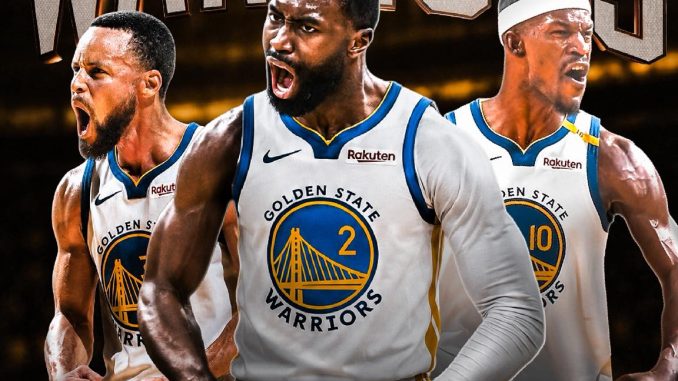
The NBA trade rumor mill has once again turned its attention toward one of the league’s premier two-way stars, and this time, the ripple effects may extend far beyond Boston. According to emerging league chatter, the Golden State Warriors are being positioned as a potential third team in a complex trade framework involving Jaylen Brown, a development that could reshape the competitive balance in both conferences if it ever gains real traction.
While no deal is imminent and conversations remain exploratory at best, the mere suggestion of Golden State’s involvement has already sparked intense speculation across front offices and fan bases. Brown, a cornerstone of the Boston Celtics championship core, is not formally on the trade block in any public-facing sense. However, league insiders increasingly describe the possibility of Boston exploring structural roster adjustments if it believes its current financial and competitive window requires recalibration. That is where the Warriors’ name has unexpectedly entered the conversation.
Golden State’s interest is not rooted in a direct pursuit of Brown in isolation, but rather in the type of multi-team transaction that has become increasingly common under the NBA’s restrictive collective bargaining environment. The new financial rules, particularly those targeting second-apron teams, have made it significantly more difficult for contenders to execute traditional one-for-one blockbuster trades. Instead, franchises are leaning heavily into three- and four-team frameworks where contracts, exceptions, and draft capital can be redistributed in more flexible ways.
For the Warriors, the logic is clear even if the execution is complicated. They remain committed to maximizing the final chapters of their championship core, built around Stephen Curry, Draymond Green, and Klay Thompson’s evolving role. However, Golden State’s front office has also made no secret of its desire to find a younger star who can both ease the offensive burden on Curry and provide long-term stability beyond the current era. Brown, at 28 years old, fits the archetype of a two-way wing who can scale into multiple timelines, though acquiring him outright would be financially and asset-wise difficult.
That is where the “third team” framework becomes strategically significant. In this scenario, Golden State would not necessarily be the team receiving Brown directly. Instead, the Warriors could facilitate salary matching, absorb contracts that other teams are unwilling to take on, or reroute incoming assets in exchange for draft capital or secondary rotation upgrades. Their role would be less about headline acquisition and more about enabling the structural mechanics that allow a larger Boston-centered deal to function under the cap.
From Boston’s perspective, any conversation involving Brown would be extraordinarily sensitive. He remains one of the defining players of their modern era, a multiple-time All-Star, and a critical two-way force who complements Jayson Tatum’s offensive versatility. The Celtics’ decision-making process would hinge not only on talent evaluation but also on financial sustainability. With the new CBA penalties escalating for teams that exceed the second apron, even contending rosters are being forced to consider uncomfortable long-term scenarios.
League executives have privately noted that Boston’s challenge is no longer about whether it can win at the highest level—it clearly can—but whether it can maintain a deep, flexible roster while paying top-of-market salaries to multiple stars. Brown’s contract, while justified by his production, represents a significant cap commitment that becomes more restrictive as the Celtics attempt to retain depth around their core. In that context, rival teams are constantly monitoring whether Boston might eventually entertain conversations that once would have been dismissed outright.
Golden State’s involvement complicates those discussions in several ways. The Warriors are one of the few franchises with the organizational experience and contractual creativity to navigate multi-team trades at scale. They have historically leveraged their championship credibility and willingness to absorb financial complexity to facilitate deals that other organizations cannot structure alone. If they step into a Brown-centered framework, it would likely be because the deal allows them to extract value in other forms—future picks, expiring contracts, or younger rotational pieces that align with their retooling timeline.
However, there is a significant gap between theoretical construction and practical execution. Any deal involving Brown would require Boston to receive substantial immediate value in return, and that creates a cascading set of requirements for every team involved. The Warriors would need to identify assets they are willing to move without compromising their core competitiveness. At the same time, they would need to ensure that any incoming contracts or obligations do not further constrain their already tight financial structure under the league’s most punitive tax brackets.
One of the more intriguing dimensions of this rumored framework is how it reflects the broader evolution of the NBA trade ecosystem. A decade ago, a star of Brown’s caliber being moved would typically center around a single blockbuster exchange between two teams. Today, the league’s financial rules and competitive parity push negotiations into more fragmented arrangements. The Warriors’ emergence as a “third team” is emblematic of how elite franchises are now functioning as both buyers and facilitators simultaneously.
From a basketball standpoint, Brown remains one of the most coveted wings in the league. His combination of perimeter defense, transition scoring, and half-court shot creation makes him uniquely valuable in a league that prioritizes versatility at the wing positions. Any team acquiring him would immediately elevate its playoff ceiling. For Golden State, pairing Brown with Curry—even indirectly through roster reshuffling—would signal an aggressive attempt to extend its championship window in the Western Conference.
Yet league sources caution that these types of discussions often remain exploratory for extended periods without progressing to formal negotiations. The complexity of matching salaries, aligning team incentives, and navigating luxury tax restrictions frequently causes such frameworks to stall before reaching the point of actual proposal exchange. In many cases, teams engage in these conversations as a way to map the market rather than to execute an imminent deal.
Still, the presence of Golden State in this conversation should not be dismissed as routine speculation. The Warriors have consistently demonstrated a willingness to act decisively when they identify a window of opportunity. Their front office, led by Bob Myers’ successor structure, has shown that it is willing to take calculated risks if it believes the reward aligns with the franchise’s championship expectations. If Brown ever becomes genuinely available in a structured deal, Golden State is expected to be among the first teams to re-engage.
For Boston, the calculus is more delicate. Trading Brown would not simply be a basketball decision; it would represent a philosophical shift in how the franchise views its current core. The Celtics are still firmly in contention mode, and moving a player of Brown’s stature would require an overwhelming return package that meaningfully improves both short-term competitiveness and long-term flexibility. That is a high bar, and one that few multi-team frameworks can realistically satisfy.
The Warriors’ potential role as a facilitator adds another layer of intrigue because it underscores how interconnected the league has become at the top end. A single star-level transaction is no longer confined to two front offices negotiating directly. Instead, it often involves a web of organizations with competing priorities, each trying to maximize its own position while enabling the broader structure of the deal. In this environment, teams like Golden State can become indispensable simply by virtue of their flexibility and experience.
As of now, there is no indication that a Brown trade is nearing completion, nor that Boston is actively pursuing a move of that magnitude. But the emergence of Golden State as a possible third-party participant ensures that this storyline will continue to circulate throughout the offseason. In a league defined by rapid shifts and aggressive front office maneuvering, even exploratory frameworks can evolve quickly when the right incentives align.
If nothing else, the rumor serves as another reminder of how volatile the NBA’s upper tier has become. Contending teams are no longer just building for the present—they are constantly evaluating how financial constraints, roster age curves, and trade flexibility intersect. And in that environment, a player like Jaylen Brown does not simply exist as a star; he becomes a central variable in the league’s ongoing recalibration.
Whether this particular framework ever advances beyond preliminary discussions remains to be seen. But the fact that the Golden State Warriors have entered the conversation at all signals that the NBA’s trade landscape remains as fluid and unpredictable as ever, with championship ambitions driving even the most complex and unlikely scenarios.
Be the first to comment