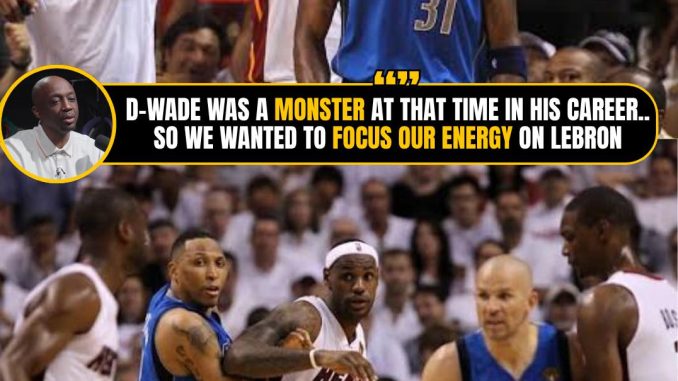
More than a decade after one of the most unforgettable NBA Finals in league history, former Dallas Mavericks guard Jason Terry is still shaking his head when reflecting on the brilliance of Dwyane Wade during the 2011 championship series against the Miami Heat. While the Mavericks ultimately captured the franchise’s first NBA title in six games, Terry recently admitted that Dallas never truly found a way to slow Wade down, even with every defensive adjustment imaginable.
For many fans, the 2011 NBA Finals are remembered as Dirk Nowitzki’s crowning achievement and LeBron James’ most disappointing postseason performance. Yet hidden beneath those larger narratives was Wade’s dominant stretch of basketball that nearly carried Miami to a championship in the first season of the Heat’s famed “Big Three” era.
According to Terry, Wade was simply unstoppable.
“We tried everything,” Terry admitted while reflecting on the series years later. “Different defenders, double-teams, trapping him, forcing him left, forcing him right — it did not work. D-Wade was unbelievable.”
Coming from Terry, the statement carries weight. Known as “The Jet,” Terry was one of the emotional leaders of that championship Mavericks team and one of the fiercest competitors in the NBA during his era. Dallas entered the Finals with confidence after eliminating Kobe Bryant’s defending champion Los Angeles Lakers and surviving a tough Western Conference battle against Kevin Durant and the Oklahoma City Thunder. The Mavericks believed they had the experience, chemistry, and shot-making necessary to beat Miami.
But containing Wade proved nearly impossible.
In the six-game series, Wade averaged 26.5 points, 7 rebounds, and 5.2 assists while shooting efficiently and attacking Dallas relentlessly in transition and in the half court. Every time the Mavericks thought they had found a solution, Wade adjusted. He punished switches, attacked the paint, drew fouls, and consistently made big plays in critical moments.
Terry explained that Dallas entered the series fully aware of the danger Wade posed. Even with all the media attention surrounding LeBron James and the immense spotlight on the Heat’s newly formed superteam, players inside the Mavericks locker room believed Wade remained Miami’s most dangerous player.
“We knew who the engine was,” Terry said. “People talked about LeBron because of the decision and all the pressure around that team, but D-Wade was the guy we feared most. He was the one who could completely take over a game.”
That fear became reality almost immediately.
Wade dominated Game 1, helping Miami secure an opening victory while displaying the explosiveness that made him one of the league’s premier postseason performers. He attacked Dallas defenders off the dribble and repeatedly found gaps in the Mavericks’ defense. Whether it was Shawn Marion, DeShawn Stevenson, Jason Kidd, or Terry himself, no defender consistently kept Wade from reaching his spots.
Dallas attempted to crowd the lane and force Wade into contested jumpers, but his quickness and footwork repeatedly created clean looks. When defenders backed off, he attacked downhill. When they pressured him, he used his body control and patience to finish through contact.
Terry admitted the Mavericks’ coaching staff spent countless hours studying film, searching for even the smallest weakness.
“We watched everything,” Terry recalled. “We looked for tendencies, favorite spots, ways to cut him off. We’d think we had something figured out, and then the next game he’d adjust immediately.”
The challenge became even more complicated because Wade thrived under playoff pressure. Throughout his career, he developed a reputation as one of basketball’s ultimate postseason performers, and the 2011 Finals showcased that mentality once again.
There were stretches in the series where Wade looked capable of winning the championship almost by himself.
In Game 3, Wade delivered one of the most complete performances of the Finals, finishing with 29 points, 11 rebounds, and 3 assists while controlling the game on both ends of the floor. Miami took a 2-1 series lead, and for a moment, it appeared the Heat were on the verge of overwhelming Dallas with star power.
But the Mavericks never panicked.
That composure, according to Terry, ultimately separated Dallas from many of Miami’s previous playoff opponents. Even while Wade torched the Mavericks’ defense, Dallas trusted its veteran leadership and offensive execution.
“We never lost confidence,” Terry said. “That’s what made our team special. We respected how great D-Wade was, but we still believed we could beat them as a group.”
The Mavericks leaned heavily on Nowitzki’s brilliance, Terry’s shot-making, Kidd’s leadership, Tyson Chandler’s rim protection, and timely contributions from role players across the roster. Yet Terry acknowledged that there was never a point where Dallas felt comfortable defending Wade.
“He kept coming,” Terry explained. “No matter the score, no matter the situation, he attacked every possession like it was life or death.”
One of the most frustrating aspects for Dallas defenders was Wade’s versatility. He could dominate in transition, isolate in the midrange, post smaller defenders, and create offense as a playmaker. Even when the Mavericks forced the ball out of his hands, Wade often made the correct read and created opportunities for teammates.
Terry noted that Miami’s spacing and athleticism made doubling Wade risky.
“You couldn’t overcommit because then you leave shooters open or you give LeBron space,” Terry said. “That team had too much talent. But D-Wade was the guy putting constant pressure on us.”
Interestingly, Terry’s comments also highlight how differently the 2011 Finals are remembered today compared to how they unfolded in real time.
Over the years, much of the conversation surrounding the series has focused on LeBron’s struggles. James averaged 17.8 points and was heavily criticized for passive stretches during key moments of the Finals. Meanwhile, Wade’s dominance often gets overlooked despite the fact that he arguably played the best basketball of anyone in the series.
Even Nowitzki, who earned Finals MVP honors after leading Dallas to the title, later acknowledged Wade’s brilliance throughout the matchup.
For Terry, the respect between competitors has only grown stronger with time.
“When you go back and watch those games, you realize just how incredible D-Wade was,” Terry said. “People remember the outcome, but from a player’s perspective, we knew we were dealing with an all-time great at the peak of his powers.”
Wade’s 2011 Finals performance continued a long tradition of postseason excellence that defined his Hall of Fame career. Long before teaming up with James and Chris Bosh in Miami, Wade had already established himself as one of the NBA’s most feared playoff performers.
His legendary 2006 Finals against the Dallas Mavericks remained fresh in the minds of many players entering the 2011 rematch. In that earlier series, Wade averaged 34.7 points and led Miami back from a 2-0 deficit to win the franchise’s first championship.
Terry admitted that history absolutely entered Dallas’ mindset.
“We remembered 2006,” Terry said. “Everybody on that team remembered what he did to us. So going into 2011, we knew exactly what type of challenge we were facing.”
That previous heartbreak became part of Dallas’ motivation throughout the rematch.
The Mavericks were determined not to allow Wade to single-handedly destroy their championship hopes again. Yet despite their improved roster and greater experience, Wade still found ways to dominate.
What changed this time was Dallas’ ability to respond offensively and maintain composure during critical moments.
Terry played a massive role in that resilience. Throughout the Finals, he provided instant offense and timely shot-making off the bench, including several clutch fourth-quarter performances. His confidence never wavered, even when Miami’s defense intensified.
One of the defining moments of the series came in Game 5, when Terry delivered key baskets late in the fourth quarter to help Dallas secure a pivotal road victory. That win gave the Mavericks a 3-2 series lead heading back to Dallas and shifted the pressure firmly onto Miami.
Even then, Terry said the Mavericks understood the danger Wade posed.
“There was never a moment where we relaxed,” Terry explained. “As long as D-Wade was on the floor, we felt like the game could change instantly.”
Wade nearly forced a Game 7 with another outstanding performance in Game 6, finishing with 36 points and battling relentlessly until the final minutes. But Dallas finally completed the upset, capturing the championship in Miami and cementing one of the greatest underdog title runs in NBA history.
For Terry, the celebration represented redemption.
After the painful loss in 2006, many around the league doubted whether the Mavericks could ever win a championship with their core group. Critics questioned their toughness and ability to handle pressure in big moments.
The 2011 run silenced those doubts forever.
Dallas defeated Portland, swept the two-time defending champion Lakers, beat the rising Thunder, and then stunned the heavily favored Heat. Along the way, the Mavericks relied on experience, chemistry, and resilience rather than overwhelming athleticism or superstar depth.
Yet Terry insists the Finals victory should never diminish Wade’s greatness.
“People can say whatever they want about that series, but D-Wade was incredible,” Terry said. “Honestly, he was probably the toughest cover I ever faced in the playoffs.”
That statement is particularly meaningful considering the era Terry played in. During his career, he competed against Kobe Bryant, Allen Iverson, Steve Nash, Kevin Durant, James Harden, and countless elite scorers. Still, Wade’s combination of speed, power, skill, and competitive fire stood apart.
According to Terry, Wade’s mentality made him especially difficult to defend.
“He had no fear,” Terry said. “You could hit him, trap him, force tough shots — it didn’t matter. The bigger the moment, the better he got.”
The respect between the former rivals reflects a broader truth about NBA history: championships often shape narratives so strongly that individual brilliance from the losing side can become forgotten.
In many ways, Wade’s 2011 Finals performance has become overshadowed by Dallas’ triumph and the criticism directe
Be the first to comment