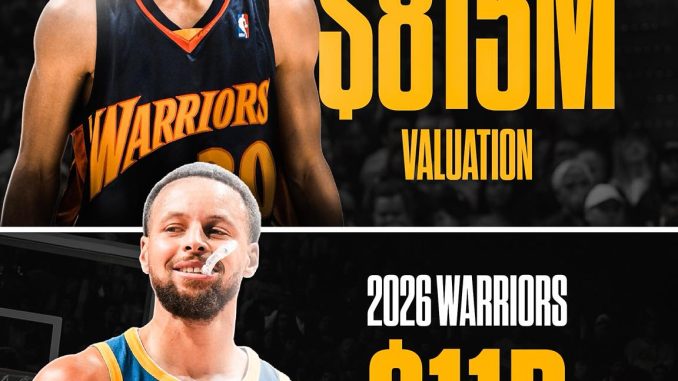
From $315 million to an astonishing $11 billion, the transformation of the Golden State Warriors has become one of the most extraordinary financial and cultural turnarounds in modern sports history. What was once a struggling NBA franchise operating in the shadows of more dominant organizations has evolved into a global basketball empire, powered by a generational superstar, visionary leadership, and a brand of basketball that reshaped the sport itself. At the center of it all stands Stephen Curry, the face of a revolution that turned the Golden State Warriors into a worldwide powerhouse both on and off the court.
When the franchise was purchased for $315 million in 2010 by Joe Lacob and Peter Guber, few could have predicted the scale of what was to come. At the time, the Warriors were considered a mid-tier NBA organization with limited national relevance and a history of inconsistency. They had flashes of competitiveness but lacked the sustained excellence and star power necessary to compete with the league’s elite franchises in market influence. The Bay Area was a strong sports market, but the Warriors were not yet its defining sports identity. That would soon change in ways that redefined the economics of the NBA.
The turning point began with the emergence of Stephen Curry, a slight but electrifying guard whose shooting ability defied traditional basketball logic. Drafted in 2009, Curry initially showed promise but was not immediately projected to become the face of a dynasty. Injuries early in his career raised doubts about his long-term durability. Yet what followed became one of the most remarkable player development stories in league history. As Curry refined his conditioning and the franchise reshaped its system around his strengths, the Warriors began to shift from a rebuilding team into a revolutionary offensive force.
By the time Golden State broke through in 2015, winning its first championship in 40 years, the NBA landscape had already begun to tilt. Curry, alongside Klay Thompson and Draymond Green, formed the core of a new basketball identity defined by spacing, speed, and three-point dominance. The Warriors were no longer just winning games—they were changing how the game was played. Their “Strength in Numbers” philosophy and ball movement-heavy system made them both analytically efficient and visually captivating.
That 2015 championship was more than a title. It was the beginning of a commercial explosion. National television ratings surged. Jersey sales spiked. Global interest in Curry’s shooting artistry spread rapidly across Asia, Europe, and Africa. The Warriors had become appointment viewing, and with that came a dramatic rise in franchise valuation. The $315 million investment was already looking like a historic bargain, but the next phase would elevate the organization into an entirely different stratosphere.
The addition of Kevin Durant in 2016 pushed the Warriors into unprecedented dominance. Already a championship team, Golden State added one of the most gifted scorers in basketball history to a roster featuring Curry, Thompson, and Green. The result was a superteam that overwhelmed the league, winning back-to-back championships in 2017 and 2018 and reaching three consecutive NBA Finals appearances. While critics debated competitive balance, there was no denying the business impact. The Warriors became a global spectacle, drawing massive international audiences and filling arenas across continents.
During this era, the franchise’s valuation skyrocketed. Corporate sponsorships multiplied. Media rights value surged. The Warriors were no longer just a basketball team; they were a premium entertainment property. Every home game at Oracle Arena became a global broadcast event, and the team’s brand identity began to rival some of the most valuable organizations in all of sports. Curry’s signature shooting range and humble persona made him one of the most marketable athletes in the world, and his presence anchored the franchise’s global appeal.
Even after Durant’s departure in 2019, the Warriors’ financial and cultural momentum did not slow. Instead, it set the stage for a redemption arc that further solidified their legacy. The 2022 championship, led by a resurgent Curry, proved that Golden State’s success was not solely dependent on superteam construction but on a deeply embedded organizational philosophy. Curry’s performance throughout that postseason reinforced his status as the defining player of his generation, and the Warriors reclaimed their place atop the basketball world.
By this point, the franchise’s value had entered the multi-billion-dollar conversation. The opening of Chase Center in San Francisco marked a new era of revenue generation. Luxury suites, premium seating, corporate partnerships, concerts, and year-round events transformed the Warriors into a 365-day entertainment business. The arena was not just a basketball venue; it was a commercial ecosystem designed to maximize every aspect of fan engagement and brand monetization.
The $11 billion valuation reflects more than championships alone. It represents a complete transformation in how modern sports franchises operate. The Warriors have become a case study in synergy between on-court success and off-court business innovation. Their ability to pair elite performance with elite branding has set a new benchmark for franchise value in professional sports. Ownership stability, forward-thinking infrastructure, and global marketing strategies have all contributed to a financial ascent that once seemed unimaginable.
At the heart of this empire remains Stephen Curry, whose impact transcends traditional statistical measures. Curry changed defensive schemes across the league. He forced opponents to extend coverage farther than ever before, effectively stretching the geometry of basketball itself. His influence led to a league-wide three-point revolution, with teams prioritizing perimeter shooting and spacing in ways that directly trace back to Golden State’s rise. In many ways, the modern NBA is built in Curry’s image.
The Warriors’ success also reflects a broader shift in sports economics. The rise of digital media, global streaming platforms, and international fan bases has allowed franchises like Golden State to scale beyond regional markets. Curry’s global popularity, particularly in China and emerging basketball markets, has been instrumental in expanding the franchise’s reach. Every highlight, every deep three-pointer, every clutch performance becomes instantly shareable content that fuels the Warriors’ global brand engine.
Meanwhile, the supporting culture around Curry has reinforced the organization’s identity. Klay Thompson’s resilience through injuries and comeback journey has become a fan-favorite storyline. Draymond Green’s defensive brilliance and emotional leadership have defined the team’s competitive edge. Together, they formed not just a roster, but a basketball philosophy rooted in trust, movement, and unselfish play.
The business side of the franchise has mirrored that same cohesion. Strategic investments, data-driven decision-making, and aggressive branding have allowed the Warriors to maximize revenue streams across merchandise, media rights, sponsorships, and live events. Corporate partnerships with global brands have further elevated their financial standing, while innovative fan engagement strategies have strengthened loyalty across generations.
Even in seasons where championship contention has fluctuated, the Warriors’ value has continued to rise. That consistency underscores a key reality in modern sports: winning matters, but brand identity and global influence matter just as much—sometimes even more. The Warriors have mastered both.
From a financial perspective, the leap from $315 million to $11 billion is not just a success story; it is a blueprint. It demonstrates how a franchise can leverage a generational athlete, a revolutionary playing style, and elite organizational planning to create sustained exponential growth. Few teams in sports history have achieved this level of transformation in such a relatively short time.
As the Warriors look ahead, their empire remains firmly intact. Curry continues to defy age expectations, still capable of delivering performances that shift playoff narratives. The organization remains committed to competing at the highest level while maintaining its global brand dominance. Whether or not future championships are added, the foundation of what has already been built is secure.
The Golden State Warriors are no longer just a basketball team that experienced a golden era. They are a global sports institution, a business case study, and a cultural phenomenon. And at the center of that transformation stands Stephen Curry—the shooter who changed the game, and in doing so, helped build an empire valued at $11 billion.
Be the first to comment