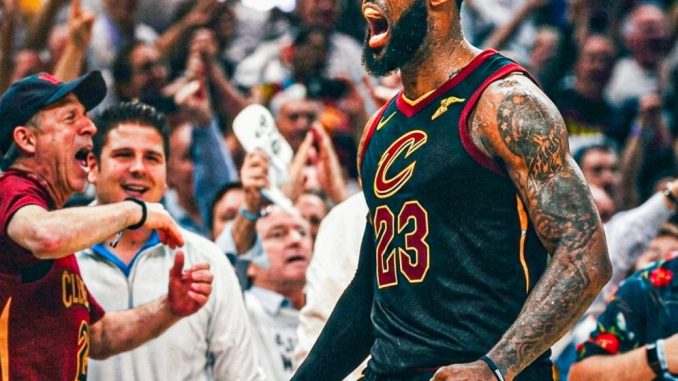
Eight years ago, under the brightest pressure imaginable and with an NBA Finals berth hanging in the balance, LeBron James authored one of the defining performances of his legendary career. Facing elimination on the road against the rival Boston Celtics in Game 6 of the 2018 Eastern Conference Finals, James delivered a masterpiece for the ages, pouring in 46 points to keep the season alive and drag the battered Cleveland Cavaliers to a dramatic 109-99 victory at TD Garden.
It was not merely another great playoff performance. It was survival basketball at its purest. Cleveland entered Boston facing a 3-2 series deficit, exhausted from a grueling postseason run and already operating with virtually no margin for error. To make matters worse, All-Star forward Kevin Love was ruled out early after suffering a concussion during a collision with rookie forward Jayson Tatum in Game 6. The Cavaliers, already top-heavy and overly dependent on James, suddenly lost their second-leading scorer and one of their few reliable rebounders before the biggest game of the season.
The circumstances only amplified the challenge awaiting James. Boston had been nearly unbeatable at home throughout the playoffs. The Celtics possessed youth, depth, elite defensive versatility, and an electric crowd sensing the franchise’s first Finals appearance since 2010. On the opposite side stood James, carrying a roster many believed had overachieved simply by reaching the conference finals. Yet in that hostile environment, with Cleveland’s season on the brink, James responded with a performance that further cemented his reputation as one of basketball’s greatest elimination-game players.
From the opening tip, James played with a level of force and urgency that immediately silenced the Boston crowd. He attacked the rim relentlessly, controlled the pace offensively, and imposed his will on every possession. The Celtics tried multiple defenders — Tatum, Jaylen Brown, Marcus Morris, even brief help schemes from Al Horford — but none could slow him down consistently. James scored from everywhere on the floor, bulldozing through contact in transition, drilling contested jumpers, and finishing through swarming defenders in the paint.
By halftime, James already had 25 points, keeping Cleveland afloat despite Boston’s physical defense and emotional energy. Every time the Celtics threatened to seize momentum, James answered. When Boston’s crowd erupted after a Tatum dunk or a Terry Rozier three-pointer, James calmly responded with a driving layup, a pull-up jumper, or a pinpoint assist that stabilized the Cavaliers.
What made the performance even more remarkable was the workload James shouldered. He played 46 minutes, essentially operating as Cleveland’s primary scorer, playmaker, rebounder, and emotional leader simultaneously. The Cavaliers’ offense revolved entirely around him, yet Boston still could not stop him despite knowing every possession would begin and end with James.
The statistical line alone remains staggering: 46 points, 11 rebounds, 9 assists, 3 steals, and 1 block while shooting efficiently against one of the league’s top defenses. But the numbers only tell part of the story. The true greatness of the performance lay in the timing and pressure attached to every basket.
Late in the third quarter, with Boston attempting to cut into Cleveland’s lead, James delivered one of the game’s signature sequences. He powered through contact for a tough and-one finish, then followed it moments later with a deep three-pointer that pushed the Cavaliers back in control. TD Garden, which had been deafening throughout the series, suddenly grew quiet as James systematically dismantled the Celtics’ confidence.
The fourth quarter became a showcase of pure championship composure. Boston repeatedly tried to rally behind its young stars, but James refused to let the Cavaliers collapse. He controlled tempo, hunted favorable mismatches, and generated quality looks whenever Cleveland’s offense appeared stagnant. His leadership extended beyond scoring, constantly directing teammates into position and demanding sharper defensive rotations.
While James deservedly captured the spotlight, the Cavaliers also received crucial contributions from supporting players who rose to the occasion. George Hill delivered timely shooting and steady ball-handling under pressure. Jeff Green provided valuable scoring and defensive versatility, helping compensate for Love’s absence. Kyle Korver stretched the floor with key perimeter shooting, while Tristan Thompson battled relentlessly on the glass against Boston’s frontcourt.
Still, the night belonged to James. It was another chapter in a postseason résumé already overflowing with iconic elimination-game heroics. Throughout his career, James repeatedly demonstrated an ability to elevate his game when facing playoff extinction, but the 2018 run represented something uniquely exhausting and spectacular. Unlike earlier championship-caliber rosters in Miami or Cleveland, this Cavaliers team relied almost entirely on James’ brilliance to survive.
The 2018 postseason became a marathon of legendary performances from James. Earlier in the playoffs, he torched the Indiana Pacers in a grueling seven-game first-round series, including a game-winning buzzer-beater in Game 5. He then dismantled the top-seeded Toronto Raptors in the second round, hitting another unforgettable game-winner in Game 3. By the time Cleveland reached the conference finals, James was already carrying one of the heaviest postseason burdens ever seen from a superstar.
Against Boston, that burden intensified further. The Celtics, coached masterfully by Brad Stevens, were fearless despite the absence of injured stars Kyrie Irving and Gordon Hayward. Young players like Tatum and Brown blossomed under playoff pressure, while veterans such as Horford and Morris gave Boston toughness and composure. Many observers believed the younger, deeper Celtics were poised to finally dethrone James in the East.
Instead, Game 6 became another reminder that postseason basketball often bends to transcendent greatness.
James attacked the Celtics mentally as much as physically. He dictated pace, manipulated defensive matchups, and forced Boston into uncomfortable rotations. When defenders sagged, he punished them with jumpers. When they pressed higher, he bulldozed into the lane. Every defensive adjustment Boston attempted seemed temporary because James processed the game at a level few players in league history ever reached.
The atmosphere surrounding that game added even more significance. Cleveland’s roster had undergone massive turnover during the season, including midyear trades that reshaped nearly half the team. Questions surrounded chemistry, consistency, and whether James could realistically drag such an uneven group back to the Finals. Many analysts viewed Boston as the fresher, more balanced team. Yet James turned the series into a personal test of willpower.
Perhaps the most memorable aspect of the performance was the expression James wore throughout the night. There were few smiles, few celebratory gestures, and almost no emotional outbursts. Instead, he played with a cold, relentless focus that reflected the magnitude of the moment. Every possession felt deliberate. Every drive carried force. Every defensive rotation seemed fueled by urgency.
By the closing minutes, the Celtics simply ran out of answers. James’ final dagger came on a powerful drive through traffic that effectively ended Boston’s comeback hopes. As the clock wound down, Cleveland’s bench erupted in celebration while stunned silence filled TD Garden. The Cavaliers had survived, and James had forced a winner-take-all Game 7 back in Boston.
The victory also reinforced James’ extraordinary reputation in elimination games. Throughout NBA history, many stars have delivered memorable playoff moments, but few consistently elevated themselves under pressure like James. Whether in Miami, Cleveland, or later with the Los Angeles Lakers, his elimination-game performances repeatedly showcased a rare combination of physical dominance, basketball intelligence, and emotional control.
The Game 6 masterpiece ultimately served as the prelude to another unforgettable moment two nights later. In Game 7, James played all 48 minutes and recorded 35 points, 15 rebounds, and 9 assists as Cleveland defeated Boston once again to capture the Eastern Conference title. The Cavaliers advanced to their fourth consecutive NBA Finals, further solidifying one of the most dominant conference reigns in league history.
Although Cleveland would eventually fall to the powerhouse Golden State Warriors in the Finals, James’ 2018 playoff run remains one of the greatest individual postseason campaigns ever witnessed. Many analysts still argue it represented the peak of his basketball powers — a season where his all-around brilliance, mental command, and physical durability reached astonishing levels.
For Boston, the series became an important stepping stone despite the heartbreak. Tatum emerged as a future superstar, Brown continued his ascent, and the young Celtics gained invaluable playoff experience that helped shape the franchise’s future identity. But on that night in Game 6, their growth story collided with one of the greatest players ever at the absolute height of his powers.
Eight years later, the performance still stands as a defining image of playoff basketball excellence. It represented everything that makes postseason sports unforgettable: pressure, adversity, legacy, and the ability of a transcendent athlete to rise above impossible expectations.
James has delivered countless iconic moments throughout his career — championships, MVP seasons, buzzer-beaters, record-breaking achievements — yet the 46-point masterpiece in Boston remains especially revered because of the circumstances surrounding it. The Cavaliers were undermanned. The opponent was dangerous. The environment was hostile. The margin for error was nonexistent.
And still, James found another level.
For basketball fans, Game 6 of the 2018 Eastern Conference Finals endures as more than just a great statistical performance. It remains a symbol of competitive greatness under maximum pressure. It was the night James once again reminded the basketball world that when elimination loomed, few players in sports history were more terrifying.
The performance also deepened the mythology surrounding James’ postseason legacy. Long before debates about championships, rankings, or eras dominate conversations, nights like that one in Boston showcased the essence of his greatness: durability, adaptability, brilliance, and an unmatched capacity to carry teams through impossible situations.
Even years later, highlights from that game continue circulating across basketball media, often accompanied by the same sense of awe. Younger fans study it as a lesson in playoff dominance, while longtime observers recognize it as one of the final masterpieces from James’ second Cleveland era. It was vintage LeBron — overwhelming physically, surgical mentally, and utterly unstoppable when everything was on the line.
In the history of elimination games, few performances have matched the combination of pressure, production, and historical weight that James delivered that night. Down 3-2. On the road. Without Kevin Love. Against a rising rival. With an NBA Finals trip hanging in the balance.
Forty-six points later, the Cavaliers were still alive, and basketball history had gained another unforgettable chapter from the extraordinary career of LeBron James.
Be the first to comment