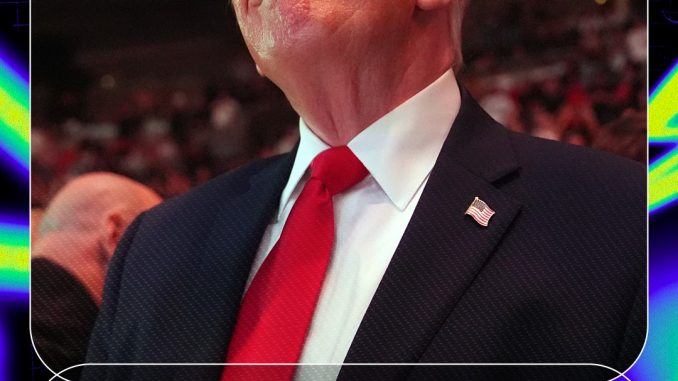
New York — The stage is already set for what promises to be one of the most politically and culturally charged nights in modern NBA history, as reports indicate that Donald Trump is expected to attend Game 3 of the NBA Finals at Madison Square Garden when the New York Knicks host. According to the New York Post, the potential appearance would place the former president — and current sitting U.S. president, depending on the timing of the report’s framing — in a moment that has never before been recorded in the league’s championship history: a sitting American president attending an NBA Finals game.
If confirmed, the visit would instantly elevate an already high-stakes Finals matchup into something far beyond basketball. It would merge the sport’s biggest annual showcase with the most recognizable political office in the United States, creating a convergence of sport, celebrity, security, and national attention rarely seen even at Madison Square Garden, a venue long known for hosting marquee cultural moments.
The Knicks, who have surged into the Finals with a resilient postseason run, are preparing for what is expected to be one of the most scrutinized home games in franchise history. The Garden has seen presidents before, celebrities of every magnitude, and countless championship moments across decades, but the presence of a sitting U.S. president at an NBA Finals game would mark an unprecedented milestone for the league and for the sport itself.
The New York Post first reported the expectation of Trump’s attendance, noting that preparations are being made for a high-security environment around the arena. While official confirmation from the White House or NBA has not been issued, the mere possibility has already shifted the narrative surrounding Game 3. What would typically be analyzed through matchups, rotations, coaching decisions, and momentum swings is now layered with an additional dimension: national security logistics, political symbolism, and the optics of presidential presence at one of basketball’s most iconic venues.
Madison Square Garden is no stranger to heightened security, particularly during playoff basketball. However, presidential attendance introduces an entirely different level of protocol. Coordinated efforts between the Secret Service, local law enforcement, and arena security would be required, transforming the area surrounding 7th Avenue into a tightly controlled perimeter. Fans entering the building would likely experience significantly increased screening procedures, extended arrival times, and heightened restrictions on movement throughout the arena.
From a basketball standpoint, Game 3 itself carries immense weight in the context of the NBA Finals. The Knicks, energized by their home crowd, are expected to lean heavily on their defensive identity and physical intensity, while their opponent arrives seeking a pivotal road win that could swing the series. In any NBA Finals, Game 3 often serves as a turning point — not quite the desperation of an elimination game, but far beyond the exploratory feel of Games 1 and 2. Adjustments have been made, tendencies have been studied, and now execution under pressure becomes the defining factor.
The added presence of a sitting president in the building would only amplify that pressure. Players on both sides would inevitably be aware of the historical backdrop unfolding beyond the court. Coaches, too, would have to manage not just tactical decisions but the emotional rhythm of a game played under an intensified spotlight. For young players experiencing their first Finals run, the moment would become even more surreal, as the usual roar of a New York playoff crowd is layered with the awareness of national attention seated just a few rows away from the hardwood.
Historically, American presidents have attended major sporting events, from Super Bowls to World Series games, often using such appearances as symbolic gestures of unity, celebration, or cultural engagement. The NBA Finals, however, have largely remained untouched by presidential presence at that level. While presidents have been photographed attending NBA games in non-Finals contexts, the championship stage — with its global audience and heightened stakes — has remained an unbroken frontier. That is what makes the potential Game 3 appearance particularly significant.
For the NBA, the moment would represent both an opportunity and a challenge. On one hand, presidential attendance at the Finals would underscore the league’s cultural reach and relevance at the highest levels of public life. It would be another signal of basketball’s position as a global sport that intersects with politics, entertainment, and media in ways few other leagues can match. On the other hand, the league would need to carefully manage optics, ensuring that the focus remains on the game itself while accommodating the unavoidable attention that follows a figure of Trump’s stature.
The Knicks organization, meanwhile, would likely approach the situation with a mix of pride and caution. Hosting a Finals game at Madison Square Garden is already one of the most prestigious assignments in professional sports. The building itself, often referred to as “The World’s Most Famous Arena,” has been home to championship boxing, legendary concerts, iconic NHL playoff battles, and some of the most memorable NBA postseason moments in history. Adding a presidential presence would further cement its status as a stage where history is frequently made.
Fans, too, would play a central role in shaping the atmosphere. Knicks supporters are known for their intensity, their loyalty, and their ability to transform the Garden into one of the loudest venues in sports during postseason runs. The intersection of that energy with the presence of a sitting president could create an atmosphere unlike anything seen in recent Finals memory. Every possession, every whistle, every momentum shift would be magnified not just by the stakes of the series but by the awareness of who is watching from a VIP vantage point.
Beyond the arena, the ripple effects would extend across media coverage worldwide. International broadcasts would not only focus on the basketball narrative but also on the historical significance of the attendance. Political analysts, sports commentators, and cultural critics would all converge on the same storyline, dissecting the implications from different angles. For a league that already operates on a global scale, the moment would likely dominate headlines well beyond the sports pages.
Inside the locker rooms, however, the message would likely remain grounded in basketball. Coaches at this stage of the season typically emphasize routine, focus, and emotional control. The challenge would be to prevent external narratives from disrupting preparation. For veteran players, the presence of political figures or celebrities courtside is not new, but the Finals stage amplifies every external factor. The key, as always, would be maintaining discipline through the chaos of spectacle.
There is also the broader question of how such an appearance would be received across different segments of the fan base. The NBA’s audience is diverse, both demographically and ideologically, and presidential appearances in sports venues often generate mixed reactions. At Madison Square Garden, a building that sits at the intersection of sports, entertainment, and New York’s complex cultural identity, reactions could range from enthusiastic recognition to pointed criticism. The league would have to navigate those dynamics carefully, ensuring that the event remains centered on basketball while acknowledging the reality of public discourse.
Still, from a purely sporting perspective, Game 3 already carries enough intrigue to stand on its own. The Finals represent the culmination of a grueling season, and each game becomes a chess match of adjustments, execution, and resilience. Whether it is star players attempting to assert dominance, role players stepping into unexpected heroics, or coaches gambling on tactical shifts, the Finals are where legacies are shaped and rewritten. The presence of a sitting president would not change the outcome on the court, but it would undeniably alter the way the game is remembered.
As anticipation builds, the NBA finds itself once again at the center of a moment that extends beyond basketball. The league has long embraced its role as a cultural crossroads, where sport meets entertainment, business, and global attention. If Donald Trump does indeed attend Game 3 at Madison Square Garden, it would add another chapter to that legacy — one defined not just by the outcome of a game or a series, but by the extraordinary convergence of sport and state at the highest level.
For now, everything remains contingent on confirmation. But even at the level of expectation alone, the spotlight on Game 3 has already intensified. What was already a Finals showdown in one of the most iconic arenas in sports has now become a potential historic moment that could be discussed long after the final buzzer sounds, regardless of who ultimately lifts the championship trophy.
Be the first to comment