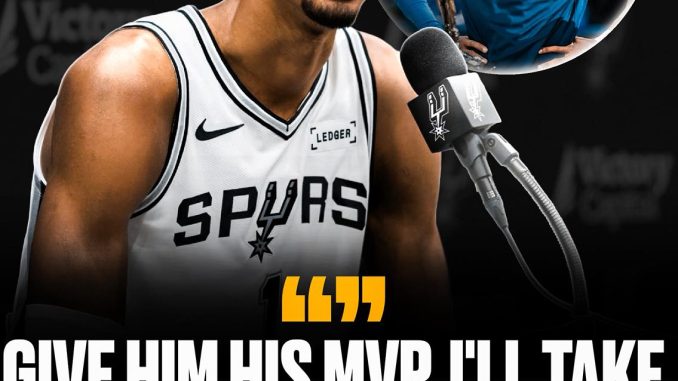
The race for NBA supremacy has officially entered a new era, and at the center of it stand two transcendent stars whose rivalry is rapidly becoming the defining battle of the Western Conference. On one side is Shai Gilgeous-Alexander, the smooth and relentless floor general who captured the league’s Most Valuable Player award after delivering a historic season for the Oklahoma City Thunder. On the other is Victor Wembanyama, the towering phenomenon redefining what basketball greatness can look like for the San Antonio Spurs. While Gilgeous-Alexander walked away with the MVP trophy, Wembanyama delivered a response that instantly sent shockwaves across the basketball world.
“I’ll take the West championship.”
Four words. Calm. Direct. Confident. Yet packed with enough competitive fire to ignite what many already believe will become the NBA’s next legendary rivalry.
The statement came shortly after Gilgeous-Alexander’s MVP victory became official, capping off a sensational regular season in which the Thunder superstar elevated Oklahoma City to the top tier of the league. Gilgeous-Alexander’s brilliance throughout the year was impossible to ignore. Night after night, he dismantled defenses with surgical precision, combining elite scoring, playmaking, and composure that transformed the Thunder from a promising young team into a legitimate championship threat.
But while the MVP trophy recognized individual dominance, Wembanyama’s message made one thing abundantly clear: he is chasing something bigger.
For years, NBA fans have debated the value of individual accolades versus postseason glory. MVP awards immortalize greatness, but championships define legacies. Wembanyama understands that distinction already, and his response carried the mentality of a player whose ambitions extend far beyond personal recognition.
It also revealed the mindset fueling San Antonio’s dramatic rise.
The Spurs entered the season surrounded by curiosity and intrigue. Wembanyama had already captivated the basketball world during his rookie campaign, showcasing an unprecedented blend of size, skill, mobility, and defensive instincts rarely seen in league history. Yet questions remained about how quickly the franchise could transition from rebuilding project to true contender. Many analysts believed the Spurs were still years away from seriously challenging the West’s elite.
Instead, Wembanyama accelerated the timeline.
Game after game, the 7-foot-4 superstar delivered performances that looked less like the development of a young player and more like the emergence of a future all-time great. He dominated defensively with rim protection that altered entire offensive game plans. Offensively, he expanded his arsenal with perimeter shooting, advanced ball handling, post dominance, and an increasingly polished midrange game that left defenders helpless.
More importantly, he transformed the culture of the Spurs.
San Antonio suddenly began playing with belief again. The organization that once built a dynasty around Tim Duncan rediscovered the championship expectations that defined its golden years. Veterans embraced their roles. Young players developed confidence. Opponents started viewing the Spurs not as an exciting young team, but as a dangerous postseason opponent nobody wanted to face.
And leading it all was Wembanyama.
The MVP race between Gilgeous-Alexander and Wembanyama became one of the season’s most fascinating storylines. Both players delivered historic campaigns in completely different ways. Gilgeous-Alexander’s consistency, leadership, and offensive brilliance made him the centerpiece of Oklahoma City’s rise. Wembanyama, meanwhile, produced numbers and defensive impact that often felt unprecedented for a player so early in his career.
The debate split fans, analysts, and former players across the basketball landscape.
Some argued Gilgeous-Alexander deserved the award because of Oklahoma City’s superior regular-season success and his ability to control games as an elite primary scorer. Others believed Wembanyama’s two-way dominance represented the most valuable overall impact in basketball. Advanced metrics frequently favored the Spurs superstar, while traditional MVP narratives leaned toward Gilgeous-Alexander’s leadership atop the standings.
In the end, the voters sided with Gilgeous-Alexander.
Few could argue against the choice. The Thunder guard earned it with a season that firmly established him among the league’s absolute elite. Yet Wembanyama’s response ensured that the conversation would not end with the award announcement.
Instead, it escalated.
His declaration about taking the Western Conference championship immediately spread across social media, television broadcasts, and NBA locker rooms. Fans praised the confidence. Analysts called it the perfect competitive response. Former players admired the mentality behind the statement. Rather than expressing frustration over losing MVP, Wembanyama shifted the focus directly toward postseason success.
That mentality is precisely why many around the league believe he is destined for greatness.
Superstars are often judged not by how they respond to victories, but by how they react when denied recognition. Some players become distracted by perceived disrespect. Others allow disappointment to linger. Wembanyama instead turned the moment into motivation, using the MVP result as fuel for a bigger mission.
And perhaps most importantly, he backed it up with his play.
Throughout the postseason, Wembanyama elevated his game to another level. His performances consistently reminded everyone why so many believed he deserved MVP consideration in the first place. He protected the rim like a defensive player from another era while simultaneously stretching defenses offensively in ways no center before him ever has.
Opponents struggled to solve the impossible puzzle he presents.
Double-team him inside, and he punishes defenses with passing and perimeter skill. Leave him one-on-one, and his combination of length, touch, and agility becomes unstoppable. Attack the basket against him, and shots disappear into the atmosphere under the reach of his endless wingspan.
The impact extended beyond statistics.
Every game seemed to carry moments that reinforced Wembanyama’s growing mythology. Impossible blocks. One-legged three-pointers. Coast-to-coast drives. Defensive recoveries no player his size should physically be capable of making. The NBA has seen dominant big men before, but it has never seen one quite like this.
That uniqueness is why comparisons to legends have become unavoidable.
Some see shades of Kevin Durant in his scoring fluidity. Others compare his defensive instincts to Hakeem Olajuwon. Certain moments evoke memories of Kareem Abdul-Jabbar, while his perimeter skills resemble a player built for basketball decades ahead of his time.
Yet even those comparisons fail to fully capture what makes Wembanyama special.
He is not merely following the path of previous superstars. He is creating a completely new archetype.
That reality makes his rivalry with Gilgeous-Alexander even more compelling.
The Thunder superstar represents precision, rhythm, and control. His game is built on footwork, patience, and an almost hypnotic ability to manipulate defenders. Wembanyama, meanwhile, plays with a style that feels limitless and unpredictable. One dominates through surgical mastery. The other overwhelms opponents with unprecedented versatility.
Together, they symbolize the future of the NBA.
And now, their individual battle has transformed into a war for Western Conference supremacy.
For Oklahoma City, Gilgeous-Alexander’s MVP season validated years of patient rebuilding and organizational vision. The Thunder accumulated young talent, developed chemistry, and built around a franchise cornerstone capable of competing with anyone in the league. Their rise was no accident. It was the product of discipline, scouting excellence, and a superstar entering his prime.
For San Antonio, Wembanyama represents the possibility of another dynasty.
The Spurs have experienced greatness before. Under legendary coach Gregg Popovich, the franchise established one of the most respected cultures in professional sports. Championships became expected. Excellence became routine. But after years of transition following the Duncan era, the arrival of Wembanyama reignited championship dreams in San Antonio.
And suddenly, the Spurs are no longer waiting for the future.
The future is already here.
What makes Wembanyama’s statement so fascinating is that it was not delivered with arrogance or hostility. It felt more like a declaration of intent. A reminder that while individual awards matter, the ultimate goal remains winning at the highest level.
That perspective resonates deeply within championship locker rooms.
NBA history is filled with players who used MVP losses as motivation for postseason greatness. Michael Jordan famously transformed slights into fuel throughout his career. LeBron James often emphasized championships over individual recognition. Kobe Bryant built his legacy around relentless competitive obsession rather than award validation.
Wembanyama appears cut from that same cloth.
At just the beginning of his career, he already speaks with the focus of a veteran superstar obsessed with winning. That mentality should terrify the rest of the league because his physical tools are already extraordinary enough. Combining generational talent with elite competitive drive often produces historically dominant careers.
The timing of his statement also adds another layer to the rivalry.
As the postseason intensifies, every matchup between the Spurs and Thunder now carries amplified significance. Every Wembanyama block against Oklahoma City will become part of the narrative. Every Gilgeous-Alexander scoring explosion will fuel debate. Fans are already circling future matchups on the calendar, anticipating battles that could define the conference for years.
The NBA desperately thrives on rivalries like this.
Magic versus Bird. Jordan versus Isiah. Kobe versus Duncan. LeBron versus Curry. Great eras are remembered not only for championships, but for the superstars who pushed each other toward greatness.
Wembanyama and Gilgeous-Alexander have the potential to become the next iconic chapter in that history.
There is mutual respect between the two stars, but beneath that respect lies unmistakable competitive tension. Elite athletes crave opportunities to measure themselves against other elite players. Gilgeous-Alexander earned the MVP crown. Wembanyama now wants the postseason crown.
And if his statement is any indication, he fully believes San Antonio can take it.
That confidence has spread throughout the Spurs organization.
Teammates speak openly about Wembanyama’s leadership growth and his relentless work ethic behind the scenes. Coaches praise his willingness to absorb film study and defensive concepts. Veterans admire the maturity he displays despite his age. The combination of talent and mentality has transformed him into one of the league’s most feared young leaders.
Opposing players feel it too.
There is a growing sense around the NBA that Wembanyama’s ascent may happen even faster than expected. What once looked like long-term potential now resembles immediate dominance. Every playoff series provides another reminder that the league is dealing with a player who could eventually reshape basketball history.
Still, Gilgeous-Alexander remains firmly in the way.
The Thunder superstar has no intention of surrendering the West to anyone. His MVP season confirmed that Oklahoma City possesses both the talent and composure to compete for championships right now. Surrounded by one of the league’s deepest young cores, Gilgeous-Alexander continues to lead with calm confidence and elite shot creation.
That sets the stage for an unforgettable battle moving forward.
One player owns the MVP trophy. The other is chasing the conference crown. Both are hungry. Both are ascending. Both appear capable of dominating the NBA for the next decade.
And judging from Wembanyama’s bold response, this rivalry is only beginning.
The most dangerous part for the rest of the league may be the message hidden beneath his words. Losing the MVP did not discourage him. It sharpened him. Instead of dwelling on what he failed to win, Wembanyama immediately focused on what still remained available.
The Western Conference championship.
For a player already viewed as one of basketball’s most unstoppable forces, that mindset could prove devastating for the NBA’s balance of power. Because if Wembanyama continues evolving at this pace while embracing the pressure of championship expectations, the Spurs may soon become the conference’s most terrifying team.
And if that happens, his message to Gilgeous-Alexander may eventually become prophecy rather than confidence.
The MVP belongs to Oklahoma City’s superstar.
But Victor Wembanyama is coming for everything else.
Be the first to comment