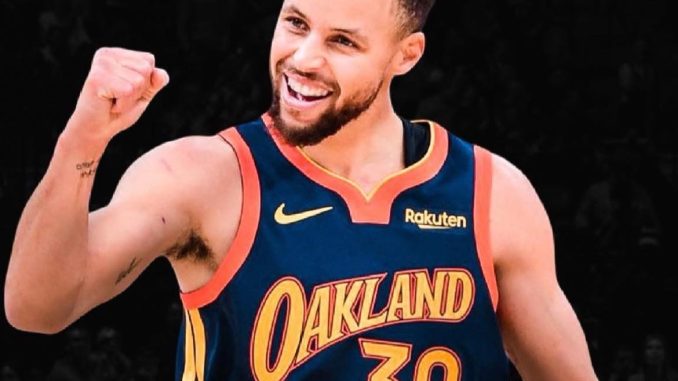
In a season already defined by boundary-pushing offense and a reshaping of what modern NBA excellence looks like, Stephen Curry has once again detonated the record books—this time in a way that may never be replicated. According to league tracking and advanced statistical review, Stephen Curry has become the first player in NBA history to average at least 30 points, 5 rebounds, 5 assists, and 5 made three-pointers per game across a full regular season, an unprecedented statistical combination that fuses volume scoring, playmaking, rebounding impact, and historic shooting gravity into a single campaign.
For a league that has already spent the past decade bending toward Curry’s influence, this season stands as something even more extreme: not just dominance within the modern three-point era, but a statistical threshold that effectively redefines what an elite offensive season can look like. No player before him has simultaneously sustained this level of scoring output while maintaining elite facilitation and rebounding contributions, all while attempting and converting threes at a rate that remains unmatched in NBA history.
The feat is even more striking when contextualized against the physical demands of modern defenses. Opponents have long built entire schemes around limiting Curry’s off-ball movement, trapping him at half court, switching aggressively on screens, and forcing the ball out of his hands at every opportunity. Yet despite being arguably the most heavily guarded perimeter player in basketball history, Curry has not only maintained his scoring efficiency but elevated his overall statistical footprint across every major category.
Within the framework of the Golden State Warriors system, this season has demanded constant offensive recalibration. With defensive attention magnetized toward Curry at all times, Golden State’s spacing has been both a weapon and a necessity, forcing opponents into uncomfortable rotations that open lanes for secondary scorers and cutters. But even in that ecosystem, Curry’s individual production has separated itself from team context and entered historic territory.
The most eye-catching number in the historic quartet is the five made three-pointers per game benchmark. While the league has gradually normalized high-volume three-point shooting, averaging five made threes over an entire season still places a player in an extremely exclusive tier. Doing so while also maintaining 30 points per game elevates the achievement beyond simple volume shooting into sustained offensive overload. Curry has not merely been a prolific shooter—he has been a constant deep-range engine whose gravity warps every defensive possession.
Even more unusual is the inclusion of five rebounds per game. For a guard, particularly one whose offensive role often keeps him beyond the arc, rebounding at that level speaks to anticipation, positioning, and an understanding of long-shot trajectory outcomes. Curry’s rebounding numbers this season reflect not size advantage, but intelligence and timing—reading long misses, rotating into space, and converting defensive possessions into transition opportunities.
The five assists per game threshold further illustrates the completeness of Curry’s offensive command. This is not a scoring specialist operating in isolation, but a primary playmaker functioning within a fluid system that requires constant decision-making under pressure. Curry’s assists this season have often come as a direct consequence of defensive overcommitment: traps at the top of the arc leading to short rolls, corner kick-outs after drive collapses, and quick-hit interior passes when help defenders overextend.
What separates this statistical combination from anything seen before is not just that Curry achieved each benchmark individually, but that he sustained all four simultaneously over the length of a full season. League historians have pointed out that even seasons considered legendary in isolation—whether scoring titles, assist-heavy campaigns, or elite shooting years—rarely overlap in such a balanced configuration. Typically, players sacrifice one statistical category to maximize another. Curry has refused that trade-off entirely.
Analysts have increasingly pointed to Curry’s conditioning and off-ball endurance as key factors behind this historic output. Unlike most high-usage scorers who rely heavily on isolations, Curry’s movement demands constant exertion—sprinting through stagger screens, relocating without the ball, and re-engaging actions multiple times within a single possession. That workload, compounded over 82 games, makes sustained statistical excellence across multiple categories even more remarkable.
Opposing coaches have openly acknowledged the dilemma he presents. Double-teaming Curry risks exposing defensive rotations. Single coverage risks instant scoring from anywhere beyond half court. Switching creates mismatches that Golden State exploits with surgical precision. The result is a paradox: the more aggressively teams try to contain him, the more opportunities he generates—not just for himself, but across every layer of the offense.
This season’s achievement also carries historical implications when measured against past offensive peaks. The NBA has seen dominant scoring seasons from players such as Michael Jordan, Kobe Bryant, and James Harden, but none combined elite scoring with high-volume three-point shooting and significant rebounding and assist contributions in the same statistical harmony. Curry’s season stands apart because it reflects not specialization, but total offensive integration.
Within Golden State’s locker room, the impact of Curry’s performance has been described as both stabilizing and catalytic. Teammates have benefited from the constant defensive gravity he commands, with driving lanes opening and perimeter looks becoming more accessible. Yet there is also an awareness that much of the team’s offensive identity is anchored in Curry’s ability to sustain an almost impossible statistical workload night after night.
Perhaps most remarkable is the efficiency behind the numbers. High volume often leads to diminishing returns, but Curry’s shooting splits and shot selection have remained disciplined even under extreme defensive pressure. His ability to maintain elite production while absorbing physical contact, constant switching, and defensive scheming speaks to an offensive maturity that extends beyond raw talent.
Across the league, rival players and analysts alike have struggled to find precedent. Some point to Wilt Chamberlain’s statistical outliers, others to modern scoring peaks from perimeter stars, but none align perfectly with the combination Curry has delivered. The modern NBA, with its spacing, pace, and emphasis on perimeter shooting, may have been required for such a season to exist—but Curry is the one who has fully realized it.
As the season progresses toward its final stretch and postseason implications intensify, attention is shifting toward how this historic regular season will translate into playoff performance. The Warriors’ championship aspirations remain closely tied to Curry’s ability to replicate, or even approximate, this level of production against playoff defenses that are even more targeted and physical.
Yet regardless of postseason outcomes, this statistical milestone already occupies a unique place in basketball history. The convergence of scoring, playmaking, rebounding, and unprecedented shooting volume represents more than a great season—it represents a structural shift in how elite guard play is defined. Curry has effectively expanded the statistical ceiling for what a perimeter player can be asked to do and still dominate.
What makes this achievement particularly resonant is its cumulative effect on his legacy. Curry has already transformed the game through his shooting range and movement gravity, but this season adds a new layer: durability at statistical extremes. It suggests not just revolutionary skill, but sustained mastery under conditions designed specifically to limit him.
As debates about the greatest offensive players in NBA history continue to evolve, this season will now be cited as a defining reference point. Not because it is simply impressive, but because it is singular. No combination of 30 points, five rebounds, five assists, and five made threes per game has ever been recorded before. It is a statistical intersection that may stand untouched for decades.
And yet, in typical Curry fashion, the most striking aspect is not the record itself, but how naturally it has been produced within the flow of his game. There is no sense of forced accumulation or statistical chasing. Instead, it reflects the byproduct of a system built around motion, spacing, and relentless offensive pressure executed by a player who has spent his career redefining the limits of perimeter basketball.
In a league that constantly evolves, Curry has once again moved it forward—not through a single highlight, not through one iconic moment, but through an entire season of unprecedented production. And in doing so, he has created a statistical line that may one day be referenced the same way the most unbreakable records in sports history are discussed: as something that happened once, to one player, in one extraordinary season, when the game reached a new frontier and he was already there waiting at the edge of it.
Be the first to comment