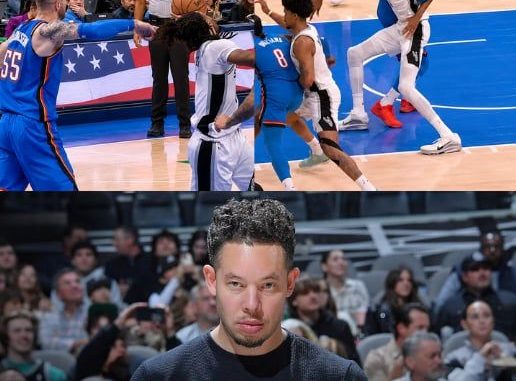
The San Antonio Spurs are reportedly weighing the possibility of legal action against the Game 2 officiating crew following a storm of internal frustration over what team sources describe as “decisive missed calls” involving Oklahoma City Thunder center Isaiah Hartenstein during a tightly contested Western Conference Finals matchup.
While no formal complaint has been publicly filed and the league has not acknowledged any disciplinary proceedings beyond routine postseason officiating reviews, the situation has escalated rapidly behind the scenes, with multiple reports indicating growing tension between Spurs leadership and NBA officiating administrators in the aftermath of the game.
Game 2, which ended in a narrow Thunder victory that evened the series, has become the center of controversy due to several late-game sequences involving physical interior play around Hartenstein that San Antonio personnel believe were not properly adjudicated. According to league observers and team-side interpretations, the Spurs were particularly incensed by a cluster of fourth-quarter possessions in which Hartenstein’s screening actions and rim contests were either not called or were judged inconsistently compared to similar contact earlier in the series.
The most scrutinized sequence came in the final minutes, when San Antonio trailed by a single possession and attempted to attack the paint through Victor Wembanyama and Devin Vassell. On consecutive trips, Hartenstein was involved in heavy contact under the basket while defending drop coverage and boxing out for defensive rebounds. Spurs players immediately gestured toward officials, signaling what they believed were missed fouls on both verticality and rebounding contact. Play continued without stoppage, and Oklahoma City capitalized with a transition score that extended the lead.
Those moments, according to sources familiar with San Antonio’s internal discussions, are now at the heart of the franchise’s frustration. The Spurs reportedly believe that the officiating crew failed to maintain consistency in how physical interior defense was adjudicated, particularly in situations involving Hartenstein’s aggressive positioning in the paint.
San Antonio’s front office has historically avoided public confrontation with league officials, but team insiders suggest that the emotional weight of the Game 2 loss—combined with what they view as a pattern of “selective whistle discipline”—has prompted more serious internal conversations than usual. While the idea of legal action against league officiating is extremely rare in professional sports and would face significant procedural hurdles, the mere consideration underscores the intensity of the Spurs’ reaction.
The NBA, for its part, is expected to conduct its standard postgame officiating review, a process that evaluates calls and non-calls from every playoff game. However, league sources maintain that such reviews rarely result in public acknowledgment of error unless the circumstances are particularly egregious and clearly defined under last-two-minute report standards.
Still, the Spurs’ concerns appear to extend beyond a single reportable stretch. According to individuals briefed on team sentiment, San Antonio believes Hartenstein’s physicality throughout Game 2 pushed the boundaries of legal screening and rim protection, creating what they see as an uneven baseline for officiating interpretation. The Spurs are said to be especially focused on contact occurring off-ball—subtle holds, displacement on box-outs, and extended arm battles that often go unreviewed in real time.
Isaiah Hartenstein’s style of play has long been characterized by physical, high-effort interior defense, and in this series he has played a pivotal role anchoring Oklahoma City’s paint protection scheme. His ability to absorb contact, establish rebounding position early, and disrupt driving lanes has been a key factor in the Thunder’s defensive strategy against San Antonio’s length-heavy offensive attack.
From Oklahoma City’s perspective, there is no indication of wrongdoing or excessive physicality outside normal playoff basketball. Team sources have privately expressed confidence that Hartenstein is simply executing the defensive identity the Thunder have built all season—one that emphasizes toughness, early positioning, and controlled aggression in the paint.
The tension, however, highlights a recurring theme in high-stakes postseason matchups: the fine line between playoff physicality and officiating interpretation. As series intensity rises, referees are often tasked with allowing increased contact while still maintaining control of the game’s flow, a balance that can easily become a flashpoint when outcomes hinge on a handful of possessions.
San Antonio’s frustration was further amplified by what they perceive as inconsistency in foul distribution across both ends of the floor. Spurs personnel reportedly reviewed Game 2 footage shortly after the final buzzer and identified several offensive possessions where they believe Wembanyama absorbed contact on drives without a whistle, as well as defensive sequences where similar contact was called against them on the perimeter.
One league analyst described the situation as “a classic playoff officiating pressure point,” noting that teams often react more strongly to interior no-calls than perimeter ones because of their direct impact on shot efficiency and possession control. “When a big man battle like that turns physical, every rebound, every box-out, every vertical contest gets magnified,” the analyst said. “If a team feels like they’re on the wrong side of those calls, emotions escalate quickly.”
The Spurs’ potential consideration of legal action—while unlikely to progress in a traditional courtroom sense—appears to reflect a broader frustration with how officiating accountability is handled in the NBA postseason. Legal experts familiar with sports governance note that teams have virtually no precedent for successful litigation against officiating decisions, as leagues maintain broad discretion over game administration under collective bargaining and competition rules.
However, symbolic legal threats or formal complaints are sometimes used as leverage to prompt league-level clarification or internal review, even if they are not intended to reach litigation. In this case, sources suggest San Antonio’s internal discussions are more about forcing transparency and consistency in officiating evaluation rather than pursuing an actual courtroom battle.
Within the Spurs locker room, the focus remains split between frustration and forward-looking adjustments. Veteran players have reportedly urged younger teammates to move past the controversy and concentrate on Game 3 adjustments, emphasizing that playoff series rarely turn on single calls in isolation. Still, there is an undercurrent of belief that Game 2 contained “correctable outcomes” that may have influenced momentum at critical junctures.
Head coach staff discussions have centered on how to better counter Oklahoma City’s interior defense without placing themselves in vulnerable positions where officiating interpretation becomes a factor. That includes more perimeter creation, quicker post-entry decisions, and increased spacing to reduce crowded paint scenarios where Hartenstein has been most effective.
On the Thunder side, there is little concern about the controversy affecting performance. Oklahoma City’s coaching staff has reportedly treated the situation as external noise, reinforcing to players that playoff physicality is expected to draw scrutiny when games are tightly contested. For them, Hartenstein’s role remains unchanged: anchor the paint, control defensive rebounding, and disrupt San Antonio’s rhythm inside.
League observers have also noted that physical playoff series often produce moments of disagreement over officiating interpretation, particularly when teams with contrasting styles collide. The Spurs’ length-driven attack and Oklahoma City’s interior resistance set up a natural friction point that tends to amplify every missed whistle or borderline call.
Historically, the NBA has consistently defended its officiating crews in public while handling grievances internally. Even in high-profile controversies, the league typically emphasizes the difficulty of real-time judgment in playoff environments rather than acknowledging systemic issues in single-game contexts. That pattern is expected to continue here unless the official last-two-minute report reveals a clear and impactful error sequence.
As the series shifts toward Game 3, the emotional temperature is rising on both sides. The Spurs are attempting to channel their frustration into competitive urgency, while the Thunder are focused on maintaining composure and home-court execution. Analysts suggest that the officiating storyline, while potentially distracting, is unlikely to define the series unless similar incidents recur.
Still, the fact that legal action is even being discussed—however informally—underscores just how high the stakes have become. In the modern NBA, where every possession is dissected and every playoff moment magnified, officiating disputes have increasingly become part of the broader narrative landscape. But rarely do they escalate to the point where a franchise considers challenging the league’s authority in such an explicit way.
For now, the situation remains fluid, with no official filings, no public statements from the Spurs, and no response beyond standard league protocols. Yet the tension lingers as both teams prepare for Game 3, where the spotlight will inevitably remain fixed not just on the players deciding the series, but also on the officials tasked with ensuring its fairness.
And in a postseason already defined by tight margins and physical battles in the paint, the spotlight on Isaiah Hartenstein—and the whistles around him—shows no sign of fading anytime soon.
Be the first to comment