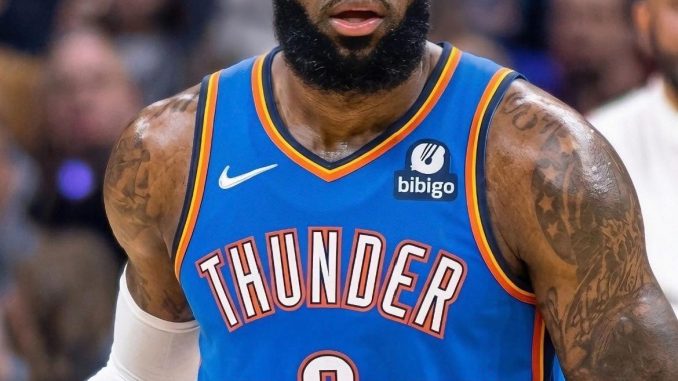
The NBA rumor mill rarely sleeps, but every so often it produces a storyline so seismic that it immediately reshapes how the league is discussed, debated, and dissected across front offices and fan bases alike. The latest entry into that category involves the Oklahoma City Thunder, who have reportedly emerged as a surprise suitor for LeBron James ahead of what would be his unprecedented 24th NBA season. As free agency buzz intensifies across the league, the mere suggestion that one of the NBA’s most historic franchises of the modern rebuild era could be positioning itself for a run at the league’s most iconic active player has sent shockwaves through front-office circles.
According to league chatter circulating among executives and agents, Oklahoma City’s interest is being framed less as a traditional pursuit and more as a calculated exploration of what it would take to inject a championship accelerant into one of the NBA’s youngest and most promising cores. The Thunder, long celebrated for their patient rebuild and asset accumulation strategy, are now at a point where the transition from contender-in-waiting to full-fledged powerhouse is no longer theoretical. They are expected to be aggressive in evaluating veteran additions that could maximize their current window, and the idea of pairing LeBron James with their emerging superstar infrastructure is viewed by some insiders as both audacious and strategically intriguing.
At the center of this conversation is the evolving identity of Oklahoma City’s roster. Built around MVP-caliber guard Shai Gilgeous-Alexander and a deep supporting cast of high-upside players, the Thunder have rapidly ascended from a rebuilding franchise into a Western Conference force. Their playoff progression has already signaled that the foundation is legitimate. However, league observers have long speculated about the next step: whether Oklahoma City would eventually rely solely on internal development or pivot toward a “star accelerator” acquisition model similar to other recent championship contenders.
Enter LeBron James, a player whose mere presence shifts timelines, expectations, and competitive ceilings. Even as he approaches what would be his 24th NBA season, James remains one of the most productive and influential forces in the league. His ability to control tempo, orchestrate offense, and elevate teammates in high-leverage moments continues to separate him from virtually every other player in the modern game. The idea of him joining a young, athletic, defensively versatile Thunder roster immediately raises questions about fit, leadership structure, and long-term vision.
From Oklahoma City’s perspective, the intrigue is understandable even if the execution remains complex. The Thunder have built a reputation for maintaining flexibility while stockpiling draft capital and young talent. This approach has given them optionality that few franchises can match. It also places them in a rare position where a bold swing does not necessarily jeopardize their long-term sustainability. In theory, adding a player of James’ caliber on a short-term arrangement could align with their competitive window while still preserving the developmental trajectory of their core.
The basketball fit, at least on paper, is equally compelling. Gilgeous-Alexander has emerged as one of the league’s most efficient and poised offensive engines, capable of thriving both on and off the ball. His midrange mastery and ability to break down defenses would theoretically complement LeBron’s elite playmaking vision. James, even in his later years, remains one of the best passers in NBA history, capable of transforming the Thunder’s offense into a multi-layered, read-and-react system that punishes defensive breakdowns with surgical precision.
Defensively, Oklahoma City’s identity could also benefit from the presence of a veteran anchor. While LeBron is no longer the relentless perimeter disruptor he once was, his positional awareness, strength, and communication still elevate team defense in meaningful ways. Surrounded by Oklahoma City’s length, athleticism, and switch-heavy schemes, he would not be asked to carry a full defensive burden but rather to stabilize high-pressure possessions and guide younger players through playoff intensity.
Still, the conversation is far from simple. The financial mechanics alone present a labyrinth of challenges. Oklahoma City’s current salary structure, while flexible compared to several luxury-tax teams, is still centered around maintaining long-term control of their young core. Any pursuit of James would likely require intricate cap maneuvering, potential sign-and-trade discussions, or a structured short-term deal designed to preserve future flexibility. League executives familiar with the Thunder’s front office philosophy have long described them as disciplined and calculated, rarely deviating from value-driven decisions unless the upside is overwhelmingly justified.
Then there is the question of timeline alignment. The Thunder are widely viewed as a team entering the heart of their contention window over the next several seasons. LeBron James, while still elite in many respects, represents a short-term commitment at this stage of his career. The tension between maximizing immediate championship probability and preserving long-term dominance sits at the center of any theoretical negotiation. For Oklahoma City, this is not simply about adding talent; it is about determining whether a finite window of greatness can be strategically expanded or accelerated.
On the player side, James’ reported openness to evaluating all competitive opportunities in the twilight of his career adds another layer of complexity. Having already achieved nearly every individual and team accolade available, his decision-making has increasingly been framed around competitive context, legacy considerations, and family-driven factors. The possibility of joining a rising Western Conference powerhouse with a strong developmental culture could appeal from a purely basketball standpoint, particularly if the vision includes championship contention without excessive roster strain.
However, there is also the matter of organizational ecosystem. The Los Angeles Lakers remain deeply embedded in James’ current career narrative, and any departure from that environment would represent not just a roster change but a seismic shift in branding, market dynamics, and legacy framing. Oklahoma City, by contrast, offers a smaller market, a quieter media environment, and a younger locker room culture that differs significantly from the veteran-laden structures James has historically operated within during his championship pursuits.
Around the league, executives are split on the plausibility of the scenario. Some view it as a classic leverage rumor, the kind of strategic noise that surfaces during free agency cycles to influence broader negotiations. Others believe Oklahoma City’s emergence as a suitor—even in preliminary or exploratory terms—signals a philosophical shift within the organization. If the Thunder are truly entertaining the idea of adding a player of James’ stature, it suggests they may be closer to a win-now pivot than previously assumed.
Coaches and analysts have also begun speculating about how such a partnership would function in real time. The most compelling vision involves staggered offensive control, with Gilgeous-Alexander operating as the primary scorer and LeBron orchestrating second-unit transitions or closing lineups depending on matchup dynamics. This dual-engine structure has been successful in various forms across recent championship teams, but rarely with two players of such distinct generational profiles.
What makes the rumor particularly fascinating is not just the names involved but the timing. Oklahoma City’s ascent has been methodical, almost mathematical in its precision. Every step of their rebuild has been deliberate, from draft selection strategy to player development infrastructure. Introducing a variable like LeBron James into that system would represent a dramatic inflection point—one that could either elevate the Thunder into immediate championship contention or disrupt the delicate balance that has defined their rise.
For now, league sources emphasize that discussions remain exploratory at best, with no formal negotiations confirmed. Still, in the modern NBA landscape, where star movement often begins with whispers before escalating into full-scale transactions, even early signals carry weight. Front offices are watching closely, not just to gauge Oklahoma City’s intentions but to understand how the broader free agency ecosystem might respond if such a pursuit gains traction.
The reality is that the NBA has entered an era where traditional roster-building logic is constantly being tested by unconventional alignments. Teams are more willing than ever to blur timelines, blend developmental phases, and prioritize opportunistic championship windows over rigid long-term planning. In that context, the idea of LeBron James joining a young, ascending Thunder squad is no longer as far-fetched as it might have seemed in previous years.
Whether this reported interest evolves into something concrete or remains a fascinating offseason footnote, it underscores a larger truth about the current league landscape: every contender is searching for the final piece, and every legend nearing the end of their career is still capable of reshaping the balance of power.
And in Oklahoma City’s case, the question is no longer whether they are ready to contend. It is whether they are bold enough to redefine what contending looks like.
Be the first to comment