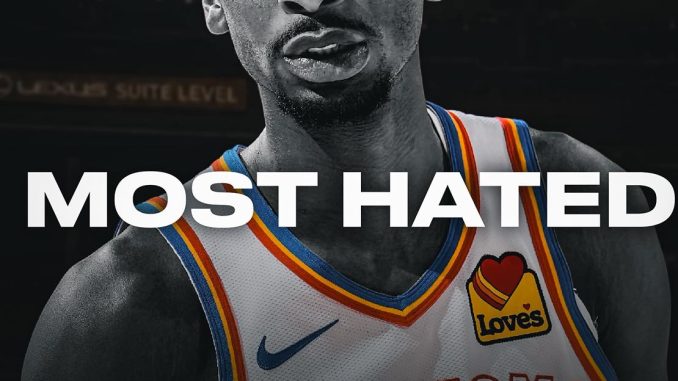
The Oklahoma City Thunder and reigning MVP Oklahoma City Thunder, along with their superstar guard Shai Gilgeous-Alexander, find themselves at the center of one of the most heated stylistic debates in the modern NBA, as questions surrounding foul-drawing, officiating consistency, and the aesthetics of elite shot creation continue to intensify across the league.
What began as a familiar talking point about elite guards maximizing defensive pressure has now escalated into a full-scale narrative battle that follows the Thunder into every nationally televised game. Opposing fans, analysts, and even some former players have increasingly voiced frustration with what they describe as an offense heavily dependent on free throws and contact-seeking drives. In turn, supporters of Oklahoma City argue that the criticism ignores both the evolution of perimeter defense and the skill required to consistently put pressure on defenders at the rim.
At the center of the storm is Gilgeous-Alexander, the league’s reigning MVP and one of its most methodical scorers. His game, defined by pacing, footwork, hesitation moves, and an uncanny ability to manipulate defenders into uncomfortable positions, has made him one of the most efficient guards in basketball. But that same style has also made him one of the most polarizing figures in the league.
Across arenas, particularly on the road, the reaction has become increasingly vocal. Opposing crowds frequently erupt when Gilgeous-Alexander draws contact on drives that result in free throws, and social media discourse often spikes after games in which he records double-digit trips to the line. The phrase “free-throw merchant,” once reserved for fringe online debates, has now entered mainstream basketball conversation, attached—fairly or unfairly—to the Thunder’s offensive identity.
Critics argue that the issue is not simply that Gilgeous-Alexander gets to the line, but how frequently and predictably it happens within the flow of games. They point to his stop-start driving rhythm, his use of subtle arm initiations, and his tendency to lean into defenders as factors that, in their view, place referees in difficult positions. In this framing, the concern is less about rule-breaking and more about exploitation of marginal contact in ways that slow down the pace and disrupt offensive rhythm.
Supporters, however, push back strongly against that interpretation. From their perspective, Gilgeous-Alexander represents the modern evolution of guard play, where controlling space and forcing defenders to commit is as important as traditional shot-making. They argue that drawing fouls is not a byproduct of manipulation, but of skill—specifically the ability to change speeds, absorb contact, and finish through traffic in a league that increasingly emphasizes help defense and rim protection.
Within NBA coaching circles, the debate is often more nuanced than the fan-driven discourse suggests. Some coaches privately acknowledge that Oklahoma City’s offensive system is built to maximize downhill pressure, with spacing and timing designed to force rotations that naturally lead to contact situations. In that sense, Gilgeous-Alexander is not an outlier but the centerpiece of a carefully structured approach that prioritizes efficiency over aesthetic preference.
Still, the volume of free throws remains a focal point. In multiple high-profile matchups this season, Oklahoma City has taken significantly more attempts from the line than their opponents, fueling postgame scrutiny and drawing questions about consistency in officiating. While league officials rarely comment on individual games, the broader pattern has become a talking point among broadcasters and analysts who argue that variability in whistle interpretation is affecting how games are experienced.
Refereeing, always a sensitive subject in the NBA, has now become part of the Thunder narrative whether the organization welcomes it or not. Critics of officiating patterns claim that certain star players are more likely to receive favorable whistle timing, particularly in transition or late-clock isolation scenarios. In contrast, league defenders of current officiating standards emphasize that elite scorers naturally draw more defensive attention and, therefore, more contact.
The Thunder organization, for its part, has largely avoided directly engaging with the controversy. Head coach Mark Daigneault has consistently emphasized execution, spacing, and defensive intensity as the pillars of the team’s success, refusing to be drawn into debates over officiating trends. Internally, the focus remains on maintaining offensive efficiency and continuing the development of a roster built around youth, length, and adaptability.
What complicates the narrative further is Oklahoma City’s rise as one of the Western Conference’s premier teams. Success often amplifies scrutiny, and the Thunder’s rapid ascent has placed them under a brighter spotlight than many of their players have previously experienced. As a result, every high free-throw total is magnified, and every close game becomes a referendum on style as much as outcome.
For Gilgeous-Alexander, the criticism is not entirely new. Throughout his ascent into stardom, he has been characterized as a player who “plays for contact,” a label that has followed him from his early breakout seasons to his MVP campaign. Yet his production has remained consistently elite, with scoring efficiency, mid-range mastery, and composure under pressure serving as the foundation of his game.
The statistical case for his impact is difficult to dispute. He remains one of the league’s most efficient high-volume scorers, regularly producing 30-plus point performances while maintaining strong shooting percentages from multiple areas of the floor. His ability to control tempo and dictate defensive positioning has made him one of the most difficult players to game plan against in the league.
Still, basketball is not only a numbers game—it is also a product shaped by perception. And in today’s NBA landscape, where entertainment value and pace are constantly weighed alongside efficiency, the optics of frequent stoppages carry significant weight. Long free-throw sequences, repeated whistle-driven pauses, and extended reviews can all contribute to a viewing experience that some fans find frustrating, regardless of the legitimacy of the calls.
The Thunder’s offensive identity has therefore become inseparable from this broader discussion. Their style, built on penetration, spacing, and decision-making in tight windows, naturally leads to situations where defenders are forced into reactive positions. In those moments, marginal contact becomes magnified, and referees are tasked with interpreting intent and impact in real time.
Around the league, players have also adapted to similar dynamics. Several top guards emphasize the importance of “getting to the line” as part of their scoring arsenal, recognizing that free throws remain one of the most efficient sources of offense. In that context, Gilgeous-Alexander is not an anomaly but rather one of the most effective practitioners of a league-wide trend.
Yet the Thunder find themselves uniquely scrutinized because of how central their star is to their system. When Oklahoma City wins, Gilgeous-Alexander’s control of the game is celebrated as mastery. When they win with high free-throw totals, the same elements are reframed as manipulation. That duality underscores how thin the line has become between strategic advantage and perceived exploitation.
The NBA, for its part, has repeatedly adjusted rules and points of emphasis over the years to address concerns about unnatural shooting motions and defensive restrictions. From the elimination of certain hand-checking allowances to the tightening of landing space rules, the league has consistently evolved in response to stylistic shifts. Whether the current wave of criticism leads to further adjustments remains to be seen, but the conversation is clearly gaining momentum.
As the Thunder continue their season, the debate is unlikely to fade. Every nationally televised appearance by Oklahoma City now carries with it an undercurrent of scrutiny that extends beyond wins and losses. Each whistle on a drive to the basket becomes part of a larger narrative about fairness, entertainment, and the modern evolution of offense.
For Gilgeous-Alexander, however, the objective remains unchanged. His focus is on production, control, and leadership for a Thunder team that views itself as a legitimate contender. The MVP trophy validated his place among the league’s elite, but it also elevated the level of attention he now receives on every possession.
In the end, the controversy surrounding the Thunder and their star guard reflects a broader truth about the modern NBA: excellence and entertainment do not always align in the eyes of the audience. As Oklahoma City continues its push through a competitive Western Conference, the tension between efficiency and aesthetics will remain part of every conversation about their success.
And as long as Gilgeous-Alexander continues to bend defenses, manipulate angles, and walk to the free-throw line with regularity, the debate over how he plays the game—and how the game itself is officiated—will remain one of the league’s most persistent and divisive storylines.
Be the first to comment