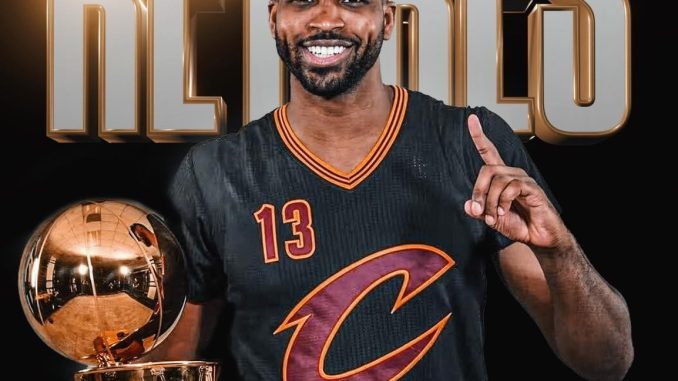
In a moment that closes one of the more quietly resilient careers of the modern NBA era, NBA champion Tristan Thompson has officially announced his retirement after 13 seasons in the league, ending a journey defined by physicality, longevity, and an unforgettable role in one of basketball’s most iconic title runs.
The announcement, delivered on Thursday morning through a personal statement and confirmed by league sources, brings the curtain down on a career that began as a high-upside lottery pick and evolved into something far more enduring: a glue guy who embraced sacrifice, rebounding excellence, and the dirty work that rarely makes headlines but often decides championships. For fans of the Cleveland Cavaliers, Thompson’s retirement marks the end of an emotional chapter still anchored in the memory of the 2016 championship run that broke a 52-year title drought for the city.
“Basketball gave me everything,” Thompson said in his statement. “From Toronto to Cleveland and every stop in between, I gave this game my heart. I leave with gratitude, peace, and pride in what we accomplished—especially that 2016 championship that changed my life forever.”
That championship, the defining moment of Thompson’s career, remains one of the most significant in NBA history. The Cavaliers’ comeback from a 3–1 deficit against the 73-win Golden State Warriors, led by LeBron James and Kyrie Irving, stands as a watershed in league lore. Thompson was not the leading scorer or the flashiest name on the roster, but his impact was unmistakable. Night after night in that Finals series, he provided relentless offensive rebounding, physical defense, and second-chance possessions that tilted momentum in Cleveland’s favor.
In many ways, Thompson embodied the identity of that Cavaliers team: toughness without glamour, resilience without complaint, and an unwavering belief that effort could bend history. While the spotlight often centered on LeBron James’ heroics or Kyrie Irving’s championship-winning shot in Game 7, Thompson’s work on the glass against a historically dominant Warriors front line, including Draymond Green, proved essential in grinding down Golden State’s margin for error.
Drafted fourth overall in 2011 by Cleveland, Thompson entered the league as a mobile, defense-first big man out of Texas with raw offensive skills but elite rebounding instincts. Early in his career, he was viewed as a developmental piece—an energy forward who could defend multiple positions but needed refinement. Few projected that he would become a decade-long starter on a championship team, let alone a fixture of one of the most famous Finals runs in league history.
Yet Thompson’s evolution mirrored Cleveland’s own trajectory. The Cavaliers endured growing pains after his arrival, cycling through rebuilding seasons before reshaping the franchise with the return of LeBron James in 2014. Suddenly, Thompson’s role shifted from developmental prospect to essential rotation anchor on a title contender.
His durability became one of his defining traits. From 2012 to 2017, Thompson played in every single regular-season game, a streak that underscored his conditioning and consistency. He thrived in coach David Blatt’s system initially and later under Tyronn Lue, becoming a constant in a roster that saw stars and role players come and go.
By the time Cleveland reached the 2016 NBA Finals, Thompson had fully embraced his identity: rebound, defend, screen, repeat. Against Golden State’s small-ball “Death Lineup,” his ability to switch defensively and crash the offensive glass gave Cleveland a counterbalance few teams could match. Game after game, his second-effort plays extended possessions that otherwise would have slipped away, especially in the critical final three games of the series.
The Cavaliers’ championship victory in Game 7 at Oracle Arena remains one of the most replayed finishes in NBA history. While the iconic block by LeBron James and Kyrie Irving’s clutch three-pointer dominate highlight reels, Thompson’s 15-point, 16-rebound performance was a foundational piece of the upset. He battled relentlessly against Draymond Green and Andrew Bogut, ensuring Cleveland controlled the interior in key stretches.
After the championship, Thompson’s career took on a different tone. The Cavaliers remained contenders for several seasons, reaching the Finals in four consecutive years from 2015 to 2018. Thompson remained a steady presence through roster changes, coaching adjustments, and evolving offensive systems. His offensive game never expanded significantly beyond finishes at the rim and putbacks, but his defensive versatility and rebounding consistency kept him valuable in playoff rotations.
However, as Cleveland’s championship core dissolved and the league transitioned further into pace-and-space basketball, Thompson’s role gradually diminished. Stints with the Boston Celtics, Sacramento Kings, Indiana Pacers, Chicago Bulls, and Los Angeles Lakers followed in the latter stages of his career. Each stop reflected a veteran presence brought in for locker-room leadership, depth, and situational minutes.
While his statistical production declined in later years, Thompson’s reputation as a professional remained intact. Coaches praised his readiness, teammates valued his experience, and younger players often leaned on him for guidance about playoff intensity and the demands of postseason basketball.
His final NBA seasons were marked more by mentorship than minutes. By the time he reached the league’s twilight, Thompson had transformed into a veteran voice in locker rooms filled with emerging talent. Even when no longer a nightly rotation player, his championship pedigree carried weight.
Across 13 seasons, Thompson finishes his career with averages built on efficiency rather than volume, but his legacy cannot be captured by numbers alone. He exits the league as one of the most notable rebounders of his era, a player whose impact often exceeded his stat line when games mattered most.
Tributes poured in following the announcement. Former teammates, coaches, and opponents acknowledged not just his role in Cleveland’s historic championship, but also his professionalism across a long and physically demanding career. Several members of the 2016 Cavaliers roster privately described Thompson as “the engine of effort,” a player whose willingness to do the unseen work allowed stars to thrive in high-pressure environments.
For Cleveland fans, his retirement inevitably reopens memories of a transformative era. The 2016 championship did more than end a title drought—it reshaped the identity of an entire sports city. Thompson’s name, often spoken alongside LeBron James, Kyrie Irving, and Kevin Love from that roster, remains embedded in that legacy.
Even as the NBA continues to evolve with new superteams, rising stars, and shifting tactical philosophies, Thompson’s career serves as a reminder of the value of specialization and sacrifice. Not every champion is defined by scoring titles or MVP trophies. Some are defined by screens set, rebounds secured, and possessions extended when everything is on the line.
In retirement, Thompson steps away with a résumé that includes an NBA championship, more than a decade of consistent service, and a place in one of the most dramatic Finals stories ever told. He also leaves behind a blueprint for role players who understand that championships are often built in the margins of the game—on rebounds that no one remembers and defensive possessions that don’t make highlight reels.
As he exits the league, the image that will likely endure most vividly is not a statistical milestone or a signature highlight, but rather a scene repeated countless times during the 2016 Finals: Tristan Thompson rising above a crowded paint, securing yet another offensive rebound, and giving the Cavaliers one more chance when there were supposed to be none left.
It was there, in those moments, that his legacy was cemented.
Be the first to comment