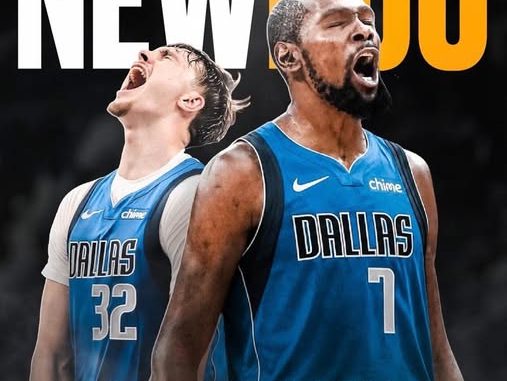
The NBA landscape was jolted on Sunday after reports emerged that the Dallas Mavericks and the Houston Rockets have both entered exploratory trade discussions centered around future Hall of Famer Kevin Durant, setting the stage for what could become one of the most consequential blockbuster negotiations in recent league memory.
While no deal is imminent and talks are still described by league sources as preliminary, the mere fact that two Western Conference franchises with drastically different timelines are simultaneously engaged in discussions involving Durant signals a potential seismic shift in how the NBA’s power structure could look heading into the next season. Durant, a two-time NBA champion, former MVP, and one of the most unstoppable scorers the game has ever seen, remains one of the most coveted assets in basketball despite being deep into his 30s.
For Dallas, the motivation is clear and increasingly urgent. After several seasons of fluctuating postseason success built around their superstar core, the Mavericks are widely believed to be in “win-now” mode. With Luka Dončić firmly established as the franchise cornerstone, the front office has been aggressively evaluating ways to maximize his prime years with a legitimate second superstar capable of easing the offensive burden in playoff environments. Durant, with his unmatched scoring versatility, playoff pedigree, and ability to function both as a primary option and elite secondary creator, fits that mold as well as almost any player in modern NBA history.
Sources familiar with the Mavericks’ internal discussions suggest that the franchise has long admired Durant’s skill set and leadership impact in high-pressure playoff settings. The idea of pairing Dončić’s heliocentric offensive orchestration with Durant’s seamless off-ball scoring and isolation efficiency has been described internally as a “championship-caliber theoretical pairing,” one that could immediately vault Dallas into title contention if the supporting pieces remain intact.
However, acquiring Durant would come at an enormous cost, both financially and in terms of assets. Any realistic trade package would likely require multiple rotation players, a combination of young talent, and a significant cache of draft capital. That is a steep price for a player on the wrong side of 35, regardless of pedigree, and it is precisely the kind of decision that has split internal opinion across rival front offices evaluating similar superstar acquisitions in recent years.
On the Houston side, the conversations carry a different tone entirely. The Houston Rockets have spent the last several seasons accumulating young talent, draft assets, and financial flexibility as part of a long-term rebuild strategy. Under this framework, Houston has become one of the league’s most intriguing developmental teams, boasting a deep collection of athletic, high-upside players who have begun to coalesce into a competitive Western Conference squad.
The emergence of the Rockets as a potential participant in Durant discussions signals a possible philosophical pivot. Rather than continuing to build strictly around youth and development, Houston appears to be weighing the value of converting its accumulated assets into an established superstar capable of accelerating the timeline. Durant, despite his age, represents precisely that type of player: a proven championship scorer who can instantly transform a promising roster into a legitimate contender.
League insiders caution that Houston’s involvement does not necessarily indicate equal intent to land Durant compared to Dallas. Instead, it may reflect due diligence, strategic positioning, and leverage-building in a market where multiple teams are believed to be circling the same star. Still, the Rockets’ presence in the conversation alone raises the stakes significantly, as they possess the type of draft capital and young players that could outbid nearly any competitor if they choose to fully engage.
The broader context surrounding Durant’s situation only amplifies the intrigue. Since leaving Golden State, Durant’s career has been defined by elite individual production and organizational volatility, with each stop generating both high expectations and uneven results in the postseason. Despite that, his reputation as a transcendent offensive force remains intact. Few players in NBA history can match his combination of size, shooting touch, and shot creation, making him a unique asset even as age naturally becomes a factor.
For Dallas, the calculus is particularly delicate. Pairing Durant with Luka Dončić could create one of the most offensively dominant duos in league history. Defenses would be forced into impossible decisions, choosing between double-teaming Dončić’s pick-and-roll mastery or allowing Durant clean isolation opportunities at midrange and beyond the arc. In theory, the combination could produce historically efficient offense, especially in playoff series where half-court execution becomes paramount.
Yet questions inevitably arise about durability, defensive fit, and long-term flexibility. Durant’s workload management has become increasingly important in recent seasons, and any team acquiring him would need to carefully balance regular-season usage with postseason readiness. Additionally, Dallas would have to ensure that the supporting cast around Dončić and Durant remains strong enough to withstand the physical demands of a deep playoff run.
Houston’s perspective is more complex. While Durant would provide an immediate offensive anchor, his presence could potentially accelerate the departure or reduced roles of several young core players who have been central to the Rockets’ rebuild. The organization would be forced to weigh short-term contention against the long-term development of its emerging talent pool. For a franchise that has spent years accumulating assets and cultivating a new identity, such a pivot would represent a significant organizational turning point.
Financial considerations also loom large over any potential Durant move. His contract status, salary cap implications, and luxury tax ramifications would require careful maneuvering from any acquiring team. Both Dallas and Houston have the flexibility to engage in blockbuster-level deals, but absorbing Durant’s salary while maintaining roster depth would require intricate multi-team negotiations or significant roster restructuring.
As discussions continue, rival teams across the league are closely monitoring the situation. Several contenders are expected to inquire about Durant’s availability should negotiations advance, particularly teams already on the cusp of championship contention. The mere possibility of Durant changing teams again has sent ripple effects through front offices, with executives reevaluating trade assets, draft positioning, and roster construction strategies.
Within league circles, there is also growing skepticism about how far talks between Dallas and Houston can realistically progress. While both teams have the assets and motivation to engage, the rivalry factor between the franchises adds an additional layer of complexity. Direct negotiations between in-state competitors are historically rare at this scale, particularly when a player of Durant’s stature is involved.
Still, the NBA has increasingly become a league defined by bold swings rather than incremental moves. Recent seasons have seen franchises prioritize star consolidation over depth, with multiple championship contenders built around two or three elite players rather than traditional balanced rotations. In that context, the idea of Durant joining either Dallas or Houston fits neatly into the league’s broader strategic evolution.
For now, the situation remains fluid. Sources emphasize that no framework is close to completion, and there is no guarantee that talks will progress beyond exploratory stages. But the significance of the conversations themselves cannot be understated. Anytime a player of Durant’s magnitude becomes the focal point of multiple franchises simultaneously, the league’s balance of power is effectively in play.
If Dallas were to succeed, the Western Conference would immediately shift, placing the Mavericks among the most formidable offensive teams in basketball. If Houston were to emerge as the aggressor and land Durant, it would mark one of the most dramatic accelerations of a rebuild in recent memory, signaling a rapid transition from development to contention.
Either outcome would reshape narratives across the NBA heading into the offseason. And even if no deal materializes, the mere existence of these discussions underscores a truth that has become increasingly central to the modern league: superstar movement remains the ultimate driver of competitive transformation.
As negotiations continue behind closed doors, the basketball world will be watching closely. Because whenever Kevin Durant’s name enters trade discussions, the ripple effects extend far beyond the teams directly involved. They reach into playoff races, championship projections, and the very identity of the league itself.
Be the first to comment