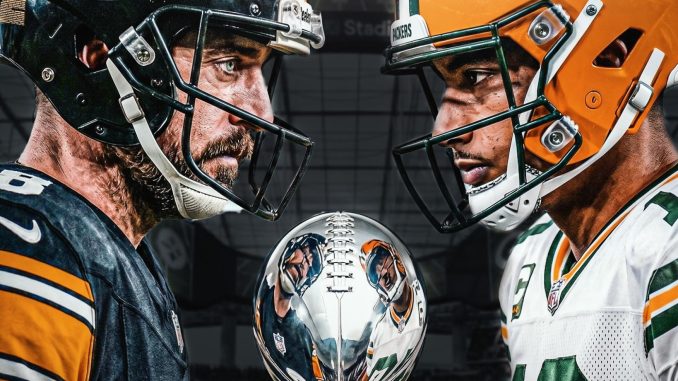
For nearly two decades, Aaron Rodgers has existed in a category reserved for only the most iconic quarterbacks the NFL has ever produced. Four MVP awards. A Super Bowl championship. Thousands of impossible throws. Endless controversies. Unforgettable moments under the brightest lights. Yet even after a career that already guarantees a gold jacket and a permanent place in football history, one possibility still hangs over the future Hall of Famer like the final chapter of an unfinished masterpiece.
It is the kind of football story Hollywood writers would probably reject for being too dramatic.
Aaron Rodgers still has one last miracle left to chase: defeating the Green Bay Packers in Super Bowl LXI to complete the impossible 32-team sweep.
The idea sounds almost fictional. Rodgers spent 18 seasons in Green Bay building one of the greatest quarterback legacies the sport has ever seen. He transformed from the patient understudy behind Brett Favre into the face of an entire franchise, leading the Packers to a Super Bowl title and consistently keeping them among the NFL’s elite. Lambeau Field became his kingdom. Packers fans treated him like royalty. For years, it seemed unimaginable that Rodgers would ever wear another jersey.
But the NFL has a way of rewriting endings.
The breakup between Rodgers and Green Bay became one of the league’s defining storylines of the modern era. What once looked like a lifelong partnership slowly unraveled through front-office tension, philosophical disagreements, roster frustrations, and the inevitable reality of time. When the Packers selected quarterback Jordan Love in the first round of the 2020 NFL Draft, the clock quietly began ticking on Rodgers’ future in Wisconsin.
Ironically, the move initially ignited one of the greatest stretches of Rodgers’ career.
Fueled by perceived disrespect and driven by the need to prove he still belonged atop the football world, Rodgers delivered back-to-back MVP seasons in 2020 and 2021. His precision, efficiency, and command of the offense reached near-mythical levels. Every week seemed to produce another absurd throw, another impossible escape from pressure, another reminder that Rodgers remained one of the most gifted passers the game had ever seen.
Yet even during those MVP campaigns, postseason disappointment continued to haunt Green Bay. Crushing playoff losses to the Tampa Bay Buccaneers and the San Francisco 49ers deepened the frustration surrounding Rodgers’ era. Despite all the regular-season brilliance, the Packers repeatedly failed to capitalize on championship opportunities.
Eventually, the relationship reached its breaking point.
Rodgers departed Green Bay carrying both gratitude and bitterness, leaving behind a legacy complicated by unmet expectations. Statistically, he ranks among the greatest quarterbacks in league history. Emotionally, however, the Rodgers era became one of football’s great “what if” stories. How did a quarterback this talented only reach one Super Bowl?
That lingering question now fuels the intrigue surrounding his final act.
If Rodgers somehow reaches Super Bowl LXI and defeats Green Bay, he would accomplish something no quarterback in NFL history has ever achieved in such dramatic fashion: beating all 32 franchises, including the team that defined his career. It would be the ultimate full-circle moment, a symbolic completion of one of football’s most polarizing and brilliant careers.
And make no mistake — Rodgers has always been motivated by legacy.
Throughout his career, he has often projected the image of a player unconcerned with outside narratives. But beneath the calm interviews and calculated confidence lies one of the fiercest competitors the sport has ever seen. Rodgers hears the criticism. He understands the debates. He knows how his résumé is discussed compared to legends like Tom Brady, Peyton Manning, and Joe Montana.
Those quarterbacks are measured not only by brilliance but by championships.
For Rodgers, that comparison has always carried an uncomfortable reality. Many analysts believe he possesses the purest throwing talent in NFL history, yet his trophy case does not reflect the dominance his skill set promised. Every playoff exit intensified the conversation. Every January disappointment added another stain to an otherwise breathtaking career.
That is why the idea of a final championship run feels so powerful.
Athletes of Rodgers’ stature are often remembered as much for their endings as their primes. Jordan’s last shot. Manning riding off after a Super Bowl victory. Brady winning a title in Tampa Bay after leaving New England. Sports history loves redemption arcs, reinventions, and poetic conclusions.
Rodgers still has a chance to author his own.
To do it against Green Bay would elevate the story into something almost mythical.
Imagine the buildup. Weeks of nonstop national coverage. Endless debates across television networks. Former teammates answering uncomfortable questions. Packers fans divided between appreciation and betrayal. Rodgers walking onto the Super Bowl stage knowing the only thing standing between him and ultimate football immortality is the franchise he once carried for nearly two decades.
The emotional weight would be staggering.
Lambeau Field is not just another stop in Rodgers’ career journey. It is the place where he became a legend. The place where he sat patiently behind Favre. The place where doubters questioned whether he could ever replace an icon. The place where he answered with MVPs, miracle throws, and unforgettable playoff moments.
It is also the place where the relationship eventually fractured beyond repair.
Sports history is filled with revenge narratives, but few could compare to the magnitude of Rodgers facing Green Bay in the Super Bowl. Favre never experienced it. Joe Montana never faced the San Francisco 49ers in a championship after joining Kansas City. Peyton Manning never met the Indianapolis Colts on football’s biggest stage after leaving for Denver.
Rodgers has an opportunity to do something uniquely cinematic.
Of course, the road to Super Bowl LXI remains incredibly difficult.
Father Time has never lost for long in professional sports, and Rodgers is no exception. Injuries, mobility concerns, offensive consistency, and roster quality all complicate the possibility of another championship run. The NFL itself has entered a new era led by younger superstars like Patrick Mahomes, Josh Allen, Joe Burrow, and Lamar Jackson.
The league Rodgers once ruled now belongs largely to the next generation.
But Rodgers has spent his entire career thriving in moments where people doubted him.
He famously slipped in the 2005 NFL Draft while teams questioned his personality and mechanics. He endured years of scrutiny replacing Favre. He battled criticism about playoff shortcomings. He responded to career uncertainty with MVP seasons. Over and over again, Rodgers has demonstrated an uncanny ability to weaponize doubt.
That mentality is part of what keeps the dream alive.
Even now, opposing defenses still fear Rodgers’ intelligence more than almost any quarterback in football. His ability to manipulate coverages, extend plays, and deliver accurate throws from impossible angles remains elite when healthy. Few quarterbacks in league history have controlled the geometry of the field the way Rodgers does.
And perhaps most importantly, Rodgers understands narrative better than most athletes.
He knows what a championship against Green Bay would mean historically. He knows how it would reshape discussions surrounding his career. One more Lombardi Trophy would not suddenly erase years of postseason frustration, but it would fundamentally alter the emotional memory attached to his legacy.
Instead of being remembered primarily for unrealized potential relative to his talent, Rodgers could be remembered as the quarterback who authored one of the most dramatic closing acts in sports history.
There is also another fascinating layer to this possibility: Jordan Love.
The young Packers quarterback inherited one of the most difficult jobs in sports, following directly behind Rodgers just as Rodgers once followed Favre. The parallels are impossible to ignore. Green Bay once again bet on youth over experience, trusting that organizational patience would produce another franchise quarterback.
If Love leads the Packers to Super Bowl LXI opposite Rodgers, the symbolism would become overwhelming.
It would represent generations colliding on the biggest stage imaginable. The former king versus the successor. The quarterback Green Bay chose to move on from against the quarterback Green Bay chose to believe in next.
No sportswriter in America could resist the story.
And for Rodgers, victory in that moment would mean more than another ring. It would validate his belief that Green Bay gave up on him too early. It would provide the ultimate competitive rebuttal. It would allow him to stand atop the football world while defeating the franchise that decided its future no longer included him.
That kind of motivation matters for great athletes.
Legacies are rarely clean. Rodgers’ certainly is not. His career has included brilliance, controversy, tension with management, complicated media relationships, public criticism, and endless debates about leadership style. Some fans view him as misunderstood. Others see him as frustratingly difficult. But nobody questions the magnitude of his talent.
Few players in NFL history have ever made quarterbacking look easier.
The throws across his body. The frozen-rope sideline completions. The effortless deep balls released without perfect footing. The famous Hail Marys. Rodgers repeatedly produced moments that felt physically impossible. Defenders often looked defeated before the snap because they knew even perfect coverage might not matter.
That is why his postseason résumé still feels so incomplete.
One championship simply does not seem to match the level of greatness audiences witnessed for nearly two decades. Fair or unfair, that reality continues to shape discussions about Rodgers’ place among football immortals.
A second Super Bowl — especially one earned through a victory over Green Bay — would dramatically shift that conversation.
Suddenly, Rodgers’ career arc would resemble something legendary rather than complicated. The separation from the Packers would feel less bitter and more transformational. The late-career gamble would appear justified. His final years would no longer be viewed through the lens of decline but reinvention.
And in many ways, sports fans crave endings like that.
We want closure. We want emotional symmetry. We want stories that feel larger than the game itself. Rodgers versus Green Bay in Super Bowl LXI would deliver all of it. The buildup would dominate the sports world for two weeks. Every throw would carry historical significance. Every sideline reaction would become a headline.
Even people who dislike Rodgers would tune in.
Because at its core, sports are about the possibility of the impossible. They are about moments so dramatic they transcend statistics and standings. Rodgers completing the 32-team sweep by defeating Green Bay for a Super Bowl championship would instantly become one of the defining stories in NFL history.
Whether it actually happens is another question entirely.
The NFL is brutal, unpredictable, and merciless. Championship windows disappear quickly. Injuries destroy dreams overnight. Super Bowl appearances require talent, timing, health, coaching, and often a little luck. Rodgers already knows better than most how difficult it is to reach the mountaintop.
Still, the mere possibility keeps the football world fascinated.
Because somewhere out there exists a path — however narrow — where Aaron Rodgers walks onto the field for Super Bowl LXI opposite the Green Bay Packers with history waiting on the other side.
One final miracle.
One final statement.
One final chance for one of football’s greatest quarterbacks to complete the ultimate revenge story and carve his name even deeper into NFL immortality.
Be the first to comment