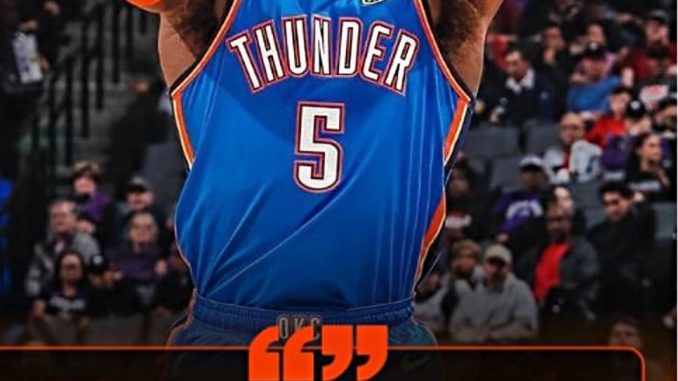
The Western Conference Finals between the Oklahoma City Thunder and the San Antonio Spurs has rapidly transformed from a high-level tactical showdown into a bruising, emotionally charged war of attrition, and few players have felt the weight of that shift more than defensive cornerstone Lu Dort. After another physically punishing night in a series now tied 2–2, Dort stepped into the spotlight not because of a highlight play or a clutch defensive stop, but because of his candid remarks on the escalating physicality that has come to define this matchup between the Oklahoma City Thunder and the San Antonio Spurs.
What began as a showcase of rising Western Conference powerhouses has increasingly resembled a grind-it-out playoff trench fight, where every possession is contested above the rim, every screen carries extra contact, and every drive to the basket feels like it comes with an unspoken warning. Game 4, a 103–82 Spurs response in San Antonio, did little to cool tensions. Instead, it amplified them. The Thunder’s usually fluid offensive rhythm was disrupted by relentless perimeter pressure, hard hedges, and physical switches that pushed the boundaries of what both sides consider playoff legal defense. The Spurs, meanwhile, absorbed their own share of contact, responding with interior resistance and aggressive rebounding that turned the paint into a nightly collision zone.
Dort, who has built his reputation on embracing physical assignments and guarding the opposing team’s most dangerous perimeter threats, did not shy away from acknowledging the tone of the series. However, his message carried an unmistakable undertone of concern—not just about the intensity, but about how far the line is being stretched as the stakes rise. In the aftermath of Game 4, he described the series as “demanding every ounce of focus and toughness,” while also hinting that the level of contact has begun to shift from competitive to borderline excessive. Though he stopped short of direct criticism of officials or opponents, the implication was clear: the series is being played on the edge of control.
Through four games, the numbers tell only part of the story. The Spurs’ Game 1 victory, a 122–113 statement at home, set an early tone with high-tempo scoring and physical perimeter defense that tested Oklahoma City’s composure. The Thunder answered in Game 2, grinding out a 123–108 win on the road behind their own defensive adjustments and transition efficiency. But it was Game 3 that first signaled the escalation, as the Thunder reclaimed control with a 123–108 victory of their own, only for Game 4 to swing momentum again in dramatic fashion as San Antonio overwhelmed Oklahoma City’s offensive sets with sustained pressure, forcing turnovers and rushed decisions that led to one of the Thunder’s lowest scoring outputs of the postseason.
For Dort, the challenge has been both physical and psychological. As the primary defender tasked with containing elite perimeter scorers and disrupting offensive rhythm, he has spent large stretches of the series locked in chest-to-chest battles, navigating off-ball screens that often border on moving contact, and absorbing repeated drives from Spurs guards determined to attack downhill. His value has never been tied solely to scoring output, but rather to his ability to set a tone defensively. Yet even for a player known for embracing contact, the cumulative toll of the series has become increasingly visible.
League observers have noted the way both coaching staffs have adjusted their schemes to exploit physical mismatches. The Spurs have leaned heavily into size and length on switches, often forcing Oklahoma City’s guards into extended isolation possessions under duress. Conversely, the Thunder have attempted to counter with speed, spacing, and early offensive actions designed to prevent San Antonio’s defense from setting its structure. The result has been a chess match that is being played at full sprint, with both sides occasionally sacrificing execution for physical disruption.
What has elevated the tension further is the rising emotional temperature. Technical fouls have been scattered throughout the series, with both benches reacting vocally to perceived missed calls and overly aggressive defensive sequences. In Game 4 alone, multiple possessions featured extended post-whistle conversations between players and officials, a sign that frustration is beginning to simmer just beneath the surface. Dort’s comments after the game reflected that reality without explicitly inflaming it, instead focusing on the need for composure as the series shifts back to Oklahoma City for Game 5.
The Thunder’s coaching staff has echoed similar sentiments internally, emphasizing discipline and emotional control as the defining factor moving forward. While the physicality is unlikely to decrease—if anything, it is expected to intensify as elimination pressure increases—Oklahoma City believes the difference between winning and losing this series may ultimately come down to which team can maintain offensive structure under duress. Dort, as one of the team’s emotional anchors, plays a critical role in that equation.
On the other side, the Spurs have embraced the rugged identity that has emerged over the past two games. Their Game 4 performance was built on defensive persistence, second-chance opportunities, and a willingness to turn every defensive possession into a confrontation. They controlled the glass, forced Oklahoma City into contested mid-range looks, and dictated tempo in a way that neutralized the Thunder’s transition attack. While they have not publicly engaged with Dort’s remarks, their on-court approach suggests a team fully committed to making the series as physically demanding as possible.
The historical context of Western Conference Finals basketball adds another layer to the narrative. Physical escalation is not new to this stage of competition, but the modern NBA’s emphasis on pace and spacing has made series like this increasingly rare. When they do emerge, they tend to polarize discussion across the league—some praising the intensity and playoff authenticity, others questioning whether consistency in officiating is sufficient to preserve flow and safety. This series between the Thunder and Spurs now sits firmly within that debate.
Dort’s perspective is particularly important because of his role as both enforcer and stabilizer. He is often assigned to the opponent’s most dynamic perimeter scorer, which means he is constantly involved in high-pressure possessions that define momentum swings. When he speaks about physicality, it carries weight not because it is confrontational, but because it comes from direct experience of the matchup’s most intense minutes. His ability to stay engaged defensively while avoiding foul trouble has been one of Oklahoma City’s most valuable assets throughout the postseason, and the Thunder will need that stability more than ever as the series shifts into its most critical stretch.
Game 5 looms as a pivotal turning point. Historically, in 2–2 series, the winner of Game 5 goes on to win the series a significant majority of the time, and both teams understand the stakes. The Thunder will return home seeking to reestablish control through pace, spacing, and defensive cohesion. The Spurs will attempt to carry over the physical edge they established in Game 4, betting that sustained pressure can once again disrupt Oklahoma City’s rhythm and silence the home crowd.
For Dort, the focus is likely to remain unchanged despite the noise surrounding his comments. His assignment will once again involve navigating screens, absorbing contact, and attempting to neutralize one of San Antonio’s primary perimeter threats while maintaining discipline. But his voice after Game 4 suggests a growing awareness within the Thunder locker room that this series is no longer just about execution or talent—it is about survival within a tightly controlled physical ecosystem that is becoming harder to regulate with each passing game.
As the Western Conference Finals continues to escalate, one truth has become unavoidable: neither the Thunder nor the Spurs is willing to yield ground, physically or mentally. And in the middle of that collision course stands Dort, not only as a defender tasked with absorbing the chaos, but now as one of the clearest voices articulating just how intense this series has become.
Be the first to comment