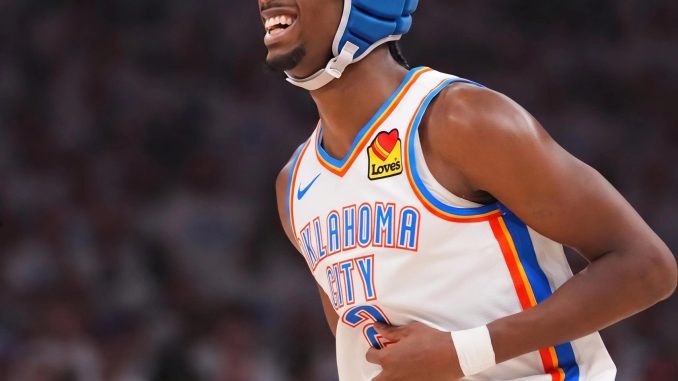
OKLAHOMA CITY — As the Western Conference Finals tighten and every possession begins to feel like a referendum on toughness, the biggest conversation ahead of Game 4 has surprisingly drifted away from playbooks, rotations and adjustments — and toward something far more unusual: a viral rumor involving Shai Gilgeous-Alexander and a so-called “helmet plan” after a string of hard falls in the series.
What began as a social media joke about the Oklahoma City Thunder superstar’s frequent tumbles to the floor during contact has snowballed into a full-blown online debate about player safety, officiating consistency, and the physical toll of modern NBA basketball. By midweek, clips of Gilgeous-Alexander absorbing contact in Games 1 through 3 were circulating with edited graphics suggesting he might “need head protection,” a tongue-in-cheek idea that quickly turned into a talking point across fan communities.
The Thunder, meanwhile, are preparing for a far more serious task: holding off a surging San Antonio Spurs team that has made it clear that physicality, pace, and defensive pressure will define the remainder of this series.
The viral “helmet rumor” is not real in any official sense, but its emergence reflects a growing tension in the matchup — one that blends elite basketball with escalating contact around the league’s reigning MVP. Gilgeous-Alexander, who has repeatedly driven into crowded lanes against the Spurs’ long and disciplined frontcourt, has taken several heavy falls in the series, including collisions that left him momentarily slow to get up before continuing play.
Spurs defenders have walked a fine line between aggressive containment and physical disruption, especially in transition and midrange isolations where Gilgeous-Alexander thrives. Oklahoma City’s star has still produced at a high level, but the cumulative contact has been impossible to ignore.
After Game 1, where San Antonio stole a double-overtime thriller behind a historic outing from Victor Wembanyama, the tone of the series shifted immediately. Gilgeous-Alexander responded in Game 2 with 30 points and nine assists in a 122–113 Thunder win that evened the series at 1–1, stabilizing Oklahoma City after a shaky opener and forcing a reset heading into San Antonio. (Reuters)
Game 3 only intensified the physical narrative. While the Spurs leaned on their length and defensive rotations, Gilgeous-Alexander continued to draw contact at the rim and through the mid-post. Several possessions ended with him on the floor, including one sequence that sparked visible reaction from the home crowd and renewed chatter on social platforms that the Thunder guard was being “targeted by brute-force defense.”
By the time clips were compiled and slowed down frame-by-frame online, the “helmet” joke was born — a satirical suggestion that Gilgeous-Alexander might need protective gear to survive the series’ physical toll. Within hours, the phrase was trending among basketball fans, with memes showing everything from football helmets to construction hard hats edited onto his likeness.
But behind the humor lies a deeper conversation that coaches around the league have quietly acknowledged for years: the increasing physical cost of elite shot creation.
Gilgeous-Alexander’s game is built on rhythm, change of direction, and controlled deceleration. He invites contact as much as he avoids it, often absorbing bumps in the lane before finishing through defenders or earning trips to the free-throw line. That style has made him one of the league’s most efficient scorers — and one of its most frequently knocked off balance.
Analysts have pointed out that players who rely heavily on driving isolation actions are naturally exposed to more mid-air collisions and awkward landings, particularly in playoff settings where defensive schemes tighten and help rotations arrive earlier. In this series, the Spurs’ defensive approach has leaned into that reality, crowding driving lanes and forcing Gilgeous-Alexander into late adjustments at the rim.
Still, there is no indication from the Thunder that his physical condition is a concern heading into Game 4. Team sources have consistently described him as “ready” throughout the postseason, and his production has remained steady despite the increased attention. Even in games where the shot has not fallen cleanly, his ability to generate free throws and control tempo has kept Oklahoma City competitive.
The Thunder’s broader challenge is not just protecting Gilgeous-Alexander from contact, but redistributing offensive responsibility. With injuries and rotation instability affecting supporting pieces at various points in the postseason, Oklahoma City has leaned heavily on its MVP to stabilize half-court possessions. That burden has only grown as the Spurs have tightened their perimeter defense and switched more aggressively across screens.
San Antonio, on the other hand, has embraced the physical tone of the series as a strategic advantage. The Spurs’ defensive identity under playoff pressure has centered on length, vertical contesting at the rim, and forcing guards into uncomfortable midair decisions. That approach has occasionally resulted in hard falls — the very plays now fueling the viral discourse — but it has also disrupted Oklahoma City’s offensive flow for stretches.
Victor Wembanyama remains the focal point of the Spurs’ defense, anchoring the paint and erasing space that Gilgeous-Alexander typically exploits. His presence has forced the Thunder guard to adjust angles and release points, contributing to the kind of contested finishes that inevitably lead to contact-heavy landings.
Still, the series remains finely balanced. After the Thunder’s Game 2 response, momentum has swung back and forth, and neither team has managed to establish full control for more than a few stretches at a time. Oklahoma City’s bench production and late-game execution have been key factors in keeping them afloat, while San Antonio’s defensive intensity and transition bursts have kept pressure on the favorites.
Amid all of that, the “helmet debate” has taken on a life of its own — less as a literal suggestion and more as a reflection of how modern NBA narratives form in real time. A few hard falls, a handful of slowed-down replays, and suddenly a superstar’s physical resilience becomes a viral storyline layered on top of a conference finals.
Inside the Thunder locker room, however, the focus remains far more grounded. Players have emphasized execution, defensive discipline, and limiting turnovers against a Spurs team that punishes mistakes quickly. Gilgeous-Alexander himself has typically brushed off external noise throughout his career, often responding to physical games with even more controlled efficiency rather than public commentary.
The expectation heading into Game 4 is that San Antonio will maintain its physical edge, while Oklahoma City will attempt to counter with pace, spacing, and more off-ball movement to reduce the burden on its primary creator. Whether that results in fewer collisions for Gilgeous-Alexander remains to be seen, but the tactical adjustment is already in motion.
What cannot be ignored is how central he remains to everything Oklahoma City does. Every possession bends toward his decision-making, every defensive scheme is designed around limiting his comfort, and every swing in momentum seems to run through his ability to withstand contact and still produce.
That reality is why even a joke about helmets has gained traction — because in this series, Gilgeous-Alexander is quite literally absorbing the weight of the matchup.
As Game 4 approaches, the basketball stakes are clear enough: a pivotal swing game in a tied Western Conference Finals, with championship implications on the line. But layered beneath that is a broader conversation about how far elite guards can be pushed physically in the modern postseason — and how much of that punishment is simply part of the job description.
For Oklahoma City, the answer is simple. Keep their MVP upright, keep him productive, and keep the series moving in their direction.
For San Antonio, the assignment is equally clear: keep making him uncomfortable — helmet or no helmet.
Be the first to comment