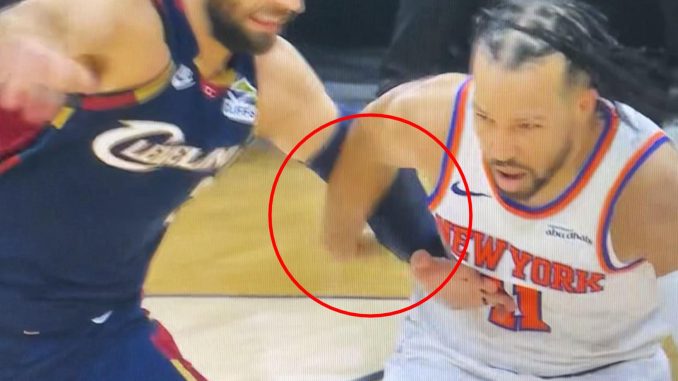
What began as a tightly contested playoff battle between the New York Knicks and the Cleveland Cavaliers quickly spilled into controversy late in the second half after a sequence involving Jalen Brunson and Max Strus ignited a storm of frustration on the Cavaliers bench and left players and coaches seething over what they believed was a glaring missed call in a decisive moment.
The flashpoint came in a tense stretch where both teams were trading possessions with playoff intensity, physical defense, and half-court execution defining every trip down the floor. With the Knicks attempting to stabilize their offensive rhythm through Brunson’s isolation mastery, the Cavaliers leaned heavily on switching schemes designed to contain him at the point of attack. It was in one of these isolations that the sequence unfolded—one that would dominate postgame discussion far more than the final scoreboard in some corners of the visiting locker room.
According to multiple broadcast angles and bench reactions, Brunson received the ball at the top of the arc and immediately engaged Strus in a one-on-one matchup. As Brunson began his signature probing dribble into the mid-range pocket, Strus attempted to fight through contact and stay attached to the Knicks guard’s hip. What followed, however, became the center of controversy: Brunson appeared to initiate contact by grabbing and briefly hooking Strus’ arms not once, but twice in quick succession as he pivoted into his shooting motion.
The initial action did not draw a whistle. Strus, still engaged defensively, tried to recover position, but the second apparent arm engagement—again involving Brunson’s upper-body control—sent Strus stumbling slightly off balance. In the process of the collision and recovery, Strus was ultimately whistled for a defensive foul, a decision that immediately triggered visible outrage from the Cavaliers bench and coaching staff.
Players leapt from their seats in disbelief, gesturing toward the replay monitors and shouting toward officials as the possession concluded. The Cavaliers’ sideline reaction was not subtle; multiple players could be seen arguing that Brunson had effectively neutralized legal defense by using his arms to manipulate Strus’ positioning before initiating upward movement toward the basket.
For Cleveland, the frustration was compounded by timing. The call came at a critical juncture where momentum was hanging in the balance and every possession carried heightened significance. Instead of a potential stop and transition opportunity, the Cavaliers were forced to watch Brunson step to the free-throw line for what they believed should have been a defensive stop or, at minimum, a no-call sequence.
The Knicks, meanwhile, saw the play differently. From their perspective, Brunson’s body control and footwork were consistent with his established offensive style—using strength, balance, and leverage to create separation in tight spaces. Knicks players did not publicly engage the controversy in the immediate aftermath, but their body language suggested confidence that the call aligned with how Brunson has been officiated throughout the postseason.
The incident immediately became the defining talking point of the quarter, overshadowing what had otherwise been a back-and-forth defensive struggle. Both teams had been trading stops, contested jumpers, and physical rebounding battles, but the officiating sequence shifted emotional energy in a way that lingered well beyond the possession itself.
On replay, the controversy centered on interpretation. Supporters of the Cavaliers’ position argued that Brunson’s arm placement crossed the boundary between offensive protection and illegal contact. They pointed specifically to the first instance of contact, where Brunson’s left arm appeared to make clear engagement with Strus’ arm as he attempted to slide laterally over a screen-like angle. The second motion, they argued, compounded the issue by restricting Strus’ ability to recover vertical defensive position.
On the other hand, those defending the Knicks’ guard pointed to the physical nature of playoff basketball, where hand fighting and upper-body contact often go unwhistled unless excessively prolonged or visibly restrictive. Brunson, widely regarded as one of the league’s most adept foul-drawers in tight spaces, has built a reputation for thriving in exactly these types of encounters—absorbing contact while maintaining scoring angles that force referees into split-second judgment calls.
Still, the Cavaliers bench did not see it as a gray area in the moment. Multiple players continued arguing even after play resumed, with one assistant coach reportedly needing to be held back as emotions escalated near the scorer’s table. The intensity underscored how sensitive officiating interpretations become in playoff environments, where every possession is magnified and every whistle carries momentum-altering consequences.
Strus himself, typically composed in high-pressure settings, appeared visibly frustrated as he retreated to the defensive end following the call. He exchanged words with teammates while pointing toward the replay monitors, seemingly requesting confirmation of what had just transpired. Though he avoided a technical foul, his body language reflected a mixture of disbelief and agitation that lingered into subsequent defensive possessions.
The broader Cavaliers response was rooted not just in the single call, but in what they perceived as a pattern of physical leniency granted to elite ball handlers in isolation situations. The argument echoed familiar playoff discourse: whether offensive stars are permitted greater freedom in initiating contact that would otherwise be penalized if reversed.
As the game continued, the emotional residue of the sequence remained evident. Cleveland’s defensive rotations became slightly more aggressive in subsequent possessions, particularly when Brunson touched the ball. Help defenders shaded earlier, and switches became more forceful, suggesting an adjustment not just in strategy but in tone. The Cavaliers were clearly intent on reasserting defensive physicality without relying on whistle interpretation.
The Knicks, conversely, leaned into Brunson’s composure. The veteran guard slowed the pace, controlled spacing, and forced Cleveland into extended defensive sets. Even as the controversy swirled around him, Brunson did not appear rattled. Instead, he continued to orchestrate half-court possessions with the same deliberate rhythm that has defined his postseason run, probing mismatches and drawing defensive attention that opened opportunities for cutters and shooters.
Coaching perspectives after similar sequences often emphasize control, and that theme was evident on both benches. The Cavaliers coaching staff reportedly urged restraint in terms of over-engagement with officials, instead focusing on defensive execution and box-out discipline. Meanwhile, the Knicks sideline doubled down on maintaining offensive spacing, ensuring Brunson continued to operate in isolation-friendly alignments that minimized congestion.
As the game progressed into its final phases, the earlier controversy remained a reference point in broadcast analysis, with commentators repeatedly revisiting the replay angles and debating whether Brunson’s arm positioning constituted illegal contact or permissible offensive shielding. The lack of a definitive consensus only amplified the tension, reinforcing how subjective such decisions can become under playoff pressure.
Beyond the immediate emotional reaction, the sequence also raised broader questions about consistency in officiating star-driven matchups. Brunson, like many high-usage guards, frequently navigates a fine line between creating space and drawing contact. In high-stakes environments, that line becomes even more scrutinized, particularly by opposing benches who feel momentum can swing on marginal interpretations.
For the Cavaliers, the concern was not just the single possession, but what it represented in terms of competitive fairness in a tightly contested series. Their frustration reflected a belief that defensive effort had been compromised by an interpretation they viewed as inconsistent with the physicality allowed elsewhere in the game. That perception, fair or not, is often what fuels postseason intensity as much as the basketball itself.
The Knicks, however, will view the sequence as part of Brunson’s established identity as a postseason engine. His ability to absorb contact, maintain balance, and still generate scoring opportunities is central to why New York has leaned so heavily on him in late-game situations. Whether defenders see it as craft or controversy, the outcome remains the same: possessions end with Brunson controlling the action.
As the dust settled on the moment, the Cavaliers were left to regroup and refocus on execution rather than officiating. The Knicks, meanwhile, moved forward with the advantage of both scoreboard positioning and psychological composure, having weathered the emotional spike without losing control of their offensive structure.
In playoff basketball, sequences like this often take on lives of their own—replayed, dissected, and debated long after the final buzzer. For Cleveland, it will be remembered as a moment where frustration boiled over in real time. For New York, it will be another example of Brunson’s ability to operate in the gray areas of elite shot creation under pressure.
And for everyone watching, it became yet another reminder that in postseason basketball, the smallest stretch of contact can reshape not just a possession, but the entire emotional temperature of a series.
Be the first to comment