The Western Conference Finals between the Oklahoma City Thunder and the San Antonio Spurs has officially shifted from high-stakes basketball into full-blown playoff theater, where every possession feels like it carries a personal grievance and every whistle is greeted with suspicion. What began as a tactical chess match for a trip to the NBA Finals has now morphed into a simmering rivalry defined as much by controversy as by execution, with Game 1’s shoe incident and Game 2’s hair-pulling accusation adding fuel to a fire that already looked dangerously close to out of control.
Game 1 set the tone early, not just with physical defense and tight rotations, but with an incident that instantly went viral and set social media ablaze. Midway through a tense second quarter, a scramble for a loose ball ended with a Spurs player’s shoe coming off in what appeared to be contact during a box-out under the rim. What should have been a routine stoppage instead turned into a prolonged debate between players, officials, and replay monitors, as Oklahoma City players argued the contact was incidental while San Antonio insisted it was part of an escalating pattern of off-ball physicality that had gone unchecked.
The officials eventually ruled no malicious intent, but the damage had already been done. The moment became a flashpoint, replayed endlessly across broadcasts and dissected from every angle imaginable. For the Spurs, it wasn’t just about a lost shoe—it was about what they felt was a broader tolerance for physical disruption that had tilted the game’s rhythm. For the Thunder, it was viewed as gamesmanship, an attempt to influence officiating through optics rather than substance. Either way, the series had found its emotional center earlier than anyone expected.
By the time Game 1 reached its final minutes, the basketball had already been overshadowed by the narrative. Every screen was harder, every rebound more contested, and every whistle carried an extra layer of interpretation. The Spurs ultimately walked away with the win, but the emotional residue of the shoe incident lingered far beyond the final buzzer, setting up a Game 2 that felt less like a correction and more like a continuation of unfinished business.
If Game 1 introduced friction, Game 2 detonated it.
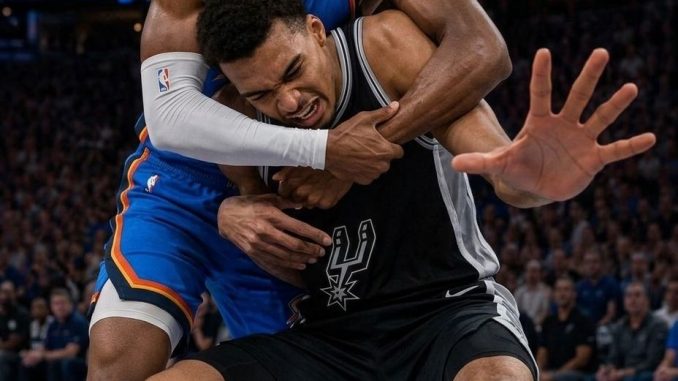
From the opening tip, the pace was frantic, the tone unmistakably physical, and the referees visibly intent on controlling escalation early. But control proved elusive. Late in the second quarter, during a contested drive to the rim, a brief but heated exchange between players turned into the series’ most explosive controversy yet. As bodies collided in the paint and arms tangled fighting for position, one possession ended with accusations that a Thunder defender had grabbed a Spurs player by the hair while attempting to deny a post entry pass.
The whistle blew, but the reaction was immediate and chaotic. San Antonio players surrounded the official, demanding a review and escalation of the call. Oklahoma City players pushed back, insisting there had been no intentional contact beyond standard rebounding physicality. The arena replay screens only intensified the debate, showing slowed angles that appeared inconclusive at best and inflammatory at worst, depending on the viewer’s allegiance.
Officials reviewed the play extensively, ultimately issuing a common foul rather than upgrading it to a flagrant. But much like the shoe incident in Game 1, the ruling did little to cool tensions. Instead, it sharpened them. The Spurs bench was visibly animated, while the Thunder responded with equal intensity, pointing to previous possessions where they believed they had absorbed similar contact without calls.
What followed was a stretch of basketball that felt more like emotional survival than strategic execution. The offensive flow disintegrated into isolation sets and hurried possessions. Defensive possessions turned into prolonged grappling matches. Every rebound attempt seemed to involve at least one player hitting the floor, and every timeout was accompanied by heated exchanges that required coaches and assistants to physically separate players.
This is how playoff rivalries are born—not just from talent, but from repetition of perceived injustice. And by the end of Game 2, it was clear neither side believed the officiating had been consistent, even if both sides believed they were the ones being wronged.
The Thunder, in particular, leaned heavily into their identity as a young, fast, emotionally charged team that feeds off adversity. Their response to the Game 1 loss was to increase pressure on the perimeter, accelerate transition opportunities, and attack mismatches earlier in the shot clock. The Spurs, meanwhile, doubled down on half-court execution, trying to slow the game into deliberate possessions that minimized chaos and reduced the impact of Oklahoma City’s athleticism.
But strategy took a back seat every time the whistle blew.
The hair-pulling accusation became the defining image of Game 2, not because it was definitively proven on replay, but because it symbolized the broader distrust between the two teams. San Antonio insisted it reflected a pattern of over-aggressive defense that had gone unpunished. Oklahoma City maintained it was a fabrication born out of frustration after a physical defensive stand. The truth, as is often the case in playoff basketball, became secondary to perception.
What makes this series particularly combustible is not just the incidents themselves, but the speed at which each moment becomes amplified. In previous eras, such controversies might have been confined to postgame reports or slow-burn debates among analysts. In this matchup, every replay is instant, every angle is dissected within seconds, and every emotional reaction is broadcast in real time across multiple platforms.
That constant visibility has transformed routine playoff contact into narrative fuel.
Through two games, both teams have shown they are evenly matched not just in talent, but in temperament. The Spurs have leaned on their composure and structured offense, trying to impose order on chaos. The Thunder have leaned on intensity and pace, trying to disrupt that order at every opportunity. Neither approach has fully broken the other, but both have contributed to the escalating physicality that now defines the series.
Coaches on both sides have publicly urged restraint, though privately, both understand that playoff basketball at this stage rarely returns to civility once lines have been crossed. The challenge is no longer just tactical—it is psychological. How do you keep focus when every possession feels like it might be scrutinized for intent rather than action? How do you maintain discipline when you believe your opponent is operating just outside the boundaries of acceptable contact?
The answer, so far, has been that neither team has fully managed it.
Game 2’s final minutes reflected that tension perfectly. Instead of crisp execution, there were rushed drives, contested threes, and defensive possessions that looked more like survival instincts than structured schemes. The scoreboard still mattered, but it was no longer the only storyline. Every possession carried subtext. Every foul carried implication. Every reaction carried risk.
When the final buzzer sounded and the series shifted, tied at one game apiece, the result felt almost secondary to the atmosphere that preceded it. The real takeaway was not who won or lost, but how quickly this series had escalated into something far more volatile than a standard Western Conference Finals matchup.
In the locker rooms afterward, both sides offered predictable answers. The Spurs emphasized the need for physical toughness without losing composure. The Thunder spoke about maintaining aggression while trusting officials to “let the game be the game.” But beneath those polished responses was an unmistakable reality: neither team fully trusts the other anymore, and neither fully trusts the environment in which they are competing.
That lack of trust is what turns incidents like a lost shoe or an alleged hair pull into defining playoff moments. Not because of their individual severity, but because of what they represent in the larger psychological war.
As the series shifts to Game 3, the question is no longer just about adjustments in pick-and-roll coverage, rotation depth, or shot selection. It is about control—who can impose it, who can maintain it, and who will lose it when the pressure spikes again.
Because if Games 1 and 2 are any indication, this Western Conference Finals is no longer just about basketball execution. It is about emotional endurance under the brightest lights, where every mistake is magnified, every contact is questioned, and every possession feels like it might ignite the next controversy in a series that is quickly becoming one of the most volatile matchups of the postseason.
Be the first to comment